On the CSAT, English’s regional gap among top scorers is wider than in Korean and math, under absolute grading
- Input
- 2026-10-18 09:55:28
- Updated
- 2026-10-18 09:55:28
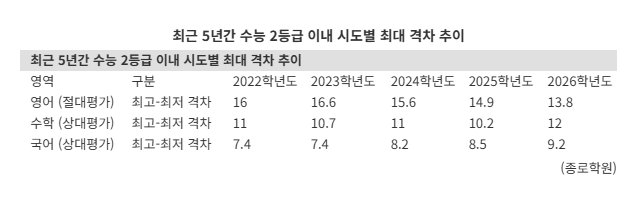
[Financial News] Over the past five years, the largest city- and province-level gap in the share of top-performing students earning Grade 2 or above on the College Scholastic Ability Test (CSAT) was greater every year in English, which is graded on an absolute scale, than in Korean or math, which are graded on a relative scale. Among the relatively graded subjects, regional gaps in math, which carries a heavy study burden, were greater than those in Korean for five straight years.
On the 18th, Jongno Academy said its analysis of five years of CSAT results, from the 2022 through 2026 academic years, based on high school seniors found that the annual gap between the region with the highest and the region with the lowest share of students earning Grade 2 or above in English ranged from 13.8 to 16.6 percentage points. Over the same period, the gap was smaller in Korean, at 7.4 to 9.2 points, and in math, at 10.2 to 12.0 points. English is graded on an absolute scale, with students receiving a grade if they score at or above a set threshold, while Korean and math are graded on a relative scale based on rank. A Grade 2 or above in English means a score of 80 or higher.
Lim Seong Ho, head of Jongno Academy, explained, "In English, which is graded on an absolute scale, the share of top-performing students has risen in both the region with the highest share and the one with the lowest, compared with relatively graded subjects. But the increase has been relatively greater in the top region." He added, "When the test is set at a very difficult level, regional gaps can actually narrow."
Among the relatively graded subjects, the gap in math was greater than in Korean for five straight years. The math gap fluctuated from year to year before reaching 12.0 percentage points in the 2026 academic year, its widest in the five-year period. The Korean gap was 7.4 points in the 2022 and 2023 academic years, then widened each year from 2024, reaching 9.2 points in 2026.
For all five of the past five years, Seoul had the highest nationwide share of students earning Grade 2 or above in Korean, math and English. In the 2026 academic year, the figures for Korean were Seoul at 13.7%, Gyeonggi at 9.2% and Sejong at 8.9%, in that order. For math, they were Seoul at 16.7%, Gyeonggi at 10.7% and Sejong at 10.0%; for English, Seoul was at 22.3%, Sejong at 16.7% and Gyeonggi at 15.5%.
However, the gap in English, which is graded on an absolute scale, varied depending on the difficulty of the test. In the 2026 academic year, when English was set at its most difficult and just 3.1% of students earned Grade 1, the gap in the share earning Grade 2 or above was 13.8 percentage points, the smallest in five years. Looking only at students earning Grade 1, the 2026 regional gap in English was 3.8 points—actually smaller than the 4.5-point gap in Korean and the 5.5-point gap in math.
Lim added, "If math, which carries a heavy study burden, were switched to absolute grading, regional gaps could look quite different from those in English," because "math is a subject where substantial gaps already exist, regardless of the grading method."
[email protected] Kim Man-gi Reporter