Birds as far as 2 km away can be driven off... Incheon Airport expands bird-control range 30-fold
- Input
- 2026-10-18 09:04:30
- Updated
- 2026-10-18 09:04:30
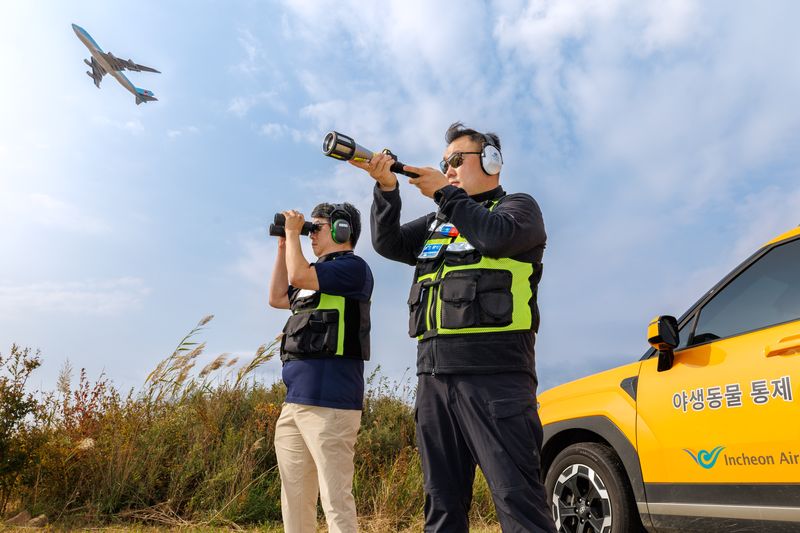
[Financial News] Incheon International Airport has introduced laser guns capable of controlling birds from up to 2 km away to prevent bird strikes involving aircraft. Their control range is at least 30 times wider than that of conventional shotguns, and they are expected to help the airport respond effectively to large-scale migratory bird movements at night and in winter. The airport plans to further strengthen its aviation safety network by introducing bird-detection radar in 2028.
Incheon International Airport Corporation said on the 18th that it had newly introduced four laser guns for bird control and put them into operation on the 15th. Developed and patented by a Korean company, the devices have been deployed one at each of Incheon Airport’s four runways.
The laser guns have a maximum bird-control range of about 2,000 m. That is at least 30 times the effective range of conventional shotguns, which is 60 m. The ability to control birds approaching aircraft flight areas from a distance is expected to help reduce the risk of bird strikes.
The guns will be used primarily around sunrise and sunset and to control migratory birds in winter. With the conventional shotgun method, it was difficult to spot birds with the naked eye in the dark, so thermal cameras and other equipment had to be used as well. By contrast, the laser guns’ beams can be seen at night, which can improve the efficiency of bird control. The airport also plans to use them to control winter migratory bird flocks that travel in large numbers, including geese.
Regulatory changes were needed to ensure flight safety before the laser equipment could be introduced, amid concerns that lasers could obstruct pilots’ vision. In February last year, Incheon Airport Corporation proposed to the government ways to use laser equipment safely, and in April of the same year, the Ministry of Land, Infrastructure and Transport established a policy to introduce the equipment.
The relevant guidelines were revised in May this year, and Incheon Airport Corporation established safety management and operating procedures in July. After securing operational approval from the Seoul Regional Aviation Administration last month, the airport was able to put the equipment to full use.
The monitoring system for preventing bird strikes will also be expanded. Incheon Airport Corporation plans to introduce bird-detection radar around 2028. Once installed, the radar will be able to monitor bird movements within a 13-km radius of the airport, and is expected to strengthen the airport’s response capabilities by linking it with existing control equipment.
Jo Yong-su, head of operations at Incheon International Airport Corporation, said, “We expect the introduction of this new equipment to greatly improve Incheon Airport’s bird-control capabilities and aircraft operational safety.” He added, “We plan to provide safer airport services to the public by continuing to expand cooperation with relevant agencies and the adoption of advanced technologies to prevent bird strikes.”
[email protected] Kim Dong-ho Reporter