KOSPI, after a “14.5% string of losses,” recovers in an average of 14 trading days this year
- Input
- 2026-10-18 08:39:15
- Updated
- 2026-10-18 08:39:15
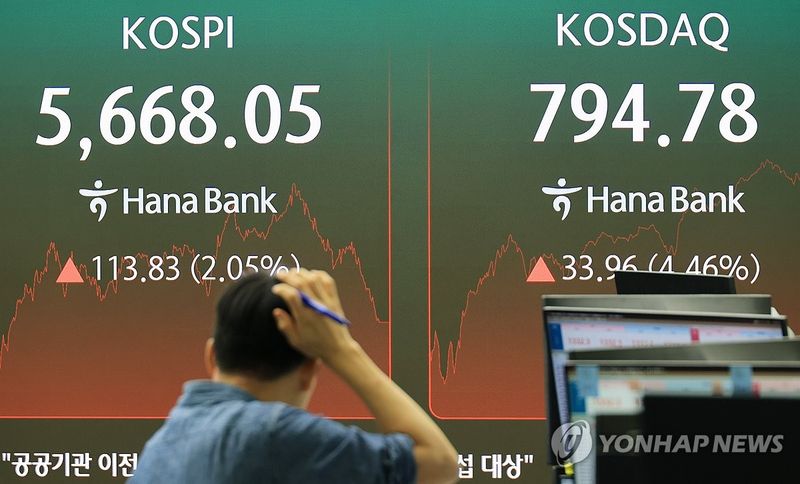
[Financial News] KOSPI took an average of 14.25 trading days to regain the points it lost during the successive sell-offs that rocked this year’s stock market. After KOSPI, which has plunged more than 20% in just seven trading days recently, broke its losing streak on the 16th, the market is watching to see whether it can rebound at a similar pace this time. While brokerages see considerable room to recover the losses, they point to the return of foreign buying as a prerequisite for a sustained rebound.
According to the Korea Exchange and other sources on the 18th, KOSPI fell every day for seven trading days from the 6th through the 15th, for a cumulative decline of 20.7%. On a weekly basis, it also shed 14.5% from the 12th to the 16th. The index briefly reclaimed the 7,000 mark on the 2nd, closing at 7,003.74, but then headed downhill, sinking to 5,668.05 on the 16th. However, it rose 2.05% that day, turning higher for the first time in eight trading days. Expectations for further gains are also supported by steady forecasts that demand related to artificial intelligence (AI) has not weakened and that memory market conditions will remain strong.
KOSPI’s seven-trading-day losing streak was its first in more than two years, since September 3–11, 2024. On that occasion, too, the index halted its slide by rising 2.34% on September 12, the eighth trading day. Foreign selling was at the heart of the latest plunge. Foreign investors remained net sellers in the main board market for seven consecutive trading days through the 14th, selling shares worth 1.1813 trillion won on that day alone. Analysts in the brokerage industry said that, despite third-quarter results released the same day by Dutch semiconductor equipment maker ASML exceeding market expectations, a wave of profit-taking weighed on sentiment toward semiconductor investments.
A look at this year’s cases in which the market fell for at least two consecutive trading days and posted a double-digit loss shows that the pace of recovery varied by episode. The longest recovery came immediately after the shock of the outbreak of the Iran war swept through markets. KOSPI fell 19.2% over three trading days from February 27 to March 4, and took 34 trading days to return to its previous level. By contrast, after falling 10.4% in four trading days from March 26 to 31, it recovered the losses in six trading days; after dropping 14.9% over three trading days from June 4 to 8, it made them back in seven. Even after plunging 17.2% over three days from July 28 to 30, the index returned to its previous level on August 13, 10 trading days later. The average recovery time across these four episodes was 14.25 trading days. It was a period when investment funds kept flowing in on expectations for memory market conditions, and the index successively crossed the 6,000, 7,000, 8,000 and 9,000 marks.
Not every sharp decline was followed by a rebound. KOSPI fell 10.4% over three trading days from July 6 to 8, slipping below the 8,000 mark, and has yet to regain that level.
Even so, this year’s pace of recovery has been quite fast by historical standards. In the past, it was not unusual for it to take several months, or even years, to recoup losses. From October 21 to 24, 2008, as the global financial crisis swept the world following the bankruptcy of Lehman Brothers, the index lost 22.2% in four trading days and fell below 1,000. It took more than two months to return to 1,200, its level just before the crash. From August 2 to 9, 2011 (six trading days), as concerns spread about a global recession originating in the United States and China, the index fell 17% and hovered below 2,000 for some time. It did not fully recover its losses until late April 2015, three and a half years later.
From March 11 to 19, 2020, when fears of a pandemic reached their peak amid the spread of COVID-19, the index shed 25.7% over seven trading days. As hopes for vaccine development revived, it returned to its previous level on May 19, 39 trading days later. When it plunged 12.1% in just two days from August 2 to 5, 2024, it took around 10 months to recover. At the time, fears of an unwind of the yen carry trade—borrowing low-interest yen to invest in higher-yielding currency assets—were weighing on the market amid a strengthening yen.
Experts are watching for signs that foreign investor flows have bottomed out. Lee Sang-jun, a researcher at NH Investment & Securities, noted, “Foreign ownership of semiconductors, where net selling is concentrated, is in the 48% range, its lowest level since 2010. It also fell into the 48% range in July before rebounding, and selling pressure has since eased.” He added, “As in July, we expect the supply-and-demand environment to improve as the third-quarter earnings season progresses. In particular, once the IPO of Anthropic, the U.S. generative AI developer, scheduled for early November is behind us, the reallocation of funds for it should also be complete, and foreign selling pressure may ease.”
[email protected] Jeong Gyeong-su Reporter