“What on earth is that hideous thing?” ... Residents in uproar over monstrous growths filling Lake Paro
- Input
- 2026-10-18 08:23:32
- Updated
- 2026-10-18 08:23:32
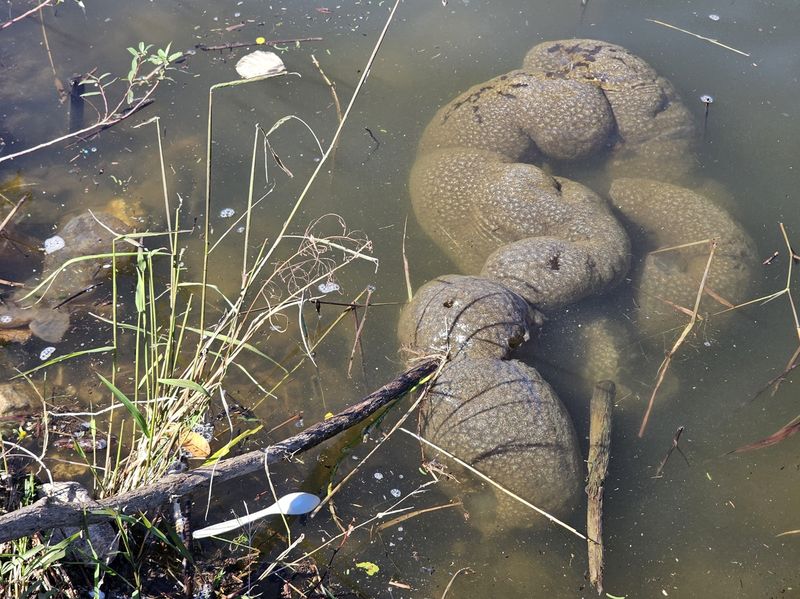
[Financial News] Large colonies of the nonnative aquatic organism keunbit-ikkibeolle have been found around Lake Paro in Hwacheon, in the upper reaches of the Bukhan River in Gangwon Province. The colonies are proliferating in clumps, particularly in areas where water flow has stagnated, raising concerns about both damage to local fishers and worsening water quality.
On the 17th, colonies of keunbit-ikkibeolle resembling giant salamander egg masses were spotted in several places in the shallow waters around Heart Island, a tourist attraction in Lake Paro, in Dosong-ri, Gandong-myeon, Hwacheon County, Gangwon Province. The colonies were concentrated around earth-filled sections built to connect the mainland and the island. The area’s terrain, which blocks water flow and makes it prone to stagnation, is thought to have provided a suitable habitat. It is unusual for keunbit-ikkibeolle to be seen in such large numbers around Lake Paro.
Local fishers say the growths are disrupting their work. Yoo, 67, an inland-water fisherman, told Yonhap News Agency, “These disgusting clumps become noticeably more numerous when it is especially dry or temperatures are high. When this organism flourishes, the catch drops sharply, dealing a considerable blow to my livelihood.”
Keunbit-ikkibeolle, which belongs to the phylum Bryozoa, is a nonnative species whose tiny individuals, around 1 mm in size, cluster on gelatinous secretions to form large rugby-ball-shaped colonies. Its translucent, jelly-like appearance can lead people to mistake it for a salamander egg mass laid in spring. However, the brown spots on its surface are individual animals, and it proliferates into irregular, large clumps when water temperatures are high.
There are differing environmental interpretations of the mass proliferation of keunbit-ikkibeolle. When it proliferated in the Four Major Rivers basins in 2014, the Ministry of Environment, based on a survey by the National Institute of Environmental Research, concluded that “no intrinsic ecological toxicity or harmful effects on fish were confirmed.”
Environmental groups, on the other hand, focus on “stagnant water flow” and “food sources” as conditions behind the appearance of keunbit-ikkibeolle. Because it surges in places where its main food sources—algal blooms and aquatic microorganisms—are abundant and water flow is blocked, they argue that its mass appearance itself is evidence of worsening water quality and rivers becoming lake-like.
Keunbit-ikkibeolle typically dies off naturally over the course of a month from late autumn, when water temperatures fall to 15 degrees Celsius or below. However, dormant buds left underwater by the colonies sprout again the following spring, prompting calls for detailed inspections of areas with reduced water flow and ongoing water-quality monitoring.
[email protected] Moon Young-jin Reporter