Nvidia alone accounts for 2 trillion won in losses... A ‘nightmare two weeks’ for Korean investors in U.S. stocks
- Input
- 2026-10-18 14:30:07
- Updated
- 2026-10-18 14:30:07
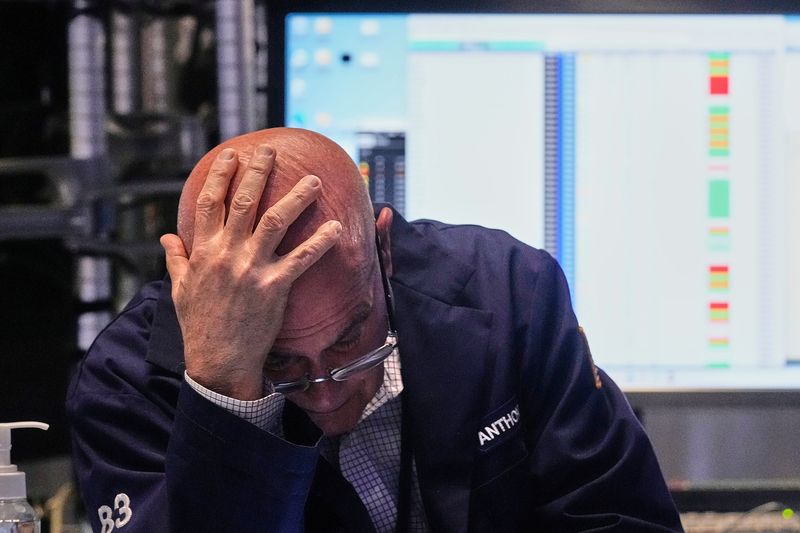
[Financial News] The plunge in AI semiconductor stocks also rocked the portfolios of Korean retail investors in U.S. stocks. U.S. semiconductor stocks plunged alongside Samsung Electronics and SK hynix. Experts warn that an investment strategy of going ‘all in’ on semiconductors is risky.■ Nine of the 10 biggest large-cap decliners were semiconductor stocksOn the 18th, Financial News analyzed data from Investing.com and found that nine of the 10 biggest decliners among the 100 largest companies by market capitalization in the U.S. stock market over the past two weeks (October 2–16) were semiconductor-related stocks. The remaining one was Dell, which had also been grouped with AI data center stocks. Even among the 14 stocks that fell 15% or more, 11 were semiconductor stocks.
Kioxia’s American depositary receipts (ADRs) plunged 33.9% over two weeks, the steepest decline. The stock, which was around $12 early this month, fell to $7.93 on the 16th (U.S. local time). It dropped more than 8% on the 14th (10.2%) and the 16th (8.64%) of this month. ARM (-25.9%), Seagate (-24.7%), Intel (-24.7%) and SanDisk (-24.5%) also fell more than 24%. Equipment makers Applied Materials (-24.2%), Lam Research (-24.0%) and KLA (-19.9%) also took a direct hit. Micron fell 18.2%, AMD 16.6% and Marvell 16.3%.
The sharp decline reflected a combination of factors, including the rise of China’s ChangXin Memory Technologies (CXMT) and the cost of financing AI investments. The Philadelphia Semiconductor Index fell for eight consecutive trading days, marking its longest losing streak since October 2008.
Analyst Philip Wool of global asset manager Rayliant Global Advisors described the market reaction as excessive, but said, “Investors had been looking for a reason to take profits on AI and memory stocks, which have risen sharply this year,” and noted, “This sell-off shows that sentiment toward AI investment has become so fragile that even small negative developments can unsettle it.”■ “An all-in semiconductor portfolio is risky”The problem is that Korean retail investors’ money is concentrated in stocks that have fallen sharply. According to the Korea Securities Depository, as of the 15th (Korea time), the value of holdings in semiconductor stocks stood at $11.17 billion (about 15 trillion won). The holdings-weighted two-week return for six stocks—Micron ($4.08 billion), SanDisk ($2.04 billion), AMD ($1.79 billion), Intel ($1.5 billion), Marvell ($1.2 billion) and Lam Research ($560 million)—was -20.1%.
The losses grow when Nvidia and Broadcom are included. Nvidia ranked second overall in value of holdings, at $17.44 billion (about 23.331 trillion won), but its share price fell 8.5% over two weeks. Broadcom, in which Korean retail investors held $2.75 billion (about 3.68 trillion won), also fell 7.4% over the same period. The value of holdings in all eight semiconductor stocks, including those two, came to $31.36 billion (about 42 trillion won).
Applying the two-week returns directly to current holding values, Korean retail investors are estimated to have lost $1.62 billion (about 2.16 trillion won) on Nvidia. Estimated losses were also substantial for Micron ($910 million), SanDisk ($660 million) and Intel ($490 million).
Unlike semiconductor stocks, energy stocks such as ConocoPhillips (15.6%) and Exxon Mobil (9.1%), as well as consumer stocks such as Walmart (14.0%), Coca-Cola (9.6%) and Philip Morris (9.5%), ranked among the top performers. Of the stocks that rose sharply over the two weeks, Coca-Cola was the only one among the top 50 in value of holdings by Korean retail investors. By contrast, six of the 14 biggest decliners were among the top 50 in holdings.
Experts advise investors to change their ‘all-in on semiconductors’ portfolios. Dan Coatsworth of U.K.-based investment platform AJ Bell said, “Semiconductors are inherently a highly cyclical industry, but some investors seem to have forgotten that,” adding, “If you are overly exposed to semiconductor stocks on the assumption that strong demand will continue forever, you will be hit hard when a market correction occurs.” Kim Dong-won, a researcher at KB Securities, also said, “Even if semiconductor earnings are strong, volatility may continue unless it is clear that AI investment is translating into actual profits.”
[email protected] Han Young-jun Reporter