Traditional markets draw people in their 20s and 30s and foreign visitors; nearby F&B franchises are cashing in too
- Input
- 2026-10-18 16:31:04
- Updated
- 2026-10-18 16:31:04
[Financial News] Traditional markets that once sold only agricultural and fishery products are gaining popularity as they shift toward desserts and dining, with offerings such as rice cakes, baked goods and tteokbokki that appeal to younger people and foreign visitors. In step with this trend, food and beverage (F&B) franchises are also benefiting handsomely, either by opening outlets in traditional markets or continuing mutually beneficial partnerships.
On the 16th, according to the Seoul Metropolitan Government’s commercial-area analysis service, sales in the food-service sector around Mangwon Market and Gyeongdong Market in Seoul are on a clear upward trend. In the second quarter of this year, average monthly sales for food-service businesses around Mangwon Market were 15.45 million won, up 1.43 million won from the same period last year. Average monthly sales around Gyeongdong Market also rose by 4.79 million won year on year to 21.82 million won. Among traditional-market visitors in the second quarter of this year, 15.95 million were people in their 20s or younger, accounting for 25% of the total—a larger share than those in their 30s (17%), 40s (17%) and 50s (15%). Food spots that have sparked buzz on social media (SNS), vintage stores and distinctive shops are drawing young consumers to the markets, observers say.
Sales are rising particularly quickly in food and dessert categories.
The expansion of trendy food offerings is behind this growth in traditional markets. In the past, these markets mainly sold agricultural, livestock and fishery products, and struggled to attract foot traffic. But they have successfully drawn crowds by expanding their offerings of unusual desserts, including the recently viral “Dubai Chewy Cookie,” pizza-style steamed rice cakes, baked goods, ice cream and mochi. As the range of F&B products favored by people in their 20s and 30s and by foreign visitors has diversified, both foot traffic and sales have surged. Google Trends data show that searches for Gyeongdong Market, Mangwon Market and Gwangjang Market rose by 20%, 60% and 40%, respectively, compared with a year ago.
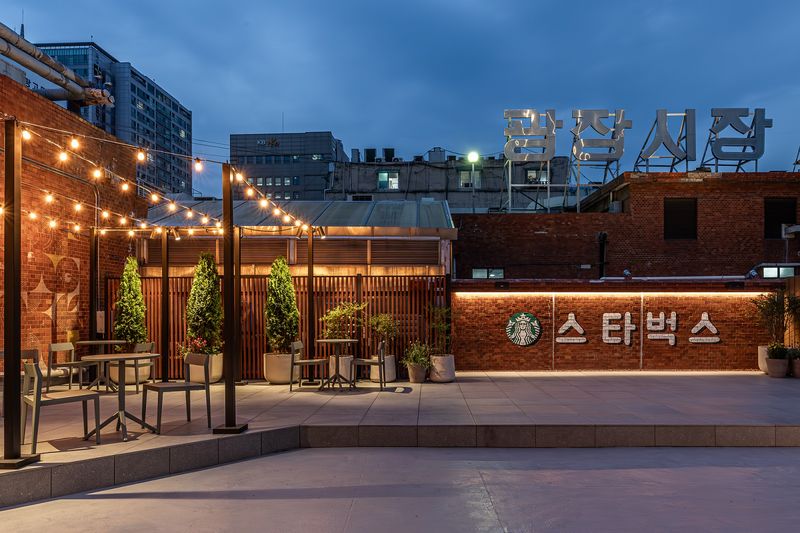
Franchises are also cashing in by opening outlets inside traditional markets or targeting nearby commercial districts. One prominent example is Starbucks Coffee Korea Co., Ltd.’s Gyeongdong 1960 branch, created by converting a former theater inside Gyeongdong Market. It has become a major hit on social media, where it is frequently named a must-visit Starbucks location. Gyeongdong Market used to have a smaller share of young visitors than other markets, but the arrival of Starbucks has led to a sharp increase in young people visiting the area.
Starbucks’ Gwangjang Market branch, which makes use of vacant space inside Gwangjang Market, has also launched locally inspired menu items, including the citrus-flavored “Golden Mandarin Hop Fizzio” and “Honey Hotteok Latte,” modeled on the Korean sweet pancake. This year, average monthly visitor numbers at the two branches have topped 5,000.
HBAF, a popular nut brand, has also opened a company-operated flagship store near the entrance to Gwangjang Market and set out to attract foreign tourists.
Experts say that, alongside the popularity of traditional markets, large franchise chains are acting as “anchor tenants” by drawing in tourists and extending the time they spend there. Lee Eun-hee, a professor in the Department of Consumer Studies at Inha University, said, “Traditional markets provide attractions such as rice cakes and Dubai Chewy Cookies, while franchises offer coffee, beverages and places to spend time—a mutually beneficial relationship.” She added, “Together, they are maximizing their ability to attract young people and foreign tourists who are unfamiliar with the markets’ aging environments.”
[email protected] Park Gyeong-ho Reporter