Wildfires, High-Temperature Aquaculture, Deepfakes... 50 Teams of Jeju High Schoolers Seek Solutions Through Science
- Input
- 2026-10-17 09:07:11
- Updated
- 2026-10-17 09:07:11
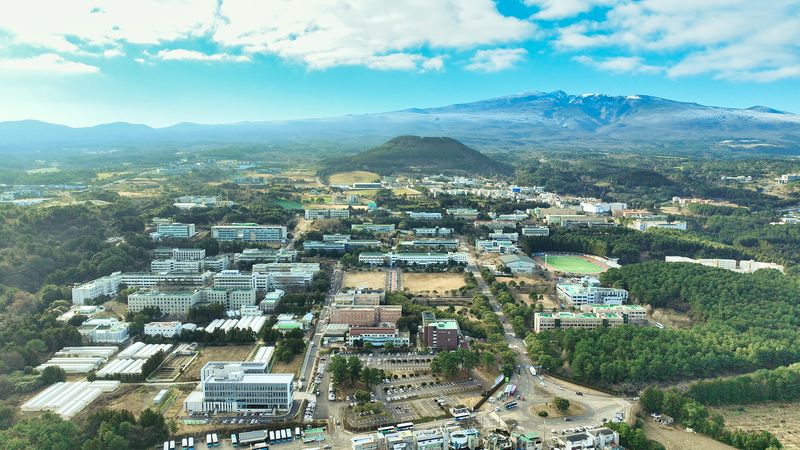
【Financial News Jeju = Reporter Jeong Yong-bok】 From the flight paths of firefighting rockets for early wildfire suppression to the efficiency of oxygen supply at fish farms facing high water temperatures and AI-based deepfake detection, 50 teams of Jeju high school students will present findings from investigations into local industries and environmental and safety issues as scientific research topics.
According to the Jeju Special Self-Governing Provincial Office of Education, the 2026 High School Convergence Conference will be held at Jeju National University starting at 9 a.m. on the 17th. Fifty teams of high school students from across the province will present their research in five fields: physics and earth science, chemistry, life science, engineering, and convergent science. About 650 middle and high school students are expected to take part, and 11 special lectures by university and research institution experts will be held in the afternoon.
The research topics chosen by the students are particularly noteworthy. Alongside experiments testing scientific principles from textbooks, the projects include analyses of problems in Jeju's industries and risks in everyday life. The students are seeking to turn issues facing the local community into specific research questions and find answers through experiments and data analysis.
The high water temperatures affecting Jeju's aquaculture industry are also among the research topics. The Kim Si-dong team from Daegi High School will present a study comparing dissolved oxygen recovery efficiency and energy consumption for different aeration methods in high-temperature aquaculture environments.
Aeration is a method of increasing oxygen levels by supplying air to water. As water temperature rises, the amount of oxygen that can dissolve in the water decreases, making oxygen supply and water quality management important at fish farms. The students investigated differences in oxygen recovery and electricity consumption depending on the method of air supply.
Research related to disaster response will also be presented. The Harahara's Physics Cafe team from Daegi High School worked on designing a flight-path control system and a ballistic prediction model for firefighting rockets intended for early wildfire suppression. The project explored the potential use of physics-based predictions of a rocket's trajectory and landing point in fighting wildfires.
Jeju's winds have also become a subject of scientific analysis. The VENTUS team from Pyoseon High School studied the principles behind increased wind speeds in open spaces between buildings around Jeju Dream Tower. The project analyzes how the shapes of high-rise buildings and surrounding spaces affect the flow of wind.
Research using digital technology also stands out. The Seogo Catch team from Seogwipo High School will present on implementing a deepfake detection system that combines transfer learning with explainable artificial intelligence (XAI).
Transfer learning is a technique for applying knowledge from an AI model that has already been trained to a new problem. Explainable artificial intelligence makes it possible for people to understand the basis on which AI makes decisions. The students researched ways to detect manipulated videos or images and explain the grounds for identifying them as such.
Projects addressing advanced industrial technologies are also included. The Q Learning team from Jeju Science High School explored ways to optimize the thermal characteristics and electromagnetic interference of power semiconductors using Q-learning, a reinforcement-learning technique. The Three Idiots team from Ohyeon High School will present a study comparing the energy efficiency of a four-legged robot's walking in a virtual environment with its walking in the real world, using reinforcement learning.
Research on eco-friendly materials using local agricultural and marine resources will also be presented. The Tangerine team from Hallim High School studied the production and properties of eco-friendly polymer films using pectin from Onju-milgam mandarins and alginate. Pectin is a natural polysaccharide found in fruits and other sources that can be used to make materials in the form of films or gels.
The Square Pants team from Seogwipo Girls' High School will present findings from an analysis of the effectiveness of oleophilic natural sorbents for cleaning up marine oil pollution. The project compares materials that absorb oil better than water and examines their potential use in responding to marine pollution.
The research presentations comprise 10 teams in physics and earth science, 10 in chemistry, 12 in life science, nine in engineering, and nine in convergent science. From 9 a.m. to 12:30 p.m., students are scheduled to present their research in their respective fields at five venues at Jeju National University.
Each team has been allotted 15 minutes, including a 10-minute presentation and five minutes for questions and answers. The format is designed for students to explain their research objectives, hypotheses, experimental designs and analysis results, then use the question-and-answer session to assess the validity and limitations of their research.
Eleven special lectures featuring experts from Korean universities and research institutions will follow from 2 p.m. Professors and researchers from Seoul National University, Pohang University of Science and Technology (POSTECH), Korea Advanced Institute of Science and Technology (KAIST), Ulsan National Institute of Science and Technology (UNIST), the Korea Research Institute of Bioscience and Biotechnology and other institutions are scheduled to introduce topics including quantum technology, AI semiconductors, life sciences, robotics and future energy.
A lecture to strengthen students' research skills has also been arranged. Choi Jin-young, a teacher at Daejeon Jeil High School, will explain how to write a scientific research report, covering how to develop research questions and form hypotheses, analyze experimental results, use generative AI in research and cross-check findings.
The event is hosted and organized by the Jeju Special Self-Governing Provincial Office of Education, with support from the College of Education at Jeju National University, the Convergence Conference Project Promotion Team, and the Subject Research Group for Science-Focused Schools.
[email protected] Jeong Yong-bok Reporter