KOSPI plunge triggers 300 billion won in forced liquidations of ‘debt-financed bets’... Funds flow into U.S. stocks
- Input
- 2026-10-17 09:15:06
- Updated
- 2026-10-17 09:15:06
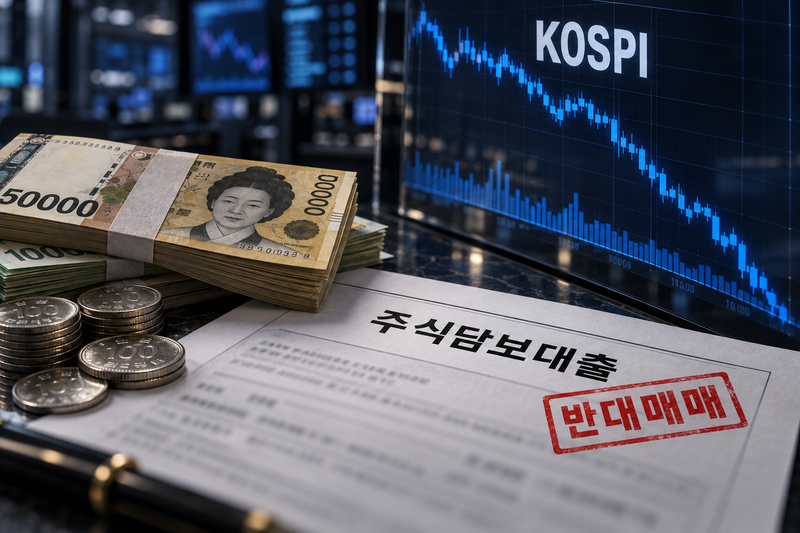
[Financial News] As domestic stocks plunged, forced liquidations of individual investors’ so-called “debt-financed bets” (borrowing money to invest in stocks) reached nearly 300 billion won in just over a week. As volatility in the stock market increased, funds flowed into domestic and overseas bonds, while investors’ responses diverged, with investment concentrated in leveraged semiconductor products in the U.S. market.
According to the Korea Financial Investment Association on the 17th, forced sales against unpaid balances from brokerage transactions totaled 298.1 billion won between the 6th and 15th. On the 14th and 15th, forced sales of 89.3 billion won and 80.5 billion won, respectively, occurred in a single day.
Forced selling occurs when a securities firm sells shares held as collateral if an investor cannot repay money borrowed from the firm or if the value of the collateral shares falls below a certain level. The rise in forced sales is thought to reflect a decline in collateral values as stock prices have recently fallen.
The KOSPI fell for seven consecutive trading days from the 6th through the 15th, sliding to 5,554.22. It then rebounded on the 16th for the first time in eight trading days, closing at 5,668.05. Investor deposits also fell 4.1%, from 101.0486 trillion won on the 6th to 96.9121 trillion won on the 15th.
By contrast, investment in U.S. stocks increased. This month, Korean investors’ net purchases of U.S. stocks totaled $3.5 billion (about 4.7201 trillion won), around 3.5 times the $1 billion recorded last month. In particular, Korean retail investors who invest in U.S. markets bought a net $2.60013 billion (about 3.4659 trillion won) of Direxion Daily Semiconductor Bull 3X Shares (SOXL), an exchange-traded fund (ETF) that tracks three times the daily return of a U.S. semiconductor index, over the past week. Another $235.36 million flowed into KORU, which tracks the Korean stock market at three times its performance, while U.S. quantum-computing company IonQ recorded net purchases of $103.44 million. This is seen as reflecting a surge in investment demand from those expecting a rebound amid falling stock prices.
[email protected] Kim Hyun-ji Reporter