“Being Korean is a competitive advantage” ... Entrepreneurs’ dreams unfold in New York
- Input
- 2026-10-17 07:21:22
- Updated
- 2026-10-17 07:21:22
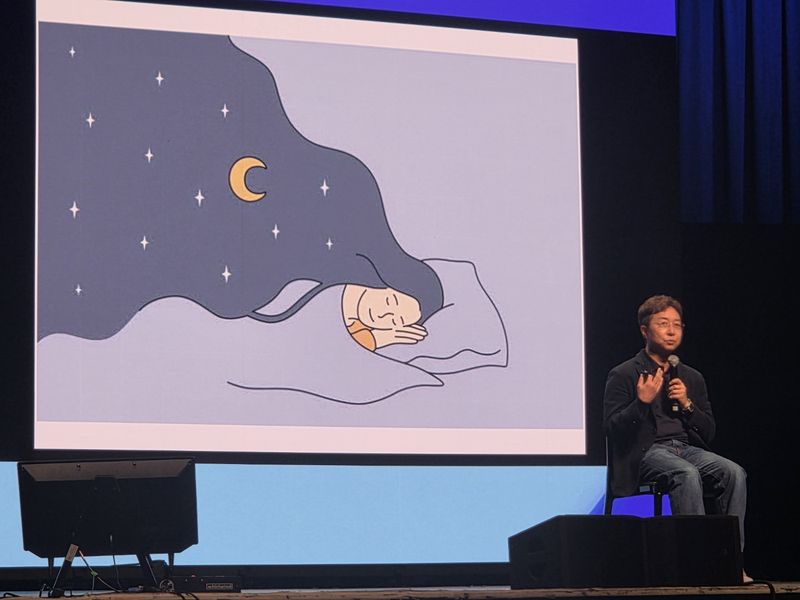
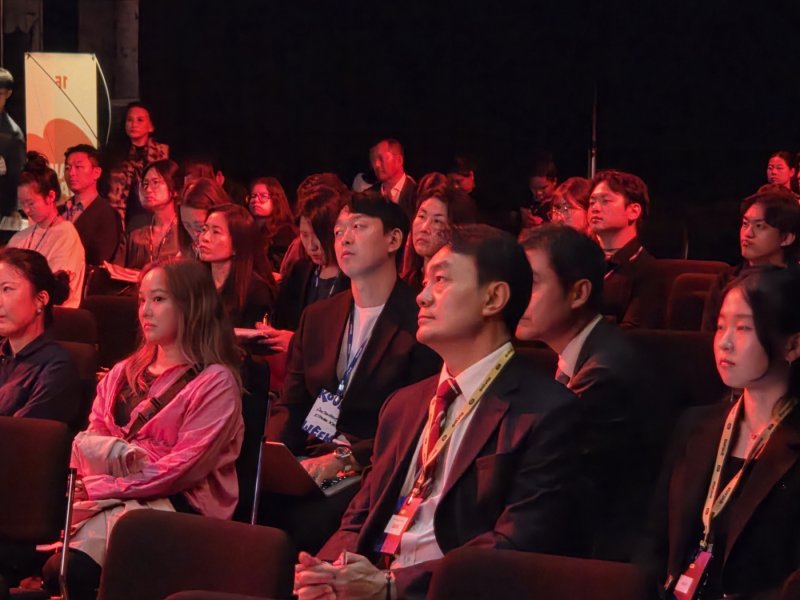
【Financial News, New York = Correspondent Lee Byung-cheol】 Terminal 5, a concert venue in Manhattan, New York, on the 16th (local time). Onstage, under red lights, the words “RISE,” “INSPIRE” and “BUILD” were displayed. In the audience sat Korean entrepreneurs and businesspeople seeking new opportunities in the U.S. market.
The founder of a Korean restaurant that earned a Michelin star in New York cited the identity struggles he experienced between Korea and the United States as a driving force behind his success, while a businessperson selling Korean food products in the U.S. stressed that it was now time to build a respected culture that goes beyond K-food’s popularity.
The second KOOM New York Festival, held that day, served as a platform for connecting global interest in Korean culture with entrepreneurship, investment and global business. The event, which debuted last year, expanded its startup product exhibition and networking programs this year. The talks covered a range of topics, from the restaurant business and food distribution to artificial intelligence (AI), but shared a clear central question: How can Korean identity be turned into a new competitive advantage in the global marketplace?
Korean solidarity expands into entrepreneurship and investment
Jeong Se-ju, the chair who leads the event, cited the combination of Korean technology and culture as the reason he created the KOOM Festival.
“As Korea’s tech industry grows, it is attracting global attention, and Korean culture is also drawing renewed interest in global markets,” Jeong said. “I created KOOM because I thought it would be good to embrace more people not only through tech startups but also through culture, and to foster solidarity through Korea’s wonderful culture and services.”
What he emphasized was not simply socializing among Koreans. It was a community where entrepreneurs seeking to enter the U.S. market could build the human networks and trusted relationships they lacked and turn them into actual business opportunities.
At the event, a lack of “social capital” was cited as one of the biggest challenges faced by entrepreneurs expanding overseas. Even when they try to start a business locally, it can be difficult to meet investors or find reliable business partners.
Jeong shared examples of entrepreneurs who had gained new ideas through gatherings like these and secured opportunities to attract investment and enter the U.S. market.
This year, programs aimed at turning these connections into tangible businesses were also expanded. A pop-up space called “KOOM House,” featuring 42 startups, operated for four days, and a variety of networking programs were held throughout the event.
About 80 volunteers helped run the event. “It’s hard because we want to do better,” Jeong said. “I’m grateful for about 90% of it, and the difficult part is around 10%.”
The idea is to use a shared Korean background as a starting point for business while extending those connections into global markets. The experiences of the businesspeople who took the stage that day showed how this vision could be put into practice.
From K-food to global brands
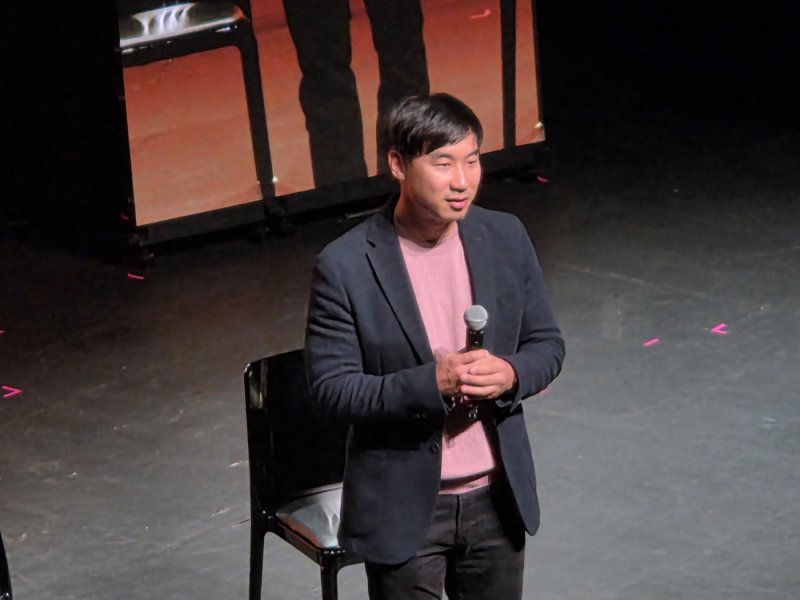
Simon Kim, founder of the Michelin-starred Korean steakhouse COTE in New York, stressed that not choosing between Korea and the United States was the starting point for his success.
After moving to the United States at age 13, he struggled with his identity, being regarded as American in Korea and Korean in the United States.
“I wanted to belong in the United States, but I couldn’t fully belong there, and when I went back to Korea, my friends still called me American,” Kim recalled.
He first ran the Italian restaurant Piora in New York’s West Village. It earned a Michelin star, but he eventually had to close it.
“A Michelin star brings you a lot of things, but it doesn’t pay your rent,” Kim said. After the business failed, he found his answer not in choosing either Korea or the United States, but in combining the strengths of both cultures.
He brought together the service and aged meat of an American-style upscale steakhouse with the tableside cooking and appreciation of a variety of cuts found in Korean barbecue. The restaurant, COTE, earned a Michelin star about four months after opening.
“When the best of Korea and the best of America come together, you can create something entirely new,” Kim said.
He likened his identity as a Korean American to a “table.” Rather than trying to sit at the table of either Koreans or Americans, he combined the strengths of both cultures to create a new table of his own.
“Instead of waiting for someone to invite me, I eventually created my own table,” he stressed.
A similar view of Korean culture’s competitive potential was expressed by Ryan Kim, CEO of Kim'C Market. What he emphasized, however, was long-term brand value that goes beyond popular appeal.
“We have to ask ourselves whether we want to remain popular by being confined to popular K-food, or become a respected cuisine and culture,” Kim said.
“I think we should even change the term ‘K-food,’” he said, noting that “it has a strong product image.”
His point was that, just as Japanese and French cuisines are highly regarded in global markets for their long traditions and sophisticated image, Korean food should also be recognized for the value of its craftsmanship and traditional food culture.
“What is popular or trendy can disappear. But food endures, and culture endures. Respect endures,” Kim stressed.
Kim'C Market introduces traditional Korean fermented sauces and ingredients to the U.S. market. According to Kim, 64% of its customers are American, and French restaurants are also using ingredients made by Korean artisans.
The company also runs experiential programs in which American chefs visit Korea to learn firsthand about kimchi, traditional fermented sauces and temple cuisine. The globalization of Korean food, he said, can go beyond food exports and lead to tourism and the revitalization of local economies.
Kim said he plans to open a new brick-and-mortar store on December 1 and showcase Korean ingredients and brands in a gallery-style setting.
While Simon Kim combined Korean and American cultures to create a new dining model, Ryan Kim is seeking to develop Korea’s distinctive traditions into a brand recognized in global markets. Their approaches differed, but both turned the value of Korean culture into new business opportunities in the global marketplace.
In the AI era, human value is a competitive advantage
The day’s discussion on turning Korean identity into a competitive advantage also led to questions about the role of humans in the AI era. Hongik University Professor Yoo Hyun-jun compared AI to a “new immigrant” arriving in human society.
“Artificial intelligence can be seen as a new immigrant,” Yoo said. “AI, which entered virtual space, is now beginning to come into the real world through self-driving cars and humanoid robots.”
He predicted that AI and robots would further expand the scope of human activity, just as elevators made high-rise cities possible and the internet opened up virtual space.
He predicted in particular that “in just a few years, AI may be able to design 95% of architectural projects more efficiently and economically.”
However, he stressed that even if technology surpasses human intellectual abilities, it cannot replace the experiences and emotions unique to humans.
“AI can analyze the chemical components of chocolate better than humans and may even be able to make chocolate that people would like,” Yoo said. “But the meaning of that chocolate is created when people eat and experience it.”
Buildings, too, can be designed by AI, but the value of a space is determined by the experiences and relationships of the people who live there.
He cited the stories and emotions people have accumulated over time, as well as their embodied experiences, as factors that distinguish them in the AI era.
This also resonated with the success stories of the businesspeople who had taken the stage earlier. Just as Simon Kim turned his experiences between two cultures into a competitive edge in a new restaurant business, and Ryan Kim found brand value in Korean tradition and craftsmanship, the point was that the more technology advances, the more important human experiences and stories unique to people become.
“To dream is to think about a future that has not yet become reality,” Yoo said. “The best way to predict the future is to create it.” He concluded his talk by saying, “The more things change, the more we need an eye for what does not change.”
[email protected] Correspondent Lee Byung-cheol Reporter