“Retail investors wiped out their paychecks”—but Samsung Electronics Co., Ltd.'s P/E is just 3.27x ... Is this an opportunity? [Money Signal]
- Input
- 2026-10-17 15:00:00
- Updated
- 2026-10-17 15:00:00

[Financial News] The stock market, in the end, is like a contest on the field. Give up momentum and you can collapse beyond control; fail to see what's behind the numbers, and you'll drink the bitter cup of defeat.
Imagine an ordinary office worker betting a hard-earned nest egg of 30 million won on “the people's stock,” Samsung Electronics Co., Ltd. On the 15th, its share price plunged about 10% in a single day, turning the market screens a vivid blue. In the space of a day, 2.84 million won vanished into thin air. It was as if a month's living expenses—or someone's child's private-academy tuition—had been futilely wiped out.
Fortunately, the next day, the 16th, Samsung Electronics Co., Ltd. rebounded 2.62% and eked out a close at 215,500 won. The KOSPI also rose 2.05%, offering some relief. But the damage runs deep. This “meager rebound” is nowhere near enough to make up for the losses suffered in the crash. Even after the rebound, the 30 million won investment is worth only about 27.88 million won. Investors still face losses of more than 2 million won and nerve-racking nights.
Amid all this turmoil, one figure from the securities industry has caught investors' attention: “3.27x.” That's the 12-month forward price-to-earnings (P/E) ratio for Samsung Electronics Co., Ltd. as of the 15th, cited by Yuanta Securities. It means the shares I bought are trading at just 3.3 times the earnings they are expected to generate a year from now.
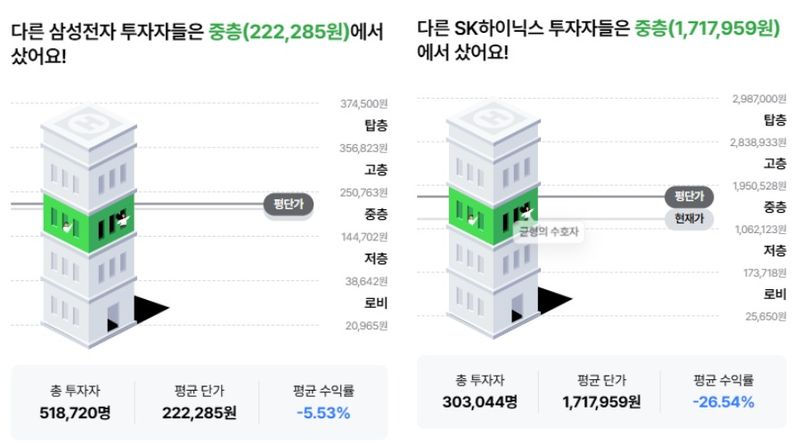
Judging by the numbers alone, it looks like an incredible “bottom.” But in the stock market, taking the 3.27x figure at face value is extremely risky. Hidden in it is the fatal trap of semiconductors as a “cyclical industry.”
Semiconductors are entirely at the mercy of cycles. During a boom, earnings surge, projected net profits rise sharply, and P/E ratios naturally plunge. Conversely, when the boom ends and earnings shrink, the P/E ratio shoots up even if the share price stays where it is. In other words, the current 3.27x is valid only if the assumption holds that Samsung Electronics Co., Ltd. will continue making huge sums of money as it does now.
The market is already looking on with suspicion. Concerns are spreading over how long investment in AI infrastructure can continue and how fierce the pursuit by Chinese companies will be. In fact, Samsung Electronics Co., Ltd.'s preliminary third-quarter operating profit rose, but its share price plunged in the opposite direction.
To make matters worse, trading flows on the field became completely snarled. Over the eight trading sessions since the 8th, during which the KOSPI plunged 16.2%, foreign investors dumped a staggering 11.5 trillion won worth of shares in a carpet-bombing barrage. Meanwhile, Samsung Electronics Co., Ltd.'s share buybacks, which had been supporting the share price from below, had already ended on the 7th, and the growth in individual investors' deposits stalled. On the 15th, pension funds made net purchases of just 35.1 billion won. The vacuum—with sellers but no buyers—amplified the plunge.
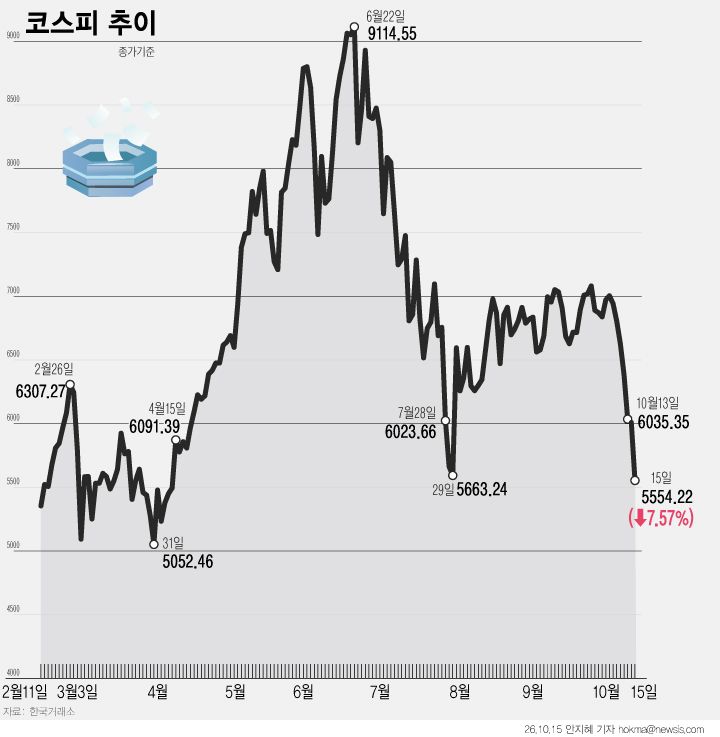
So, is the rebound on the 16th the first sign of a genuine V-shaped recovery?
Past statistics are sobering. According to an analysis by Yuanta Securities, in about 83% of the 12 past instances when the KOSPI plunged by at least 10% over seven trading days, share prices were higher a week later. But when the decline exceeded 15%—a devastating blow—prices staged a sustained rebound a month later in only 20% of cases. It's a painful reminder that a temporary technical rebound and a sustained upward trend are entirely different things.
Ultimately, the turning point depends on when foreign investors' selling barrage subsides and whether Samsung Electronics Co., Ltd.'s earnings forecasts hold up without being cut.
But the final checkpoint, more important than all these market conditions, is the investor's own “account.” Someone with money needed for immediate living expenses tied up in the market cannot respond the same way as someone who has invested spare funds with a view to holding them for years. Before being lured by the attractive 3.27x P/E and impulsively hitting the “average down” button, take a clear-eyed look at the nature of your money and your investment horizon. That's the first rule for surviving to the end in the brutal stock market.
[email protected] Jeon Sang-il Reporter