“Tariff and visa barriers remain even with billions of dollars invested in the U.S.” — Cho Jung-sik urges former U.S. lawmakers to address them
- Input
- 2026-10-16 19:03:19
- Updated
- 2026-10-16 19:03:19
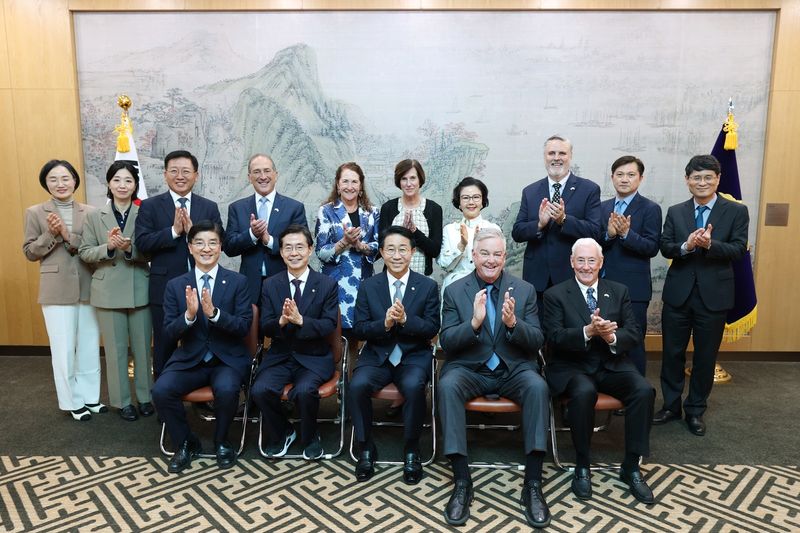
On the 16th, National Assembly Speaker Cho Jung-sik met at the National Assembly with a visiting delegation from FMC (Former Members of Congress), a group of former U.S. Representatives, and asked the U.S. to improve the investment climate in line with increased South Korean investment there.
Cho said that, under the Joint Fact Sheet agreed to by the South Korean and U.S. leaders last November, the first energy-sector investment project in the U.S. had been finalized and was moving into implementation. He emphasized, “South Korean global companies are investing a great deal in the United States.” He then asked for “a great deal of attention and support to create a stable investment environment for Korean companies, expedite permits and approvals, and resolve visa issues.” His point was that, as South Korea follows through on its investment commitments to the U.S., the U.S. should also address the practical business difficulties faced by companies investing there.
The U.S. side also acknowledged that tariff issues are burdening South Korean companies’ investments. Recalling his meeting the previous day with the chairman of Korea Zinc, former U.S. Representative David Trone said, “Korea Zinc is a company that invested $7 billion in a plant in Tennessee,” and praised its expected contribution to job creation and the supply of rare minerals in the U.S. He added, “I’ve heard that many Korean businesspeople are having difficulties related to tariffs. I’m told Korea Zinc has also run into a lot of difficulties because of tariffs,” and said, “I gave a lot of advice on how the tariff issue could be resolved.”
The U.S. expects economic benefits from large-scale investments by South Korean companies, including job creation and securing supplies of critical minerals, yet those very companies are struggling with U.S. tariff barriers. This is why addressing investors’ cost burdens and workforce management issues, alongside expanding the scale of investment in the U.S., has emerged as a practical challenge for South Korea-U.S. economic cooperation.
The visit was organized by the Korea-U.S. Research Institute, founded by former Representative Jay Kim, the first Korean American to serve in the U.S. House of Representatives. Since leaving office, Kim has continued to promote exchanges among political and business figures in South Korea and the U.S., as well as private-sector public diplomacy activities such as parliamentary diplomacy. Since 2019, the institute has supported visits to South Korea by former U.S. lawmakers and worked to expand people-to-people networks between the two countries.
During their weeklong visit, the delegation met with Korea Zinc officials, visited industrial sites including a Dongwon Industries plant in Jincheon, North Chungcheong Province, and called on an immigration law firm to review related issues. They also visited Seoul National Cemetery and Osan Peace Park to reflect on the historical significance of the South Korea-U.S. alliance.
The meeting also raised the need to establish a permanent communication channel between the South Korean and U.S. legislatures. Cho noted that the Korea-U.S. Parliamentary Association, comprising 161 lawmakers from the ruling and opposition parties, has been established in South Korea’s National Assembly, and asked the U.S. Congress to consider creating a standing exchange organization to match it.
[email protected] Song Ji-won Reporter