Will Takaichi pay her respects at Yasukuni? All eyes are on her ahead of the autumn festival
- Input
- 2026-10-16 16:09:54
- Updated
- 2026-10-16 16:09:54
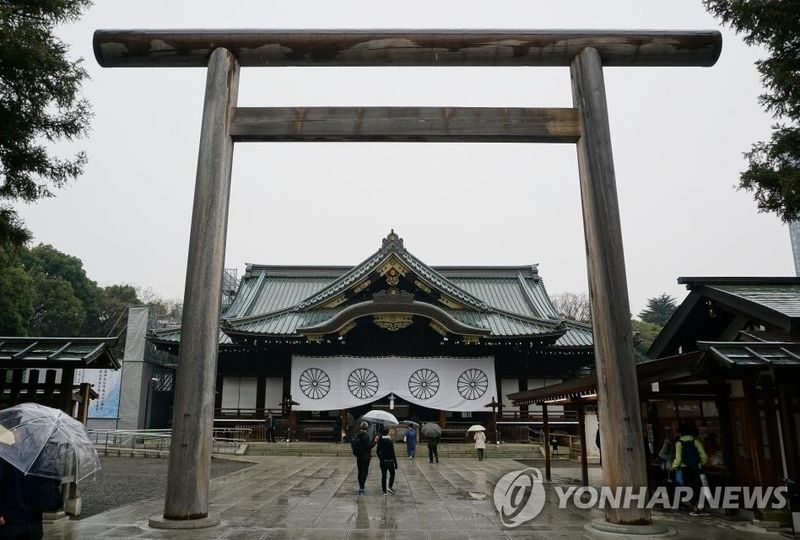
【Financial News, Tokyo—Correspondent Seo Hye-jin】 Japanese Prime Minister Sanae Takaichi did not state her position on whether she would visit Yasukuni Shrine ahead of its autumn festival. At the Diet that same day, she said she would uphold the Murayama Statement, which expresses remorse and apology for colonial rule.
According to NHK on the 16th, Chief Cabinet Secretary Minoru Kihara said at a press conference after a cabinet meeting that day, in response to a question about Prime Minister Takaichi’s plans to visit Yasukuni Shrine or offer a tribute, “The prime minister will make an appropriate decision.” He said he would decide in the same way whether he himself would visit.
Yasukuni Shrine’s autumn Grand Festival will be held over three days, from the 17th to the 19th. Chief Cabinet Secretary Kihara did not provide details on whether Prime Minister Takaichi would visit or offer a ritual item known as a “masakaki.”
Before becoming president of the Liberal Democratic Party (LDP) last autumn, Prime Minister Takaichi visited Yasukuni Shrine every year during its spring and autumn Grand Festivals and on August 15, the anniversary of Japan’s defeat. However, she did not visit during last autumn’s or this year’s spring festival.
She also did not visit the shrine in person on August 15 this year. Instead, from the grounds of Nippon Budokan, several hundred meters away, she paid her respects from afar toward Yasukuni Shrine.
Against this backdrop, Prime Minister Takaichi said that day at the House of Councillors Budget Committee that she would uphold the historical views of successive cabinets, including the Murayama Statement.
Prime Minister Takaichi said, “I have said that the positions of successive cabinets on historical issues will remain unchanged going forward,” adding, “The Murayama Statement is, of course, included.” She continued, “We must not place the burden of responsibility on future generations. That is the approach I am taking.”
Issued in 1995, the Murayama Statement expresses remorse and apology for Japan’s past colonial rule.
Kiyomi Tsujimoto, a member of the Constitutional Democratic Party of Japan (CDP) who questioned Takaichi that day, pointed out that before taking office, Takaichi had taken a negative stance toward the statement, including criticizing it as “a view lacking in insight.”
Meanwhile, Chief Cabinet Secretary Kihara said the Russian side had issued a “consular notification” on the 15th (local time) regarding the detention of a male reporter with the Hokkaido Shimbun.
A consular notification is a procedure through which a country is informed via diplomatic channels that one of its nationals has been detained; it does not mean that a consular visit has taken place.
Chief Cabinet Secretary Kihara said, “I will do everything in my power to arrange a consular visit as soon as possible so that we can confirm his health and his understanding of the case, among other things.”
Earlier, Russia’s Federal Security Service (FSB) detained a male reporter with the Hokkaido Shimbun in Sakhalin Oblast in Russia’s Far East on suspicion of espionage. Asahi Shimbun also reported that a Russian court had ordered him held for at least two months.
Amid concerns that the detention could be prolonged, Japanese media organizations also called for the reporter’s release. Shiro Nakamura, chairman of the Japan Newspaper Publishers and Editors Association and chairman of Asahi Shimbun Company, called on Russian authorities to release the reporter promptly at the 79th Newspaper Convention in Matsue, Shimane Prefecture, that day, saying, “I express strong concern and anger.”
The Japan Newspaper Workers’ Union Federation and the Hokkaido Shimbun Labor Union also issued a joint statement on the 14th calling for the reporter’s prompt release. The two organizations said, “Freedom of the press is the foundation of democracy and must be respected to the fullest extent.”
[email protected] Seo Hye-jin Reporter