False “Magnitude 9.9 Quake” Alert Causes Scare Across Japan; Canceled After 8 Minutes
- Input
- 2026-10-16 15:55:55
- Updated
- 2026-10-16 15:55:55
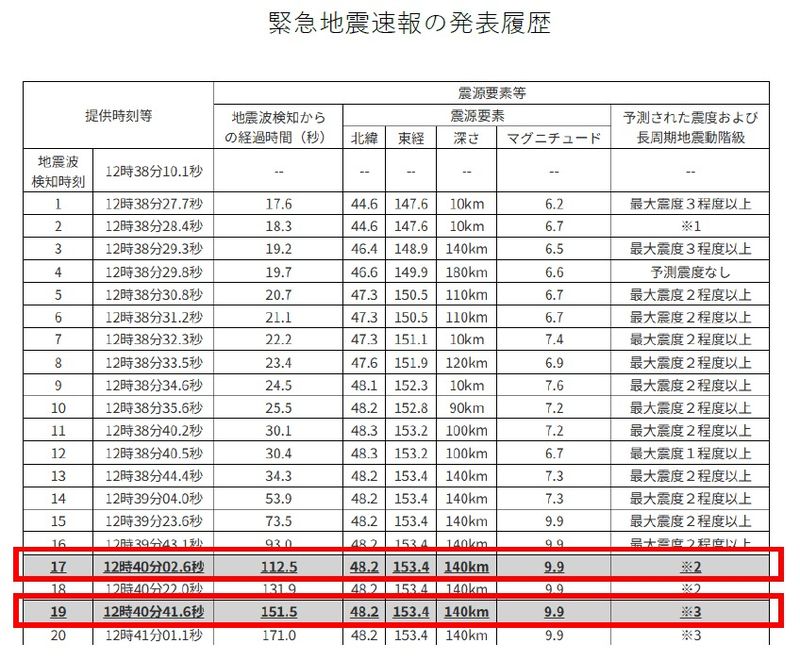
【Financial News, Tokyo—Correspondent Seo Hye-jin】The JMA mistakenly determined that a magnitude 9.9 earthquake—larger than any ever recorded—had occurred and issued an emergency alert across Japan. The actual quake was magnitude 6.9, and shaking observed in Japan was slight, but disaster-prevention systems linked to the alert were activated, temporarily halting even Shinkansen services. This was the first time the agency had canceled an Emergency Earthquake Early Warning alert.
According to NHK and The Nikkei on the 16th, the JMA issued an Emergency Earthquake Early Warning at 12:40 p.m. that day for areas from Hokkaido to the Kanto region, which includes Tokyo, and the Tokai region. The system had determined that a magnitude 9.9 earthquake had occurred in the Kuril Islands and forecast shaking at the maximum seismic intensity of 7. The alert was canceled eight minutes later, at 12:48 p.m.
A magnitude 9.9 earthquake would be unprecedented in size. According to the U.S. Geological Survey (USGS), the largest earthquake ever recorded was a magnitude 9.5 quake that struck Chile in 1960. A magnitude 9.9 quake would release about four times as much energy. Since the energy released increases by about 32 times with each one-point increase in magnitude, the energy difference between magnitudes 9.9 and 6.9 is about 32,000-fold.
In reality, a magnitude 6.9 earthquake occurred around 12:38 p.m. near Russia’s Kamchatka Peninsula. Its focal depth was estimated at about 160 kilometers. In Japan, seismic intensity 1 was recorded in Hakodate, Hokkaido, with no strong shaking. There was no tsunami threat either.
A magnitude 6.9 earthquake can also cause major damage if its focus is shallow and close to a densely populated area. However, “magnitude” indicates the size of an earthquake itself, while “intensity” refers to the strength of shaking in a particular area. Even for the same earthquake, shaking and damage vary depending on the distance from and depth of the focus, as well as local ground conditions.
This time, the earthquake occurred deep underground, far from Japan, so shaking within the country was weak.
The Emergency Earthquake Early Warning system detects the small tremors that arrive first just after an earthquake and forecasts the stronger shaking that may follow. It sends an alert to the general public when shaking with a maximum seismic intensity of 5-lower or higher is expected. In this case, the system misestimated the earthquake’s location and magnitude and judged that strong shaking would hit a wide area.
The alert’s effects spread to the transportation network. JR Central suspended service in both directions on the Shin-Yokohama–Toyohashi section of the Tokaido Shinkansen after its disaster-prevention system was activated, then resumed operations about 15 minutes later. Chief Cabinet Secretary Minoru Kihara also remained at the Prime Minister’s Office to gather and analyze information.
The JMA held a press conference at 2 p.m. and apologized. Ayataka Ebita, head of the Earthquake and Tsunami Monitoring Division, said, “By issuing an Emergency Earthquake Early Warning with information that overstated the actual situation, we caused considerable inconvenience to many people.”
The JMA is leaning toward the possibility that the problem occurred in information processing rather than in hardware such as the equipment. It is investigating why the earthquake’s magnitude was calculated so high and which part of the program malfunctioned. The agency denied the possibility of a cyberattack, saying no external access had been confirmed during the relevant period.
[email protected] Seo Hye-jin Reporter