Despite proposal to raise grant rate by 1 percentage point, concerns over “crowding out school budgets”... Education superintendents nationwide coordinate in Jeju
- Input
- 2026-10-16 15:53:44
- Updated
- 2026-10-16 15:53:44
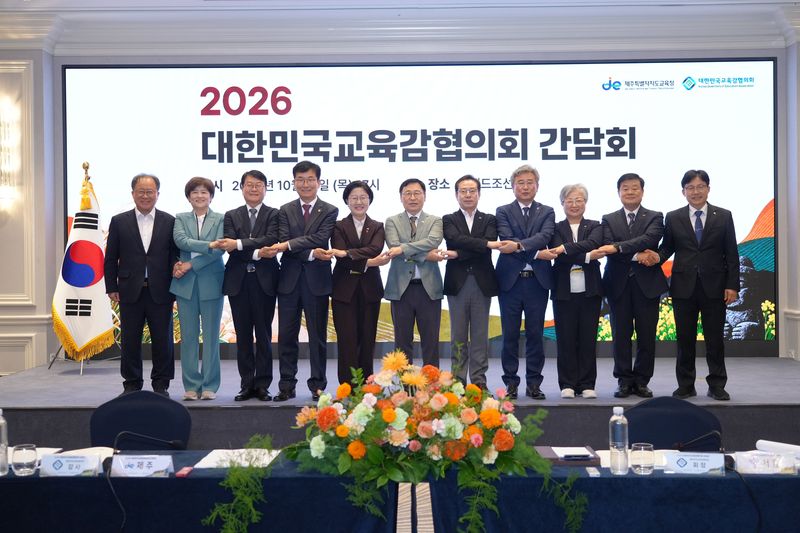
【Financial News, JEJU—Reporter Jeong Yong-bok】 As the government’s reform of the Local Education Finance Grant coincides with a bill to raise the grant rate, education superintendents nationwide have warned that budgets for existing primary and secondary education could be reduced.
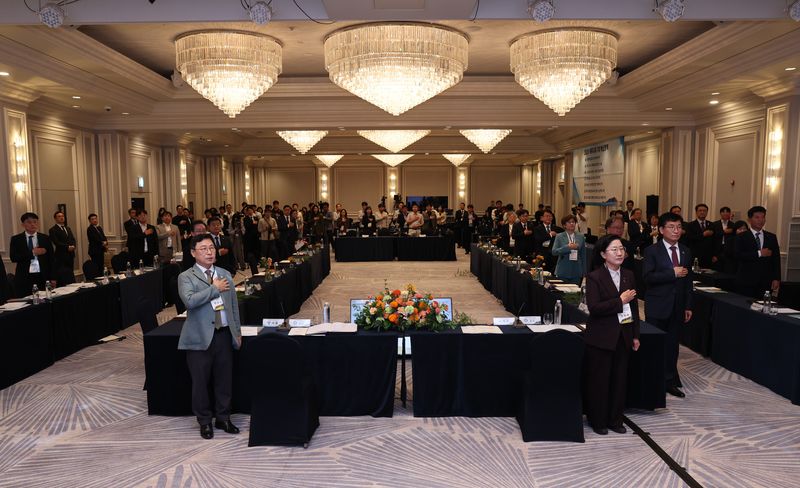
The Korean Council of Superintendents of Education said on the 16th that it held its “2026 Meeting of the Korean Council of Superintendents of Education” the previous day at Grand Josun Jeju in Jeju, where participants discussed joint responses to key issues, including education finance reform, teacher protection and student safety. The meeting was hosted by the Jeju Special Self-Governing Provincial Office of Education.
The main issues were how to calculate the Local Education Finance Grant and how to allocate funding from the Future Response Fund. The Local Education Finance Grant is a budget distributed to city and provincial offices of education, funded by taxes and other revenue collected by the national government. It is a key source of funding for education at kindergartens and elementary, middle and high schools, supporting staff salaries, school operating costs and improvements to educational environments.
On August 21, the government announced a plan to reform the existing system, under which 20.79% of domestic tax revenue is allocated as grants, to one that takes into account factors including economic growth and changes in the school-age population.
Under the new calculation method, the previous year’s grant is adjusted to reflect the average nominal growth rate over the past three years and the rate of change in the school-age population. To mitigate the impact of declining student numbers, the method was designed to apply only 35% of the rate of change in the school-age population.
The government plans to redirect the difference between grants calculated under the existing domestic-tax-linked method and the new method to the Education and Talent Account of the Future Response Fund, investing it in early childhood, higher and lifelong education, among other areas. It also said it would stipulate in law that the state make up any shortfall if the total grant amount falls below the previous year’s level.
The superintendents were concerned that the stability of existing school education budgets might not be adequately secured. They pointed out in particular that resources for primary and secondary education could shrink if funding for the Future Response Fund is secured first and the grants to be distributed to city and provincial offices of education are then calculated.
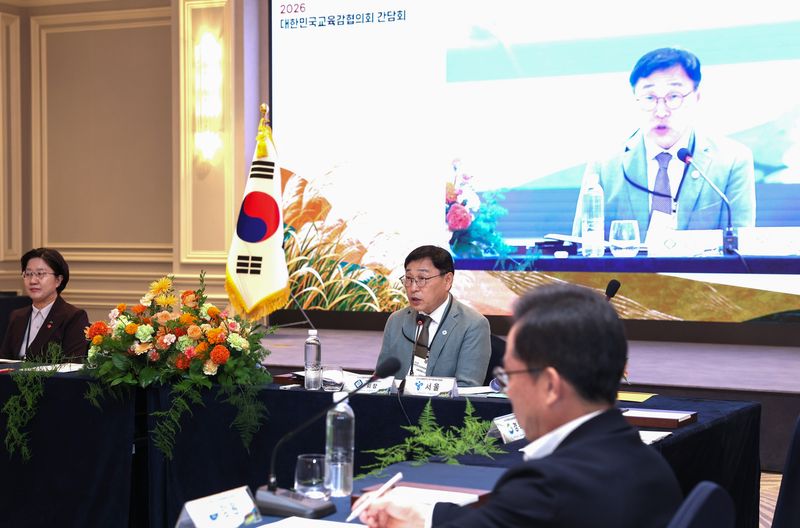
An amendment to the Local Education Finance Grant Act, introduced on the 2nd by Democratic Party of Korea lawmaker Han Jeoung-ae as its lead sponsor, was also discussed. The amendment would raise the share of domestic tax revenue linked to the grant from the current 20.79% to 21.79%, an increase of 1 percentage point, and include childcare centers among the eligible recipients of grant funding.
The aim is to secure additional funding for the integration of early childhood education and childcare, which are currently divided between kindergartens and childcare centers. Han’s office estimated that the integration would require at least 5 trillion won in additional funding.
The council viewed the amendment’s aims positively, as it would maintain the principle of linking grants to domestic tax revenue and strengthen the state’s fiscal responsibility for integrating early childhood education and childcare. However, it said the impact on existing school education finances could vary depending on how the creation of a new fund is combined with the method for calculating grants.
The superintendents therefore agreed to step up efforts to persuade the National Assembly to adjust the weight given to student numbers in the government’s reform plan and to stipulate in law the uses of the Future Response Fund and the principles for allocating its funding. They also agreed to address, as a medium- to long-term reform task, the transfer of funds from local governments to offices of education and the shifting of costs onto those offices for joint national and local government projects.
The issue has direct implications for education in Jeju as well. Jeju Superintendent of Education Ko Ui-suk said at a plenary meeting of the Korean Council of Superintendents of Education on September 17 that education funding should not be cut solely on the basis of declining student numbers. The point was that growing education needs independent of student numbers—such as expanding artificial intelligence (AI) education, easing overcrowded classrooms and rising personnel costs—must also be taken into account.
However, it has not been determined how much the grant to the Jeju Provincial Office of Education would change if the government’s reform plan is implemented. The impact on regional finances could also vary depending on future legislative amendments and detailed allocation criteria.
Legislative amendments to protect teachers’ educational activities were also a key agenda item. The council agreed to strengthen cooperation with the National Assembly to prevent indiscriminate child abuse reports over legitimate educational activities and to improve the effectiveness of education superintendents’ written opinions submitted in reported cases.
Proposed measures included amendments to the Child Welfare Act and the Special Act on the Punishment, etc. of Child Abuse Crimes, as well as establishing a dedicated body at the national level to protect educational activities. The focus was on clarifying the criteria for legally distinguishing legitimate educational activities from acts of child abuse.
The scope of teachers’ liability for safety accidents during field trips was also discussed. The council shared updates on the appeal proceedings involving teachers in connection with the 2023 death of a young child in Mokpo, South Jeolla Province, and agreed to explore ways to improve the system so that student safety is ensured without placing excessive responsibility for accidents on individual teachers accompanying students.
The meeting also discussed how to respond to the so-called “Yacha Rule,” a new form of school violence spreading among students. The term refers to fighting barehanded without protective gear. Concerns have been raised that, even when the participants claim they consented, the violence may stem from peer pressure or coercion.
Another concern was that the fights could be filmed and circulated online, or lead to further crimes such as extortion and illegal betting. The council agreed to consult with relevant agencies on strengthening prevention education, with school resource officers at the center; refining the criteria for reviewing school violence cases; and removing or blocking circulated videos.
Geun-sik Chung, chair of the Korean Council of Superintendents of Education and superintendent of the Seoul Metropolitan Office of Education, emphasized that the four agenda items, including education finance, teacher protection and student safety, are linked to the future of public education. He said the council would work to turn its joint response into tangible institutional improvements.
The tasks set out by education superintendents from across the country in Jeju focused on how to guarantee the stability of education finance and protect students and teachers through laws and institutions. As reforms to the grant system and measures to protect educational activities remain at the legislative and consultation stages, deliberations in the National Assembly and the government’s follow-up actions are expected to be pivotal to actual policy change.
[email protected] Jeong Yong-bok Reporter