Worker in Their 30s: “810,000 Won in the Red Each Month After Moving Out ... How Should I Save?” [Personal Finance Q&A]
- Input
- 2026-10-17 08:00:00
- Updated
- 2026-10-17 08:00:00

Q. A, a 32-year-old office worker who moved out a year ago, used to save 1 million won each month while living with their parents and still have money left over for trips. But since moving out, they have been running a monthly deficit after setting aside money for savings and have been withdrawing money from another account.
The family home was not so far away that commuting was difficult, but A chose to live independently because they wanted a space of their own. They knew rent and maintenance fees would add to their expenses but had not worked out the exact size of the deficit. They are also considering how much they should save, whether to keep their housing subscription savings account, and how to prepare for retirement through pension savings and an Individual Retirement Pension (IRP).
A’s take-home pay is 3.58 million won a month, and annual bonuses total 3 million won. Fixed costs total 900,000 won, including rent of 500,000 won, maintenance fees of 190,000 won, insurance premiums of 120,000 won and phone bills of 90,000 won. They spend 500,000 won on variable living costs and 1.44 million won on personal expenses. They save 1.05 million won a month, including 800,000 won in installment savings and 250,000 won in housing subscription savings, and have 9 million won in annual irregular expenses.
A’s assets total 97.1 million won: 4.6 million won in a checking account, 14 million won in fixed-term deposits, 19.5 million won in investments, 9.4 million won in housing subscription savings, 18.6 million won in installment savings and other accumulated savings, a 10 million won rental deposit, and 21 million won in retirement savings. A has no debt.
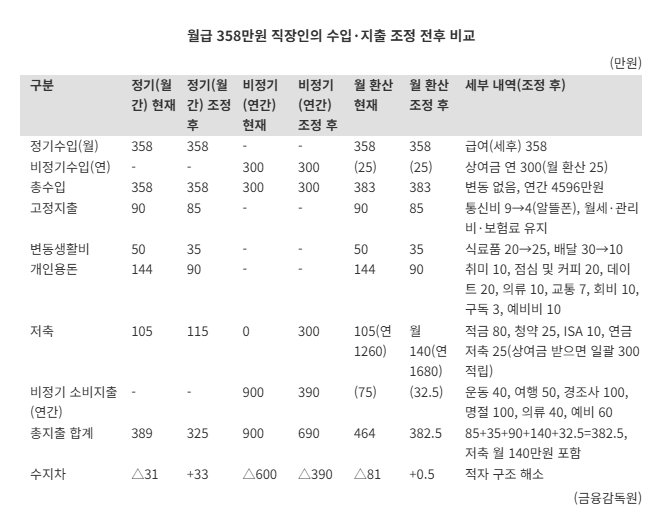
A. According to the Financial Supervisory Service, the first thing A needs to do is determine the size of the deficit. Average monthly income, including salary and bonuses, is 3.83 million won, while average monthly spending, including savings, is 4.64 million won. The resulting deficit is 810,000 won a month, or 9.72 million won a year.
A saves 1.05 million won each month but withdraws money from existing assets to cover living expenses. As a result, actual net savings amount to just 240,000 won a month—the 1.05 million won in savings minus the 810,000 won deficit.
The additional costs of living independently were estimated at 1.09 million won a month, or 13.08 million won a year. Rent of 500,000 won, maintenance fees and utilities of 190,000 won, and 200,000 won for groceries and household necessities are new expenses. Spending on food delivery and dining out has also risen by 200,000 won compared with when A lived at home. The deficit stems from maintaining the same spending level despite the added costs of living independently while income remained unchanged.
The FSS proposed cutting A’s monthly personal spending from 1.44 million won to 900,000 won. Spending on hobbies and social activities would fall from 400,000 won to 100,000 won, while lunch and coffee costs and dating expenses would each be reduced from 300,000 won to 200,000 won. Grooming and clothing expenses would be cut from 200,000 won to 100,000 won, and a new 100,000-won contingency fund would be set aside for unexpected expenses.
Annual irregular expenses would also be cut from 9 million won to 3.9 million won. Exercise classes would be reduced from 4 million won a year to 400,000 won, and travel from 3 million won to 500,000 won, while congratulatory and condolence expenses and holiday-related costs would each remain at 1 million won. Another 400,000 won would be set aside for seasonal clothing and 600,000 won for contingencies. A would deposit 325,000 won a month into a separate account for irregular expenses.
Separate accounts would also be used for variable living expenses and personal spending, with monthly budgets of 350,000 won and 900,000 won, respectively. A would use a debit card instead of a credit card and avoid further spending once the account balance runs out. Switching to a low-cost mobile carrier would reduce the phone bill from 90,000 won to 40,000 won a month, and food delivery costs would be cut from 300,000 won to 100,000 won.
Monthly savings would increase from 1.05 million won to 1.4 million won. A would contribute 800,000 won to installment savings, 250,000 won to housing subscription savings, and 100,000 won to a Productive Finance ISA (ISA) each month. The 3 million won contribution to pension savings would be paid in a lump sum when the annual bonus arrives. The youth housing subscription account should be kept as long as A plans to move into rental housing or buy a home.
With these spending adjustments, average monthly expenses would fall from 4.64 million won to 3.825 million won, eliminating the deficit. Annual savings would also rise from 12.6 million won to 16.8 million won.
Housing costs should be reduced over the medium to long term. When the lease expires in a year, A should consider switching to jeonse or semi-jeonse—a deposit-based arrangement with reduced monthly rent—to lower or eliminate the 500,000-won rent. Existing assets and additional savings could be used, with a jeonse loan covering any shortfall. The FSS also suggested checking the income and asset requirements for public rental housing and applying when a suitable unit becomes available.
An FSS official advised, “A’s deficit is not due to insufficient income but is the result of maintaining the same spending after choosing to live independently. By continuing to live independently while cutting back on spending that had been unconstrained and managing expenses within budgets for each account, A can save 1.4 million won a month consistently.”
For free, personalized financial counseling for consumers, search for “FINE,” the Financial Consumer Portal operated by the Financial Supervisory Service, or call the FSS Call Center at 1332 and select option 7 for Financial Advisory Services.
[email protected] Lee Jeong-hwa Reporter