KOSPI plunges 21% in 7 trading days ... “A buying opportunity ahead of a November rebound”
- Input
- 2026-10-16 15:46:32
- Updated
- 2026-10-16 15:46:32
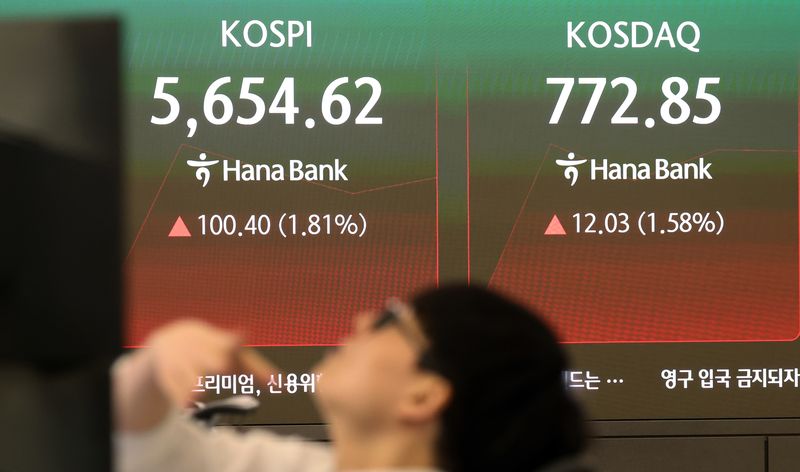
[Financial News] The KOSPI, which plunged 21% over seven trading days, is attempting a rebound around the 5,700 mark intraday on the 16th. The index fell sharply amid concerns over the AI industry’s outlook and pressure from U.S. inflation and interest rates. But analysts say the bad news has already been largely reflected in share prices, and that this could offer a chance to buy at lower prices ahead of a November rebound.
According to the Korea Exchange, the KOSPI closed at 5,554.22 the previous day, down 454.59 points (7.57%) from the previous trading day. It has fallen for seven consecutive trading days since the 6th, losing 1,449.52 points (21%) over that period. As of 3 p.m. on the 16th, the KOSPI was trading at 5,717.96, up 163.74 points (2.95%) from the previous trading day.
Analysts say the sharp sell-off could lay the groundwork for a November rebound. They point to concerns over the AI industry’s profitability and the interest-rate burden from rising U.S. inflation being priced in all at once, as well as technical indicators and valuations moving closer to short-term support levels.
Byun Jun-ho, a researcher at IBK Investment & Securities, said, “Since 2010, there have been only 11 instances of the KOSPI falling for seven consecutive trading days. After those declines ended, the KOSPI rose by an average of 0.2% after one trading day, 0.9% after five trading days, and 3.7% after 20 trading days.” He added, “In past instances of seven consecutive trading-day declines, losses were generally around 5%, but this time they reached 21%, making a rebound over the coming month more likely.”
Technical indicators also signaled that the index was nearing a short-term bottom. The KOSPI’s 20-day disparity index fell to 83. The disparity index measures the distance between a stock price and its moving average, and typically ranges between 80 and 120. Given that it fell to 76 during the COVID-19 crash and to 80 during last summer’s sharp decline, analysts say there may be limited room for further losses. However, another view is that further declines remain possible, as the 60-day disparity index has fallen to 70–75 during past sell-offs.
Byun Jun-ho, a researcher at IBK Investment & Securities, said, “The KOSPI’s 12-month forward price-to-earnings ratio (PER) has fallen to 4.2 times, and its price-to-book ratio (PBR) to 1.08 times.” He added, “The 5,000-point level, corresponding to a PBR of 1, could act as strong support, making it likely that the KOSPI will form a bottom in the mid-5,000s.”
The U.S. midterm elections were also cited as a reason to expect a November rebound. Since 2000, the KOSPI has risen in November in all six years when U.S. midterm elections were held. The explanation is that uncertainty ahead of the Federal Open Market Committee (FOMC) meeting in late October and the midterm elections in early November was reflected in this month’s correction, and investor sentiment could recover once those events have passed.
Foreign investors’ selling is seen as a factor that could constrain a rebound. In October alone, foreign investors have been net sellers of about 18 trillion won worth of KOSPI shares. Analysts say it remains to be seen whether concerns over the AI industry’s outlook will lead to actual cuts in investment or weaker earnings, and how much further pressure from U.S. interest rate hikes may intensify.
Byun said, “The short-term plunge driven by concerns over AI and inflation should be used as a buying opportunity at lower prices ahead of a November rebound.”
[email protected] Bae Han-geul Reporter