Warsh: “I won’t prejudge the October rate decision ... Price stability will definitely be achieved”
- Input
- 2026-10-16 14:55:41
- Updated
- 2026-10-16 14:55:41
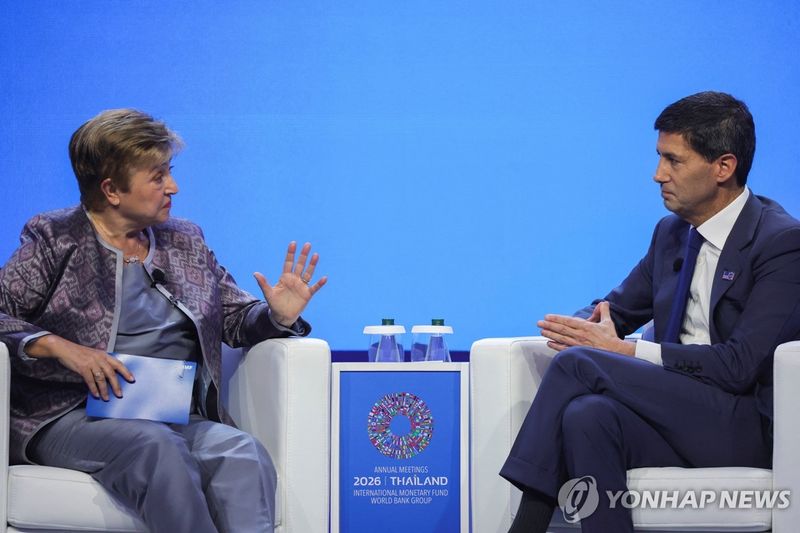
[Financial News] Kevin Warsh, chair of the U.S. Federal Reserve (Fed), gave no specific signal about the October interest rate decision.
While saying that artificial intelligence (AI) would boost productivity in the U.S. economy and drive structural growth, he forecast that, in the short term, its demand-stimulating effect would emerge before an expansion in supply.
In a discussion with International Monetary Fund (IMF) Managing Director Kristalina Georgieva in Bangkok, Thailand, on the 16th, Warsh said, “The Fed has made clear that it will achieve price stability,” while adding, “I do not prejudge the decisions of monetary policy meetings.”
Warsh said, “About a month ago, we partially unwound our accommodative monetary policy,” and stressed that he would not say in advance what decisions would be made at the remaining monetary policy meetings this year.
Financial markets did not take Warsh’s remarks as a clear signal of further tightening. During the discussion, S&P 500 and Nasdaq futures rose to intraday highs.
In foreign exchange markets, the dollar weakened against major currencies. The euro strengthened against the dollar, while U.S. Treasury futures also edged higher. A rise in Treasury futures prices indicates movement toward lower Treasury yields.
New York futures rise, dollar weakens amid Warsh’s remarks
The market moves came as Warsh expressed an optimistic view of the U.S. economy’s growth potential while offering no specific signal of another rate hike this year.
The Fed raised its benchmark interest rate by 0.25 percentage points last month, bringing it to an annual range of 3.75% to 4.00%. The next Federal Open Market Committee (FOMC) meeting will be held on the 27th and 28th.
After the U.S. Consumer Price Index (CPI) and Producer Price Index (PPI) for September both came in above market expectations, the possibility of another rate hike drew attention, but Warsh did not provide a specific rate path.
Warsh devoted considerable time during the discussion to the structural changes that increased AI investment could bring to the U.S. economy. He said, “The U.S. economy is currently experiencing structural growth and a surge in investment,” and described the increase in investment as the most important positive change taking place in the global economy.
In particular, he said, “AI will affect the demand side of the economy before a supply-side shock emerges.”
This was interpreted to mean that AI-related investment would first expand demand, while the increase in supply resulting from productivity gains could take longer to materialize.
Warsh said, “AI will make the economy more productive and prosperous, but the process will not be smooth,” adding that its short-term effect on employment was uncertain.
Caution over financial risks ... “Need to watch for downside tail risks”
He also expected AI to help central banks analyze economic indicators and make monetary policy decisions. The Fed plans to hold an AI-related field hearing in the San Francisco Bay Area on November 16.
He also stressed the need to remain alert to financial stability risks. Warsh said the Fed should examine whether there are downside tail risks to which it could respond through policy.
He assessed the global economy as showing greater resilience than expected. “The global economy is proving more resilient than I expected five months ago,” he said, explaining that many Group of Twenty (G20) economies were withstanding multiple shocks.
In closing the discussion, he expressed confidence in the U.S. economy’s growth potential. Warsh said, “The U.S. will have a stronger and more sustainable economy, increasing its capacity to lead global economic growth,” adding, “It is not a zero-sum game.”
[email protected] Lee Seok-woo, International Affairs Correspondent Reporter