Don't fall for claims that say, “We know all your information” ... Bithumb launches scam-prevention campaign
- Input
- 2026-10-16 14:34:35
- Updated
- 2026-10-16 14:34:35
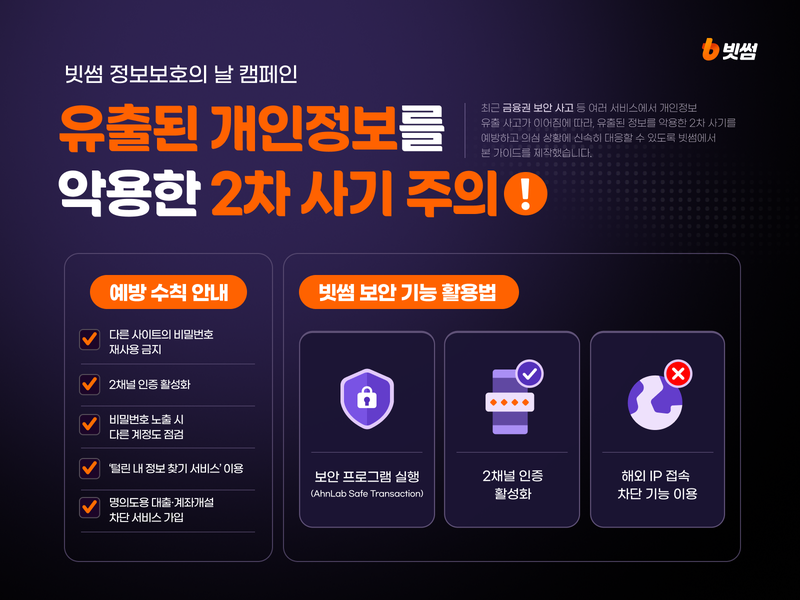
[Financial News] We have reached an era when even someone who can accurately state your name and contact details—even part of a password you used in the past—cannot be trusted. According to financial authorities, AI-related hacking breaches had been confirmed at 16 financial firms as of the 14th of this month, with approximately 100,000 records confirmed leaked. The virtual-asset sector was also among those affected. Leaked information is now being reused as a “resource” for scammers to gain people’s trust. According to the virtual-asset industry on the 16th, Bithumb is running a campaign to prevent victims from falling for “secondary scams exploiting leaked personal information” as part of its October information security campaign. The move comes amid a sharp rise in targeted cybercrimes that exploit leaked information, as personal information leaks continue across various services, including in recent security incidents in the financial sector.
Scammers approach people with messages such as “Your information has been leaked, and you are eligible for compensation” or “We need to verify your account for a security check.” They present not only names, mobile phone numbers and email addresses, but also past order numbers, the names of services people have used, and even parts of passwords they used in the past, pretending to be someone who “already knows my information.” In reality, they try to get victims to visit phishing sites, install remote-access apps or transfer money.
Falling for these tactics can expose identity-verification information, identity documents and account details, as well as verification codes entered on fake login pages. In particular, attackers have been found to cause direct financial losses by repeatedly trying leaked passwords on other services to take over accounts, or by demanding upfront payments under the pretext of refinancing loans.
Bithumb emphasized that “the fact that someone knows your personal information is not proof that the contact is official” and shared practical guidelines for keeping accounts safe.
First, even if you are contacted about identity theft, compensation for losses or a security check, do not click links in text messages, emails or messaging apps. Check directly through the official app or website you normally use instead. The more specific the information, the more convincing it may seem, but you must always verify it yourself.
Do not reuse passwords that you use on other sites or that were issued temporarily; it is safer to set a unique password used only for Bithumb. If you receive a notice that your password may have been exposed, you should also change it on other services where you use the same or a similar password. You can check whether your username and password have been illegally circulated through the “Stolen Personal Information Lookup Service,” run by the Personal Information Protection Commission and the Korea Internet & Security Agency.
For safer transactions, users are advised to use proven security features such as Bithumb’s official “two-channel authentication.” This feature requires an additional verification step after logging in with a username and password, effectively preventing account takeovers even if a password is leaked. Bithumb also offers an “Overseas IP Access Blocking” feature that enables the immediate detection of abnormal login attempts. It also provides the AhnLab Safe Transaction security program, which protects keyboard input and helps block phishing and prevent memory hacking.
If you have already entered your information or run an installation file, disconnect from the network immediately. Then, using a separate, uninfected device, take steps to protect your account, such as changing your Bithumb password, resetting two-factor authentication, deleting API keys and reviewing your withdrawal-address whitelist. If you detect suspicious transactions, you can report them immediately to the Bithumb Investor Protection Center.
A Bithumb representative said, “Once personal information has been leaked, it can be misused again even after time has passed, so you should not trust someone solely because they know your information,” and added, “Bithumb will continue to strengthen its security features and expand prevention campaigns to create an environment where customers can trade with peace of mind.”
[email protected] Han Yeong-jun Reporter