KOSPI rebounds in the 4% range after sharp plunge; foreign investors return, but semiconductors remain key
- Input
- 2026-10-16 14:19:03
- Updated
- 2026-10-16 14:19:03
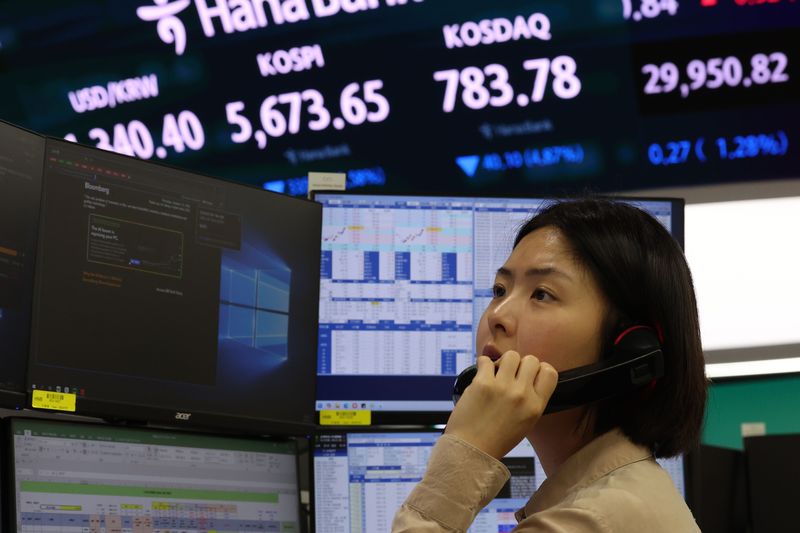
[The Financial News] South Korea's stock market, which plunged the previous day, is rebounding on the back of bargain buying. At around 2:03 p.m. on the 16th, the KOSPI was up in the 4% range and moving to recoup its losses, while foreign investors also returned to net buying on the main board.
However, it remains uncertain whether this rebound will lead to a trend reversal. Whether gains in large-cap semiconductor stocks continue and whether foreign investors sustain their spot-market buying are seen as factors that will determine the market's direction.
According to the securities industry, iM Securities forecast a rebound in South Korea's stock market as bargain hunters moved in after the previous day's plunge. Although the U.S. September producer price index (PPI) came in well above market expectations, the reaction in U.S. stocks was limited.
The firm also said that easing concerns about AI-related credit risks could have a positive effect on South Korean stocks, after Nvidia CEO Jensen Huang dismissed concerns about the financial health of AI infrastructure company CoreWeave.
However, it also cautioned against assuming that sentiment across the semiconductor sector would recover quickly. TSMC's third-quarter results and fourth-quarter revenue outlook showed that demand for advanced semiconductors remained robust, but its shares were weak. The interpretation is that market attention is focused less on immediate demand than on financing pressures from AI capital spending and the sustainability of future growth.
Foreign investors turn net buyers in spot market...retail investors net-sell 789.6 billion won
A notable feature of intraday investor flows was that foreign investors returned to net buying on the main board. As of 2:03 p.m., foreign investors had net bought 184.7 billion won in KOSPI shares. Retail investors, by contrast, had net sold 789.6 billion won, while institutions had also net sold 116.4 billion won.This contrasts with the previous day, when foreign investors net sold about 3.7 trillion won in KOSPI shares. The shift to net buying by foreign investors, who had intensified selling pressure during the sharp selloff, is a favorable signal for a short-term rebound.
However, one day's trading flows are not enough to conclude that foreign investors have shifted to sustained buying. iM Securities said that continued foreign selling could weaken the rebound's momentum early in the session, but that the index could recover from its outsized losses if trading flows in Samsung Electronics and SK hynix stabilize.
Kang Jin-hyuk, a senior researcher at Shinhan Securities, said in a report that day that Jensen Huang's remarks had eased some AI-related credit concerns and prompted bargain buying.
Kang said, “It is worth noting that CEO Huang mentioned improvements in the financial health of AI infrastructure company CoreWeave and a decline in capital-raising costs,” adding, “Expectations that financing pressures across the AI value chain could ease led to bargain buying.”
However, doubts about AI investment have not been fully dispelled. U.S. September PPI and retail sales exceeded expectations, reviving inflation concerns. The assessment was that the U.S. 10-year Treasury yield also fell further below 5.10% as concerns about the sustainability of AI capital spending and credit risks grew, outweighing inflation pressures.
This means market attention is focused not only on AI demand growth but also on the ability to finance massive capital investments and the pace of monetization.
Semiconductors, autos and defense gain...sustainability of rebound remains to be seen
Shinhan Securities saw large-cap semiconductor stocks as leading the day's rebound, with Samsung Electronics and SK hynix rising 2.3% and 2.6%, respectively. Large-cap stocks in the auto and defense sectors also gained, while rotational buying continued in sectors that had fallen sharply, including biotech and cosmetics.However, a rebound in the semiconductor sector does not necessarily mean sentiment has fully recovered. iM Securities noted that despite evidence from TSMC's results and revenue outlook that demand for advanced semiconductors remains robust, its shares were weak, indicating that market attention is focused on the burden of AI capital spending and the sustainability of growth.
Industry watchers say whether this rebound proves to be a short-term technical retracement or develops into a sustained recovery will depend on foreign investors' spot-market flows and the share-price performance of large-cap semiconductor stocks.
If concerns about AI companies' financing conditions and the profitability of capital spending ease, and foreign buying continues, the rebound could persist. Conversely, if foreign investors resume selling or gains in large-cap semiconductor stocks lose steam, volatility could rise again after the sharp plunge.
[email protected] Kang Jung-mo Reporter