“Creating drug candidates with robots and light”: KAIST develops a “24-hour unattended synthesis platform”
- Input
- 2026-10-18 12:00:00
- Updated
- 2026-10-18 12:00:00
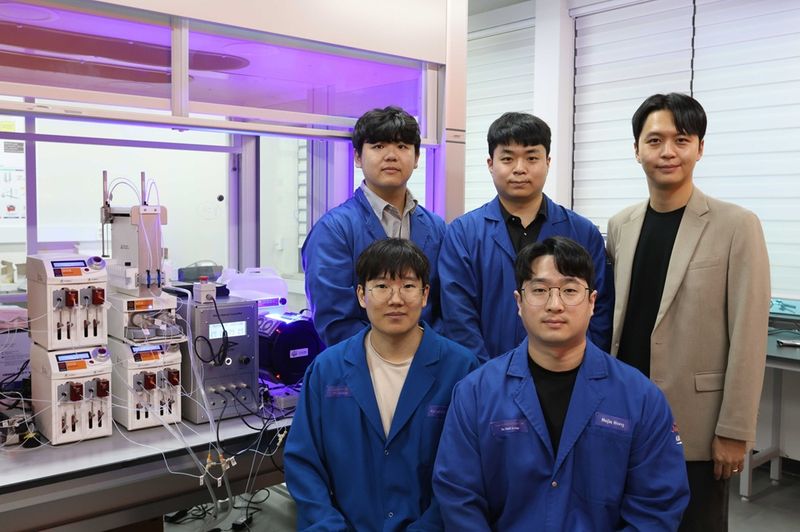
[Financial News] Researchers at the Korea Advanced Institute of Science and Technology (KAIST) have developed an “unattended synthesis platform” that uses a synthesis robot and light to automatically carry out everything from mixing raw materials to synthesis and analysis. The platform is expected to ease the burden of repetitive experiments and help researchers obtain a range of potential drug compounds.
KAIST announced on the 18th that a research team led by Professor Park Yoon-soo of the Department of Chemistry had built an unattended synthesis platform combining visible light with a continuous-flow process. Using the platform, the team synthesized the N-methyl pyrrole scaffold, a basic molecular framework used in drug development, and demonstrated the potential to increase output through continuous production.
In drug development, designed molecules must be produced and tested for efficacy and safety. However, new synthesis conditions must be found for each compound with a slightly different structure. And even if a small amount can be synthesized successfully, increasing production may change how much light or heat reaches the material, requiring the conditions to be adjusted again.
To reduce this burden, the team connected a raw-material preparation robot, an automated pump, a light-irradiation reactor, and analytical equipment into one system. Once researchers prepare the equipment and set the conditions, the robot mixes the raw materials, and the pump steadily feeds the solution through a narrow tube. This method, in which the raw materials are continuously fed as they react, is called a “continuous-flow process.” The team says that using a narrow tube makes it easier to distribute light evenly through the solution and allows the same process to run for longer, increasing production.
Once the reaction is complete, the solution is automatically transferred to analytical equipment. The equipment checks whether the desired compound was produced correctly and how much was made. The process runs automatically from mixing the raw materials through checking the results, without researchers having to transfer and measure the solution each time.
To assess the performance of the automated system, the team benchmarked it using a single-atom editing reaction. This is a new technology that selectively changes a specific atom while leaving the overall framework of a starting material called furan intact. The resulting compounds can alter how drugs bind to proteins in the body, and are attracting attention as a game changer in drug development.
The team applied this synthesis method to at least 20 furan-based compounds. Even in structurally complex natural products, they were able to change the desired part while keeping the rest intact. They also succeeded in continuously producing the N-methyl pyrrole scaffold in a process that continuously feeds the raw materials.
In drug development, compounds with slightly different structures are produced to compare their efficacy and safety. This technology is expected to help researchers obtain the compounds needed for such comparisons more efficiently and find promising drug candidates.
Professor Park Yoon-soo said, “How quickly and reliably we can synthesize designed molecules will determine the pace of drug development in the future. I expect the platform we have built to provide a foundation for moving toward an era of automated organic synthesis by making it possible to quantify and reproduce reaction conditions.”
KAIST Department of Chemistry students Byeon Hyeon-bin and Hong Ho-jin participated in the study as co-first authors, while Professor Park Yoon-soo and Kim Ha-eun, an InnoCORE Fellow (InnoCORE AI-CRED Innovative Drug Research Center), served as corresponding authors. The findings were published online on August 7 in JACS Au, an international journal published by the American Chemical Society.
[email protected] Yeon Ji-an Reporter