Sh Suhyup Bank Assistant Vice President Yang Gi-tae Sets Out to Train Corporate Rehabilitation Experts
- Input
- 2026-10-16 16:21:21
- Updated
- 2026-10-16 16:21:21
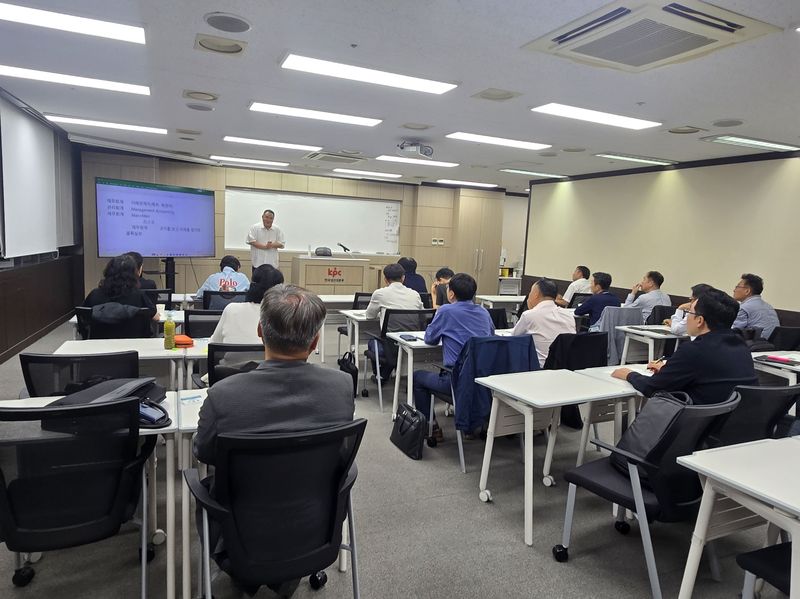
[Financial News] Yang Gi-tae, assistant vice president of the Risk Management Group at Sh Suhyup Bank, has set out to train corporate rehabilitation experts. Yang is an expert who has received the Korean Productivity Center’s (KPC) Best Instructor Award in the finance category three times.
According to Sh Suhyup Bank on the 16th, Yang delivered a lecture on financial analysis at the Korean Productivity Center’s 102nd Corporate Rehabilitation Administrators and Auditors Training Course, held in Gwangju Metropolitan City on the 15th. Under the theme “Corporate Health Check and Management,” he explained methods for corporate valuation and financial ratio analysis.
The Corporate Rehabilitation Administrators and Auditors Training Course run by KPC is a specialized education program featuring instructors who are experts in the legal, accounting and finance fields. It provides comprehensive training in the various professional competencies required for corporate rehabilitation practice.
Yang is the first external instructor at the Korean Productivity Center to receive the Best Instructor Award in the finance category three times, and is an expert in financial and credit analysis. He currently serves as an adjunct professor at Soongsil University’s Graduate School of Business and a visiting professor in the Department of Economics at Seoul Women’s University, teaching in the fields of the real economy and finance.
The lecture introduced analytical techniques for identifying early signs of corporate distress in financial statements and assessing the potential for improving a company’s financial structure and for corporate rehabilitation.
Yang particularly emphasized that, when determining whether a company should undergo corporate rehabilitation, it is necessary to consider comprehensively not only its current financial condition but also its future cash-generation capacity and the potential to improve its financial structure. He also explained the need for analysis that takes into account external factors such as corporate governance, business cycles and liquidity in financial markets.
Yang emphasized, “Corporate distress builds up gradually in financial statements, and financial risks begin to materialize in earnest when borrowing shifts from a means of growth to a means of survival,” adding, “For corporate rehabilitation, it is necessary to examine not only a company’s current financial condition but also its future financial condition, so proactive and comprehensive management is needed.”
[email protected] Seo Ji-yoon Reporter