South Korea-U.S. OPCON Transfer: Minister Kang Shin-chul’s “Trust Argument” Clashes with General Brunson’s “Armistice Responsibility”
- Input
- 2026-10-16 16:36:35
- Updated
- 2026-10-16 16:36:35
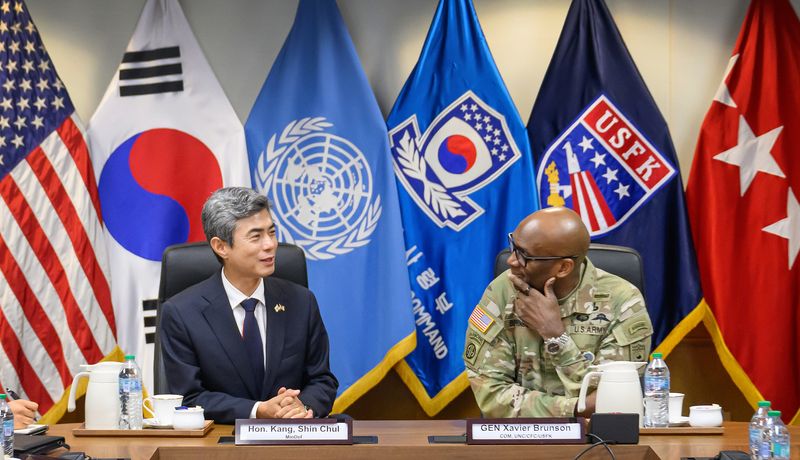
Minister Kang declared, “If trust in the ROK-U.S. alliance is assured, there would be no problem at all with transferring OPCON right now, or even tomorrow.” On changes to the command structure, he explained the military rationale, saying, “It would shift to a concept in which a South Korean commander who knows Korea well leads, with the strongest U.S. military supporting,” and, “A structure led by a South Korean military commander and backed by the U.S. military could be a stronger command structure than the one we have now.” He compared the OPCON verification process to the realms of “Science,” or scientific quantitative analysis, and “Art,” or strategic qualitative judgment, arguing that the conditions could be met if there were trust within the alliance (Art). However, he made clear that the basic framework of the “three conditions,” including the South Korean military’s ability to lead combined defense, would remain unchanged, regardless of whether the conditions for OPCON transfer themselves were revised.■ General Brunson’s pointed social media remarks: “It is my duty to defend the territories of both South Korea and the United States”The arguments put forward by the U.S. government and military leadership in Washington, D.C., are rooted firmly in “responsibility under the armistice system and agreed documents,” as reflected in General Brunson’s posts on his personal social media account. Shortly after speaking at a seminar hosted by the Center for Strategic and International Studies (CSIS), General Brunson used his official social media account to discuss the unique nature of the ROK-U.S. alliance and his duty as a commander to defend territory. “I spoke today at the summit. The ROK-U.S. alliance has lasted for over 70 years and is unlike any other alliance in the world. Defending the territory of both the Republic of Korea and the United States is my duty.” (I spoke at the summit today. The ROK-U.S. alliance has lasted for more than 70 years and is unlike any other alliance in the world. It is my duty to defend the territories of both the Republic of Korea and the United States.)
General Brunson then posted messages addressing the current security situation on the Korean Peninsula and the nature of the armistice system. “How can a peace regime be established in a place where peace does not exist? Armistice is not peace.” (“How can a peace regime be established in a place where peace does not exist? An armistice is not peace.”) “Although South Korea did not sign the armistice agreement, I have a responsibility to enforce the agreement to protect the South Korean people.” (“Although South Korea did not sign the armistice agreement, I have a responsibility to enforce it to protect the South Korean people.”) In particular, he pointed to the historical fact that the Republic of Korea did not directly sign the Korean Armistice Agreement and asserted the legitimacy of his own mission to manage the armistice on behalf of South Korea and the United States. “We have an agreed document. However, the Republic of Korea did not sign the armistice agreement. Nevertheless, I am tasked with executing that agreement to protect the Korean people.” (“We have an agreed document. But the Republic of Korea did not sign the armistice agreement. Nevertheless, I have been tasked with enforcing it to protect the Korean people.”) General Brunson also said of those seeking to exploit shifts in the situation on the Korean Peninsula, “There are forces everywhere trying to disparage and drive a wedge into the ROK-U.S. alliance.” (“There are forces everywhere seeking to disparage and divide the ROK-U.S. alliance.”) On the formal verification of OPCON transfer, the commander said, “I am in full support of OPCON transfer that is conditions-based. Full stop.” (“I fully support a conditions-based OPCON transfer. That is all.”) He nevertheless concluded, “But conditions have changed, and because we have changed our plans, there are new standards that must be met.” (“But the conditions have changed, and because we have changed our plans, there are new standards that must be met.”), again stressing the importance of quantitative verification.■ The framework for OPCON transfer: What the 2014 46th SCM’s COTP agreement entailsForeign affairs and security experts say General Brunson’s pointed social media remarks and principled rhetoric reflect a determination to uphold the spirit of the Conditions-Based Operational Control Transition Plan (COTP) document signed at the 46th Security Consultative Meeting (SCM) between South Korea and the United States in October 2014, during the Park Geun-hye administration. They noted that the COTP’s central purpose was to eliminate a political deadline for transferring OPCON “by a certain year.”
At the time, the defense ministers of the two countries formally agreed on “three conditions” to prevent the risks of a time-bound transfer: △ securing key military capabilities for the South Korean military; △ the alliance’s comprehensive ability to respond to North Korea’s nuclear and missile threats; and △ a security environment on the Korean Peninsula and in the region conducive to a stable transfer.
The U.S. military leadership is focused on the fact that the joint ROK-U.S. nuclear and non-nuclear operations plan (OPLAN) was comprehensively revised during the previous Yoon Suk Yeol administration, as North Korea’s nuclear and missile capabilities have advanced and the regional security environment has deteriorated. Since the operational plans have changed completely from a military standpoint, it is a simple military fact that the requirements for specific reconnaissance assets and the quantitative standards for response capabilities (Science) needed to meet the three conditions in the 2014 SCM agreement must also be reassessed in light of the changing battlefield environment. Minister Kang’s somewhat skeptical response to the proposal to change the method of OPCON transfer entirely from “conditions-based” to “date-specific”—saying that it would “require agreement between the governments of both countries”—is also understood to reflect his awareness of this firm U.S. position.■ Overseas military think tanks assess the weight of OPCON in a “First Island Chain” mega-theaterThe sharp gap in perspectives between South Korea and the United States must be viewed in the context of a major shift in the global security paradigm, extending beyond the Korean Peninsula as a localized area. The International Institute for Strategic Studies (IISS), a world-renowned British defense and security think tank, said in a recent report that the military geopolitics of the Asia-Pacific region is being rapidly reshaped, moving beyond bilateral alliances between individual countries toward a multilateral joint defense system known as a “kill web.”
According to IISS’s latest analysis, the core deterrence strategy envisioned by the U.S. military leadership is to bring the entire “First Island Chain”—stretching from the Kuril Islands through Japan, Taiwan and the Philippines—together as one vast “Mega Theater.” This is in line with NATO’s concept of collective defense under Article 5. IISS said that the trend of South Korea and the United States upgrading their operational plans in response to increasingly sophisticated North Korean nuclear threats and changes in the regional security environment is also directly linked to this kind of multilateral collective deterrence mechanism.■ Implications of the “Pershing Rule,” a bedrock principle of modern U.S. military cooperationMeanwhile, underlying the debate over the quantitative conditions for ROK-U.S. OPCON transfer and the handover of command authority is the “Pershing Rule,” a longstanding fundamental principle of the U.S. military. Established by U.S. General John Pershing during World War I, the principle centers on fully delegating authority over military operations and command to field commanders while not exposing to the outside world the limitations of friendly forces’ core surveillance capabilities and intelligence assets.
The U.S. military leadership’s rigidly “Science”-centered approach during the OPCON transfer verification process is entirely in keeping with the Pershing Rule. Until it has been scientifically demonstrated that operational plans and the precise detection capabilities of combined assets are fully in place, it is a field commander’s instinct and an ironclad principle not to transfer military sovereignty hastily under pressure from political schedules or deadlines. Ultimately, this makes clear that the OPCON issue should not be treated merely as a political debate over the timing of a command handover, but as a question of broader alliance realignment: how to maximize the value of combined forces’ key assets and real-time intelligence-sharing networks, based on the Pershing Rule, while optimizing collective deterrence across the entire Asia-Pacific region.
[email protected] Lee Jong-yun Reporter