[Exclusive] Barun-Dongin merger draws mixed views internally... “Whether it will go through remains undecided”
- Input
- 2026-10-18 14:42:57
- Updated
- 2026-10-18 14:42:57
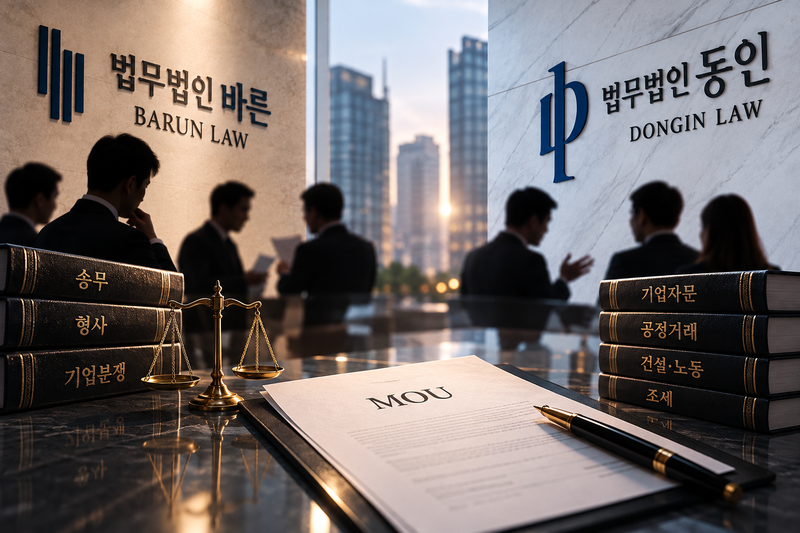
[Financial News] Barun and Dongin, two of Korea’s leading large law firms, have signed a memorandum of understanding (MOU) to pursue a merger, but views are divided internally over the need for a merger and its practical benefits. Since the two sides must negotiate the details over the next year and then go through internal approval procedures again, the assessment is that it is difficult to say whether the merger will go through.
According to legal industry sources on the 18th, Barun and Dongin recently formalized their plans to pursue a merger and began detailed discussions. The firms reported revenues last year of 107.6 billion won for Barun and 80.1 billion won for Dongin, for a combined total of 187.7 billion won. Barun has 303 lawyers and Dongin 250; if the merger goes through, they would form a mega-firm with 553 lawyers.
On the premise of a merger of equals, the two sides have set a goal of forming a merger task force to discuss governance, personnel, evaluation and compensation systems, organizational operations, branding and office space, and signing a definitive agreement within 12 months of the MOU taking effect.
Recently, however, some of Barun’s partner lawyers have raised objections over the need for a merger and the practical synergies it would bring. One Barun partner lawyer disclosed, “Several lawyers among the partners oppose the merger,” adding, “It’s true that internal discussions among the partners are needed.”
Both Barun and Dongin count civil and criminal litigation and corporate matters among their main strengths, meaning their areas of practice overlap substantially. Some are questioning whether the combination would make up for each firm’s shortcomings.
Barun, for its part, also sees the merger as being at the stage of starting detailed discussions, not as a done deal. A senior Barun official said, “At this point, nothing has been decided at all about whether the merger will happen or not,” adding, “We have only just begun discussions.”
The official continued, “If we proceed with the merger, we’ll need to discuss and settle a number of factors,” explaining, “We’ll spend about a year discussing each issue and working out what to do with each system, then bring everything together, report it to a partners’ meeting and obtain approval.”
On the internal disagreements, the official stressed that they were not at the stage of persuading partner lawyers who oppose the merger or resolving the conflict. “This isn’t about persuading the partners or quelling dissent right now,” the official said. “That doesn’t mean we’re ruling out pursuing the merger at this stage, either.” As for the eventual outcome, the official said, “We don’t know what will happen. There are various possibilities.”
By contrast, the mood inside Dongin was understood to be relatively favorable toward the merger.
Asked about the internal reaction to the merger, one Dongin partner lawyer said, “Some lawyers are opposed, but the general mood is in favor,” adding, “Since the MOU was signed, people have been assuming the leadership will handle things as it sees fit.”
The MOU signed by the two sides has indeed brought merger discussions into full swing, but many steps remain before a final deal can be reached. In particular, how far the two organizations—whose core practices overlap—can find common ground on key terms such as personnel and compensation systems and organizational operations is expected to be a major factor in the negotiations ahead.
[email protected] Yoo Seon-jun Reporter