Jeju alone sees home sale, jeonse and monthly rent prices all fall nationwide; 10-percentage-point gap with Seoul in apartment prices
- Input
- 2026-10-16 12:08:39
- Updated
- 2026-10-16 12:08:39
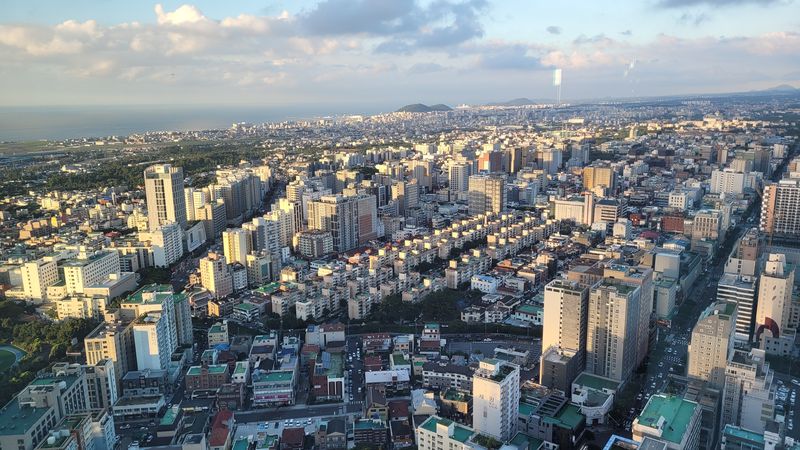
【Financial News, Jeju = Reporter Jeong Yong-bok】 While home sale, jeonse and monthly rent prices all rose nationwide, all three indicators fell in Jeju alone. As declines continued for six consecutive months, the gap between Seoul and Jeju in this year’s cumulative change in apartment sale prices widened to 10.18 percentage points.
On the 16th, an analysis of the “September 2026 National Housing Price Trend Survey,” released the previous day by the Korea Real Estate Board, found that overall home sale prices in Jeju fell 0.21% from the previous month. Jeonse prices fell 0.17%, and the composite monthly rent price fell 0.16%. Jeju was the only top-level region nationwide where sale, jeonse and monthly rent prices all declined.
Over the same period, home prices nationwide rose by 0.30% for sales, 0.34% for jeonse and 0.39% for monthly rents. In Seoul, they rose by 0.84%, 0.74% and 0.82%, respectively. Housing prices also rose outside the capital region, by 0.02% for sales, 0.09% for jeonse and 0.13% for monthly rents, in contrast to Jeju.
Sale prices fell in seven top-level regions nationwide, including Jeju. Jeju and North Gyeongsang were the only two regions where jeonse prices declined. Jeju was the only region where the composite monthly rent price fell. Jeju’s declines in home sales, jeonse and monthly rents were each the largest among the country’s top-level regions.
The downward trend was not temporary. In Jeju, home sale, jeonse and monthly rent prices all fell for six consecutive months, from April through September this year. Over the same period, all three price indices rose every month nationwide.
The decline in Jeju home sale prices widened from 0.15% in April, 0.17% each in May and June, and 0.18% in July to 0.21% in both August and September. Jeonse prices fell 0.14% in April, then declined by 0.16–0.17% each month from May through September. The composite monthly rent price likewise recorded monthly declines of 0.13–0.16% over the same period.
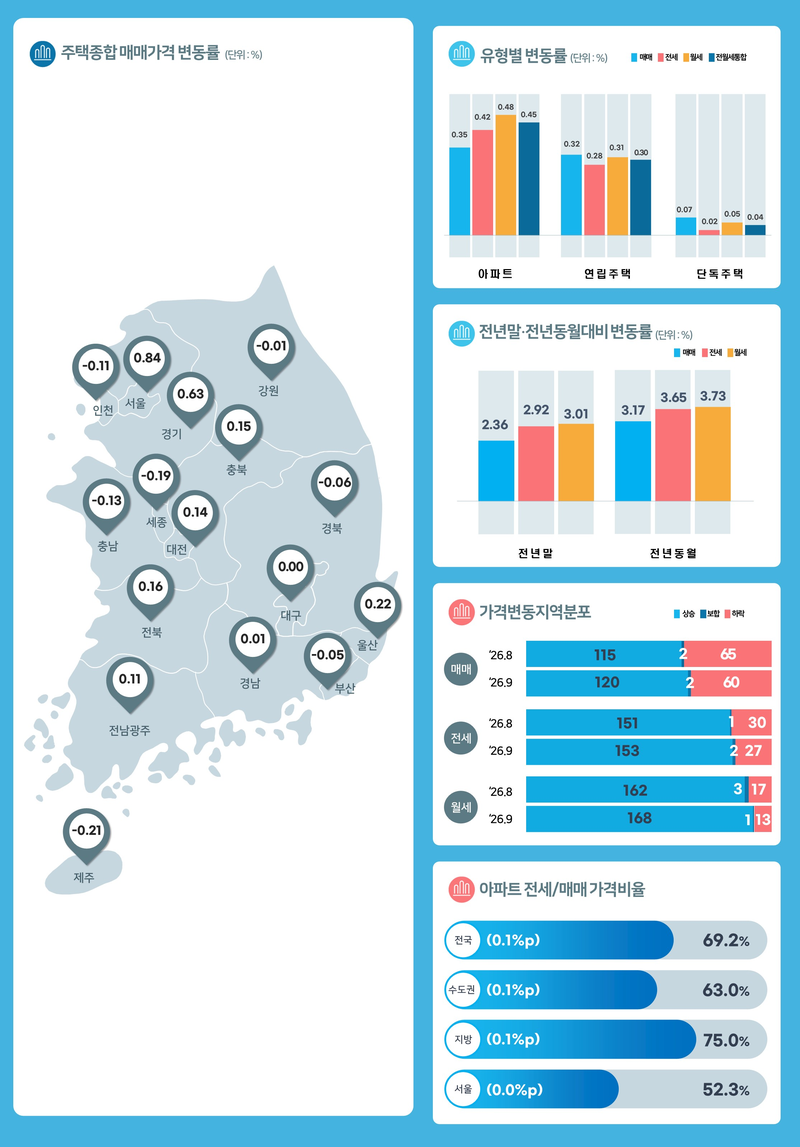
Regional differences were also evident in cumulative changes this year. Compared with December last year, overall home sale prices in Jeju were down 1.47% in September, while Seoul’s were up 7.58%. The cumulative change gap between the two regions was 9.05 percentage points.
The gap was even larger in the apartment market. Through September this year, apartment sale prices in Jeju fell 1.86%, while those in Seoul rose 8.32%. The cumulative change gap reached 10.18 percentage points. This figure compares the two regions’ rates of price increase and decline against the end of last year; it does not represent a difference in actual apartment price levels.
In September alone, apartment sale prices fell 0.29% in Jeju, while they rose 0.35% nationwide and 0.74% in Seoul. Jeju was weak across housing types: in addition to apartments, prices fell 0.27% for row houses and 0.09% for detached houses.
Regional differences also widened in the jeonse and monthly rental markets. Through September this year, jeonse prices in Jeju fell 1.35%, while those in Seoul rose 6.70%, creating a cumulative change gap of 8.05 percentage points. The composite monthly rent price fell 1.25% in Jeju and rose 6.52% in Seoul, a difference of 7.77 percentage points.
Within Jeju, home sale prices fell more sharply in Seogwipo City than in Jeju City. In September, home sale prices fell 0.28% in Seogwipo City and 0.19% in Jeju City. The Korea Real Estate Board said prices declined mainly for small homes in Daejeong-eup and Donghong-dong in Seogwipo City, and in Ildo 2-dong and Hoecheon-dong in Jeju City.
In the jeonse market, prices fell mainly for relatively recently built homes in Seogwipo City. The term refers to homes that were built not long ago. Jeju apartment jeonse prices fell 0.21% in September, bringing the cumulative decline for the year to 1.49%.
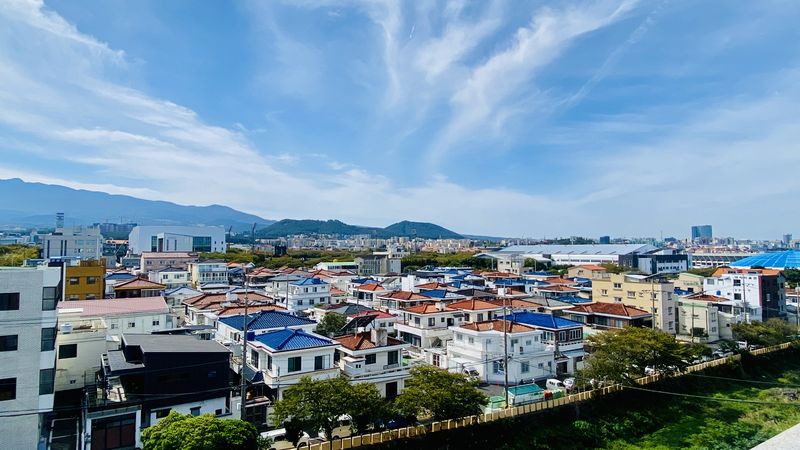
The monthly rental market also declined across all rental types. In September, monthly rent prices in Jeju fell 0.15%, quasi-monthly rent prices fell 0.19%, and semi-jeonse prices fell 0.32%. Quasi-monthly rent and semi-jeonse are rental arrangements in which the deposit makes up a larger share than in standard monthly rentals. The Korea Real Estate Board’s composite monthly rent price is an index that takes a transaction-volume-weighted average of price changes across these types.
Jeju’s housing market weakness was also evident in the year-over-year figures. Compared with September last year, housing prices in Jeju fell 1.84% for sales, 1.74% for jeonse and 1.67% for monthly rents. Over the same period, prices nationwide rose 3.17%, 3.65% and 3.73%, respectively.
The Korea Real Estate Board said buying and rental demand continued in popular areas of the national housing market, including large apartment complexes and neighborhoods near transit stations. In contrast, small homes and relatively recently built homes were among the main drivers of price declines in Jeju.
The Housing Price Trend Survey calculates price changes as an index by combining actual transaction prices of sampled homes with nearby transaction examples, asking prices, market price information and other data. This survey covered September 1–30, with October 1 as the reference date. The results should be interpreted separately from the actual transaction prices of individual homes and the housing-cost burden on individual households.
[email protected] Jeong Yong-bok Reporter