Seoul: “The housing market will not stabilize until 2038”
- Input
- 2026-10-16 13:32:54
- Updated
- 2026-10-16 13:32:54
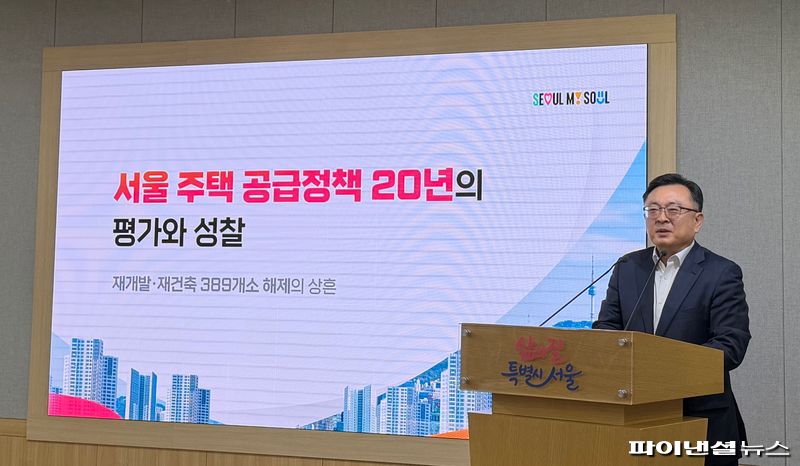
Myeong No-jun, head of Seoul’s Housing Office, said at a press conference for the release of the white paper “Assessment and Reflection on 20 Years of Seoul’s Housing Supply Policies,” held at Seoul City Hall on the 16th, “Based on an analysis of Seoul’s current population and number of households, as well as the net increase in housing units, it seems that housing prices will stabilize in 2038.” He explained, “The current housing supply ratio is about 93% of the number of households. If that figure exceeds 100%, it theoretically means there would be vacant homes even if every household moved into one.” This includes the 310,000 housing units Seoul plans to start building by 2031. Myeong added, “By around then, people should be able to tell when and which homes will come onto the market and decide they can save up and buy one.”
Regarding the government’s public housing complex project, he said it was “holding back private-sector projects.” Kim Seong-bo, Seoul’s second vice mayor for administrative affairs, said, “The government’s urban complex project is ultimately the same concept as a redevelopment project,” and criticized the government, saying, “It keeps touting the announcement of urban complex projects, but leaves all the relocation and resettlement measures to Seoul.” He added, “If you average out the 310,000 housing units Seoul plans over six years, that comes to about 50,000 a year,” and, “Seoul is supplying enough housing, but the government keeps talking only about urban complex development, which is a concern.”
The white paper Seoul released that day includes data analyzing how the massive resources invested in lifting redevelopment-zone designations and urban regeneration led to a smaller supply base and fewer housing starts. In particular, the city attributed the ongoing housing shortage to redevelopment zones that were lifted during former Mayor Park Won-soon’s tenure. It said that areas accounting for 57% of the total were excluded from redevelopment projects under Mayor Park, eliminating the opportunity to supply 430,000 housing units.
The white paper also notes cases in which residents’ wishes and procedural legitimacy were not adequately secured during the process of lifting redevelopment-zone designations. Of the 389 areas whose designations were lifted, 264 (68%) were Type B, where opinion surveys—including requests from residents—were conducted but procedures were inadequate; 66 (17%) were Type A, where designations were lifted unilaterally on grounds such as ordinance amendments without surveying residents; and 59 (15%) were Type C, lifted under the sunset clause.
In response to some claims that Seoul Mayor Oh Se-hoon lifted redevelopment-zone designations before Mayor Park did, the city said, “All the areas Mayor Oh lifted were areas earmarked for redevelopment; none were projects that had begun and then stalled.” Vice Mayor Kim said, “Most cases in which redevelopment designations were lifted under Mayor Park were abnormal,” adding, “I don’t think the lifting of New Town designations under the previous mayor respected residents’ wishes or was reasonable.”
[email protected] Kwon Jun-ho Reporter