President Lee's approval rating rises 2 percentage points to 39%; positive and negative evaluations both increase [Gallup Korea]
- Input
- 2026-10-16 10:46:12
- Updated
- 2026-10-16 10:46:12
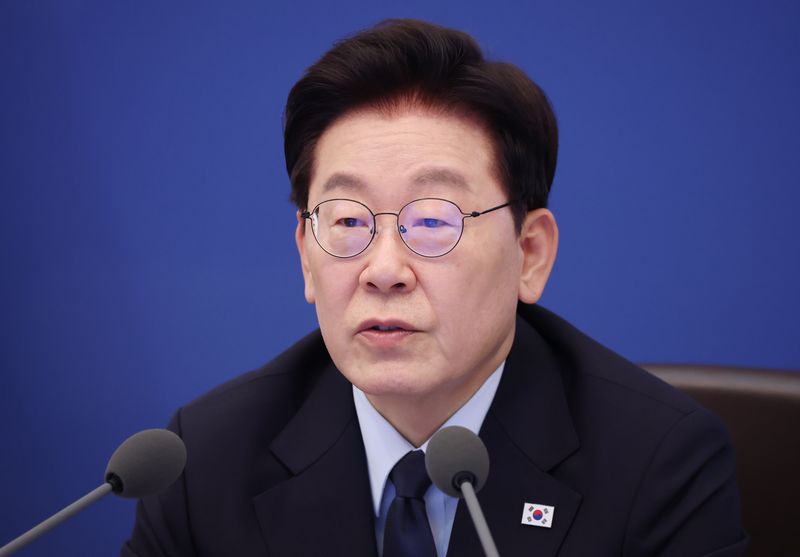
[Financial News] A poll released on the 16th found that President Lee Jae-myung’s job approval rating rose 2 percentage points from the previous week to 39%. Positive evaluations rebounded from their lowest level since he took office, while negative evaluations also rose by 1 percentage point to 52%.
According to a survey for the third week of October released that day by Gallup Korea, 1,003 people aged 18 or older nationwide were asked about Lee’s performance from the 13th to the 15th. Of them, 39% gave a positive evaluation and 52% a negative one. The remaining 9% were undecided.
Gallup Korea said, “The downward trend in evaluations of the president’s job performance that continued before Chuseok has come to a halt for now in October,” adding, “The negative rating remains above 50%, but the positive rating has avoided a post-inauguration low.”
Among centrists, 40% gave a positive evaluation and 51% a negative one. Among independents with no party affiliation, negative evaluations also outnumbered positive ones, at 57% to 24%. While 74% of Democratic Party supporters and 65% of progressives gave positive evaluations, 86% of People Power Party supporters and 77% of conservatives gave negative evaluations.
“Foreign policy” was the most commonly cited reason among those who gave positive evaluations, at 20%. It was followed by “the economy and people’s livelihoods” at 11%; “communication” and “doing well overall” at 7% each; and “policies for ordinary people and welfare” at 6%.
“Real estate policy” was the most frequently cited reason for negative evaluations, at 19%. It was followed by “the economy, people’s livelihoods, and the response to the stock market” at 12%, and “national defense, security, and North Korea” at 11%. “Foreign policy,” “ethical issues and avoiding his own trial,” “doing poorly overall,” and “personnel appointments” each accounted for 5%.
Gallup Korea said, “Real estate issues have continued to rank as the top reason for negative evaluations since the fourth week of July, while mentions related to national defense and prosecutorial reform have declined from last week.” On the increase in criticism related to the economy, it said, “This appears to be related to the KOSPI’s seven consecutive trading-day declines, which took it from the 7,000 level to the 5,500 level.”
The Democratic Party of Korea had 36% support and the People Power Party 27%, with both parties up 1 percentage point from the previous week. The gap between them was 9 percentage points. The Rebuilding Korea Party had 3%, the New Reform Party 2%, and the Progressive Party and other parties and organizations 1% each. Independents accounted for 29%.
In a survey asking what respondents hoped to see in the 2028 general election, 47% said, “Many opposition candidates should be elected to keep the current government in check,” higher than the 34% who said, “Many ruling-party candidates should be elected to support the current government.” Eighteen percent were undecided. The survey measured respondents’ expectations, not their predictions of the election result.
The survey was conducted independently by Gallup Korea using telephone interviews with interviewers. Randomly selected wireless phone numbers were drawn from virtual numbers provided by the three mobile carriers. The margin of sampling error was ±3.1 percentage points at the 95% confidence level, and the response rate was 10.4%. For more information, see the website of the National Election Survey Deliberation Commission.
[email protected] Seong Seok-woo Reporter