‘Travel back and forth without passports’: Japan also takes note of Choi Tae-won’s ‘Korea-Japan economic community’ proposal
- Input
- 2026-10-16 11:59:00
- Updated
- 2026-10-16 11:59:00
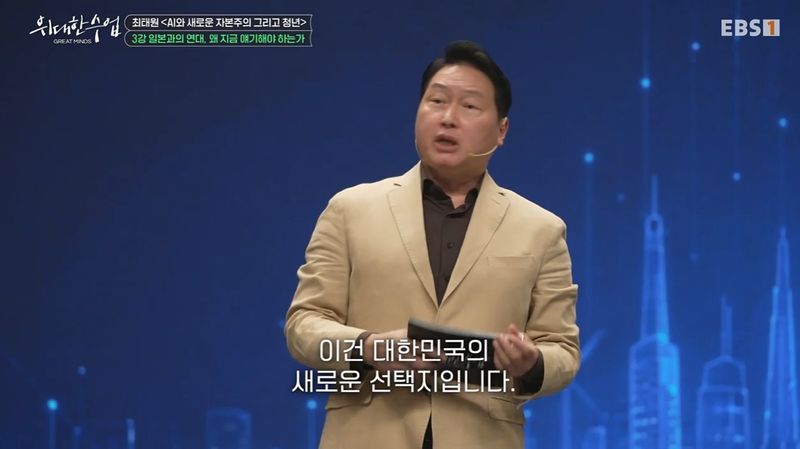
【Financial News, Tokyo = Correspondent Seo Hye-jin】 Interest is growing in Japan as well in the idea of a “Korea-Japan economic community,” in which the two countries would allow travel without passports and share energy and semiconductor supply chains. The proposal aims to combine the two countries’ markets and industrial competitiveness in the face of population decline, stagnant growth and U.S. trade pressure. However, given the high political and institutional barriers, some say cooperation should be built first in areas with clear benefits, such as joint energy procurement.
According to the Nikkei on the 16th, Japan’s business community is also responding positively to the Korea-Japan economic community proposal put forward by Choi Tae-won, chairman of SK Group and the Korea Chamber of Commerce and Industry. At the Korea-Japan Business Conference last May, Japanese participants also made a series of forward-looking remarks.
■A $6 trillion economic bloc: starting with energy and semiconductors
The proposal Choi presented in 2024 is modeled on the European Union (EU), where people, goods, capital and services move freely. The Nikkei reported that, if realized, it would create the world’s fourth-largest economic bloc, with a gross domestic product (GDP) of more than $6 trillion, after the United States, the EU and China. The aim is for the two countries to join forces and go beyond following international rules to help shape them.
Changes in the external environment are also increasing the need for cooperation. Both countries depend on their alliances with the United States for security, while facing trade pressure and security uncertainty under the Trump administration’s America First policy. They must also respond to pressure from China.
Energy is seen as a priority area for cooperation. The argument is that if the two countries, both heavily reliant on imports, jointly purchased and stockpiled crude oil and liquefied natural gas (LNG), they could reduce costs and respond to supply disruptions. According to the Nikkei, Japanese Prime Minister Sanae Takaichi and President Lee Jae-myung agreed at their summit last May to flesh out energy security cooperation, including stockpiling crude oil and petroleum products and sharing reserves with each other.
In semiconductors, one proposal is to combine South Korea’s manufacturing capabilities with Japan’s competitiveness in materials and equipment. A longer-term proposal is to do away with border checks, as under Europe’s Schengen Agreement, so people could travel between the two countries without passports.
Ryota Takeda, former minister for internal affairs and communications and chairman of the Japan-Korea Parliamentarians’ Union, stressed in an interview with the Nikkei that day that, while EU-style integration may be difficult, the two countries should actively cooperate in areas where both stand to benefit.
He drew particular attention to South Korean companies’ ability to expand overseas. Japan can grow its industries to some extent through domestic demand alone, while South Korea has competed globally despite its small home market, he said. “Japan should leverage Korea’s ability to expand overseas, while Korea should leverage Japan’s reliability and stability, to increase added value,” he said.
■Differing views on the benefits of integration: “Start with cooperation that is possible”
Many hurdles remain before the community proposal can be adopted as an official agenda item by the two countries’ leaders. A Japanese government official said, “We also need to be mindful of public sentiment,” adding, “The benefits for Japan are not readily apparent.”
Views also differ on the effects of market integration. South Korea would gain access to an integrated market with a population more than three times its own, while Japan’s market would expand by about 1.5 times. In a survey released by the Korea Chamber of Commerce and Industry last July, support for the community proposal stood at around 70% in South Korea and around 60% in Japan. Historical issues remain a factor as well.
Against this backdrop, gradual cooperation, such as South Korea joining the Comprehensive and Progressive Agreement for Trans-Pacific Partnership (CPTPP), is seen as a realistic alternative. Since the two countries have no separate bilateral free trade agreement (FTA) or economic partnership agreement (EPA), South Korea’s participation in the CPTPP alone could significantly advance market opening.
Kazunobu Hayakawa, a senior research fellow at the Institute of Developing Economies of the Japan External Trade Organization (JETRO), pointed to the political and institutional burdens of an EU-style community and called for a phased approach. He also recommended designing an open framework that includes Australia and the Association of Southeast Asian Nations (ASEAN), among others.
Former minister Takeda said, “I will create an environment where cooperation between private companies is not hindered, even if political relations deteriorate,” adding, “It is important to lay the groundwork for winning together in international competition without being excessively swayed by politics.”
[email protected] Seo Hye-jin Reporter