Civic groups, including KTU’s Busan chapter, condemn government’s bid to cut education funding
- Input
- 2026-10-16 10:33:58
- Updated
- 2026-10-16 10:33:58
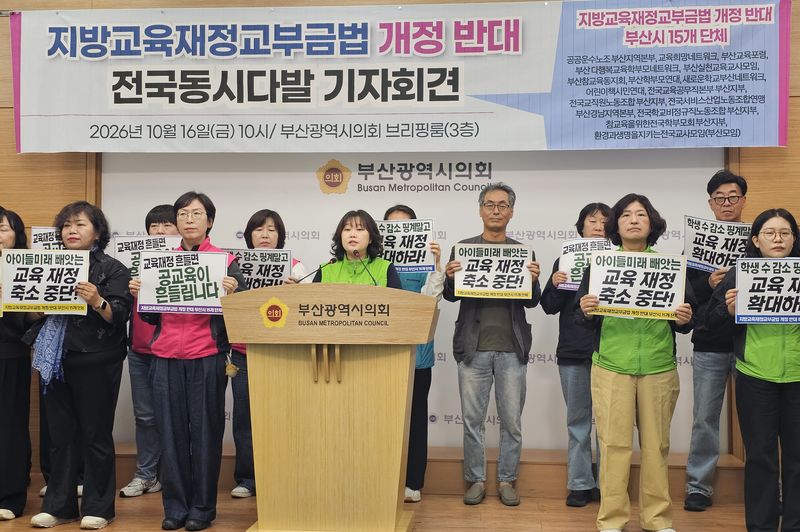
[Financial News] Civil society groups in Busan’s education sector have condemned the government’s attempt to overhaul local education finance grants. They say that cutting local education funding to reduce government spending is not fiscal reform but a dangerous experiment that undermines the stability of local education.
Representatives of 15 organizations, including the Busan chapter of the Korean Teachers and Education Workers Union (KTU) and the Busan chapter of the National Association of Parents for True Education, held a press conference in the briefing room of the Busan Metropolitan Council on the morning of the 16th and raised these concerns.
The government recently submitted its National Fiscal Management Plan to the National Assembly. The plan calls for spending restructuring totaling about 107.6 trillion won, while the government is also attempting to reform local education finance grants worth about 32.5 trillion won.
Teacher and parent groups in Busan said, “This reduces the funding allocated to local education finance compared with what it would be if the current system linking grants to domestic tax revenue were maintained, and counts the difference as a result of the government’s spending restructuring.” They added emphatically, “The government must give a clear answer. Is this reform intended to increase investment in future education, or to cut local education funding to reduce government spending?”
They went on to say, “The government should release objective data comparing the size of grants under the current system linked to domestic tax revenue with the size under the new formula.” They also pointed out, “The public should be told what period was used to calculate the 32.5 trillion won fiscal impact, how much grants are expected to decline each year, and what the basis is for factoring in a 35% decline in the school-age population.”
They also argued that the plan’s inclusion of “abolition of the system linking grants to domestic tax revenue” would undermine the stability of education finance.
They stressed, “Provincial and metropolitan offices of education across the country have no independent taxing authority. The system linking grants to domestic tax revenue is therefore not merely a method of allocating funds, but a minimum safety net that guarantees local educational self-governance and the autonomy of education.” They added, “When fiscal stability collapses, the continuity of education policy is bound to collapse along with it. Education finance must be assessed based on the state’s public responsibilities, such as ensuring the quality and conditions of education, welfare, and the elimination of educational disparities.”
[email protected] Byeon Ok-hwan Reporter