Brokerage analysts: “Markets will recover in November ... now is the time to buy the dip”
- Input
- 2026-10-16 10:28:43
- Updated
- 2026-10-16 10:28:43
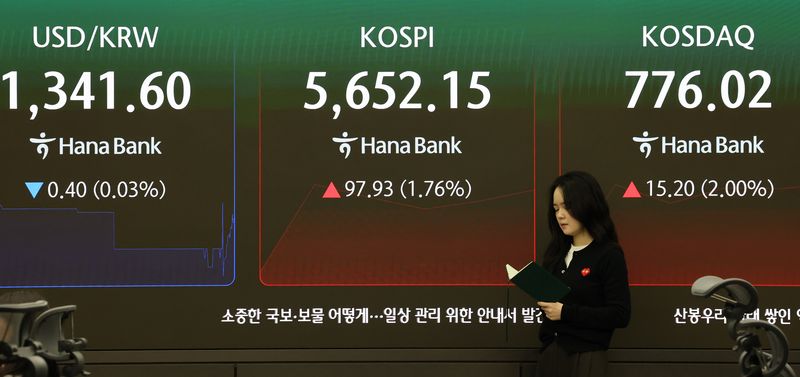
[Financial News] South Korea’s stock market is rebounding after plunging the previous day. The KOSPI Composite Index has risen more than 3% intraday, while the KOSDAQ is up in the 4% range. Samsung Electronics and SK Hynix have also risen in tandem. With losses mounting over a short period amid concerns about the artificial intelligence (AI) industry and fears of U.S. interest rate hikes, market attention is focused on whether today’s rebound can lead into a recovery trend in November.
As of 10:20 a.m. on the 16th, the KOSPI Composite Index was up 176.31 points (3.17%) from the previous trading day at 5,730.53. It rebounded after plunging 7.57% the day before. The KOSDAQ Index was also trading up 32.67 points (4.29%) at 793.49. Samsung Electronics was up 2.62% at 215,500 won, while SK Hynix was up 3.17% at 1,302,000 won.
One factor that has recently weighed on the stock market is doubt about whether growth in the AI industry can be sustained. Controversy over AI companies’ revenue and profitability, delays to listing schedules and the burden of raising funds for infrastructure investment have all combined to dampen investor sentiment. The semiconductor industry has also been unable to escape concerns about intensifying competition as Chinese companies catch up technologically.
The fact that market expectations for the AI industry are changing is also a concern. The market is moving beyond a phase in which company valuations were based solely on growth expectations, and demand is growing to see whether massive investments translate into actual revenue and profits. Security incidents resulting from the misuse of AI and the possibility of regulation are also cited as factors that could affect the pace of investment going forward.
The sharp drop has also made prices look more attractive. The KOSPI Composite Index fell about 21% over the preceding seven trading days. There have been only 11 instances of seven consecutive down days since 2010, and losses in those cases were generally around 5%, making the speed and scale of the current correction both unusual. After those past instances, stock prices rebounded on average over the following month or so.
Valuations have also fallen. After the sharp drop, the KOSPI Composite Index’s 12-month forward price-to-earnings ratio (PER) declined to 4.2 times, while its price-to-book ratio (PBR) fell to around 1.08 times. The key question is how much share prices have already priced in concerns about a future slowdown, as exports remain strong and growth forecasts continue to be revised upward.
Byun Jun-ho, a researcher at IBK Investment & Securities, explained, “The key events that will determine the direction of the stock market in November are the U.S. Federal Open Market Committee (FOMC) meeting at the end of this month and the U.S. midterm elections early next month. U.S. inflation in September came in above expectations, heightening concerns about interest rate hikes. But if the market correction has already priced in a substantial part of that burden, the events passing could provide an opportunity to ease uncertainty.”
The market’s performance around the U.S. midterm elections is also worth watching. In all six Novembers since 2000 in which midterm elections were held, the KOSPI Composite Index rose. Investors who had stayed on the sidelines amid policy uncertainty ahead of the elections may return to the market after seeing the results.
Researcher Byun said, “Foreign investors net sold about 18 trillion won in the first half of October alone, adding to downward pressure on the index. Even if prices become more attractive, continued selling could limit the scale of a rebound.” He nevertheless forecast, “The current sharp short-term downturn in the stock market, with the KOSPI Composite Index in the mid-5,000s amid combined concerns about AI and inflation, should be used as an opportunity to buy at lower prices ahead of a November rebound.”
[email protected] Choi Doo-sun Reporter