“Was 7,000 the peak?” Retail investors’ cries of anguish continue despite KOSPI rebound
- Input
- 2026-10-16 11:12:56
- Updated
- 2026-10-16 11:12:56
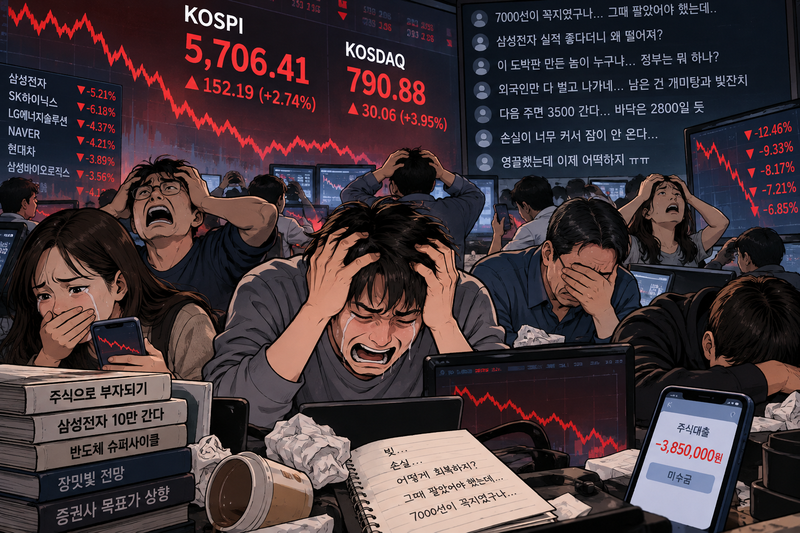
[Financial News] “So 7,000 was the peak. I should have sold then...” The KOSPI is attempting a rebound on the 16th after falling sharply for several consecutive sessions, but retail investors remain gloomy. The market had been on the verge of breaking above 7,000 on the 2nd, but collapsed within just seven trading days. As estimates have emerged that assets worth as much as 1.2 quadrillion won in market capitalization have evaporated from South Korea’s stock market, investors’ regret and anxiety are growing.
At around 10:06 a.m. on the 16th, the KOSPI was at 5,706.41, up 2.74% from the previous trading day. The KOSDAQ was also up 3.95% at 790.88, with both markets rebounding.
However, it is difficult to say that investor sentiment, damaged by the sharp sell-off, has recovered in a single day. Even if a technical rebound follows the steep decline, market anxiety could persist if foreign selling and external uncertainties remain unresolved.
During the rally, retail investors pinned their hopes on Samsung Electronics Co., Ltd.’s strong operating profits, expectations for an improvement in the semiconductor industry, and positive analyses from securities firms.
Many believed that share prices would hold up because earnings were strong, but the situation changed as the market abruptly reversed course. Investors continue to lament, “How on earth are we supposed to recover our losses?”
“I should have sold then”...Retail investors who believed the rosy outlook
What stands out in investors’ reactions is their regret at not selling at the peak. When the KOSPI was nearing 7,000 on the 2nd, expectations for further gains were high, but after the market abruptly reversed, investors began ruefully saying that that had effectively been the peak.Investors who held onto shares in the belief that earnings at major semiconductor companies, including Samsung Electronics Co., Ltd., would be strong are particularly bewildered. They say it is difficult to understand why share prices plunged even as corporate earnings improved and securities firms remained positive.
Investors who bought at lower prices each time shares fell or delayed selling because they expected the rally to continue are finding it difficult to decide how to respond as their losses grow. Fearing further declines, they are considering stop-loss sales but also struggling to lock in their losses, deepening their uncertainty.
Criticism of the government and policymakers also intensified during the steep sell-off. Comments calling for measures to stabilize the market appeared on a stock-investing forum, including, “Who turned this into a gambling den?”, “Is having no plan the plan?” and “Where has the National Pension Service gone?”
There were also complaints about retail investors having to absorb the large volume of shares sold by foreign investors. Alongside rueful remarks that individuals are left bearing the losses after foreign capital flows out, calls continued for measures to curb the market’s sharp volatility.
However, reactions on online forums do not represent the views of all retail investors. Even so, the simultaneous rise in distrust of policymakers and calls for market stabilization during the sell-off offers a glimpse of worsening investor sentiment.
Fear persists despite rebound...Investors can breathe easy only when foreign selling stops
Fears of further declines also remain. After the KOSPI fell to the 5,500 level, some stock discussion forums even saw extreme predictions such as, “It’ll hit 3,500 next week” and “The bottom is 2,800.” These claims are not evidence of where the market is actually headed, but they show how difficult investors find it to gauge where the decline will end.Although the KOSPI and KOSDAQ are rebounding today, it is too early to say that the market’s overall direction has changed. The sustainability of the rebound can be assessed only after it becomes clear whether foreign selling is easing, major semiconductor stocks such as Samsung Electronics Co., Ltd. and SK hynix are stopping their decline, and the won-dollar exchange rate and U.S. technology stocks are stabilizing.
Foreign investors are in fact continuing to be net sellers of South Korean stocks even during the rebound. Intraday trading data by investor type as of this morning show that foreign investors net sold 278.6 billion won on the KOSPI and offloaded another 112.7 billion won on the KOSDAQ. Their combined net sales on the two markets totaled about 391.3 billion won.
By contrast, retail investors were net buyers of 35.8 billion won on the KOSPI and 54.7 billion won on the KOSDAQ, while institutions also bought a net 76.7 billion won and 48.9 billion won, respectively. The indexes are rebounding, but analysts say it is too early to be optimistic about a change in the market’s trend, given that foreign capital is still flowing out.
[email protected] Kang Jung-mo Reporter