"Want to Attract Investment but Don't Know How"... Only 2.9% of Women-Owned Businesses Receive External Investment
- Input
- 2026-10-16 10:44:04
- Updated
- 2026-10-16 10:44:04
[Financial News] Women-owned businesses in South Korea are finding it difficult to attract external investment despite their ambitions to grow. Their funding is concentrated in their own capital and loans, and they also lack information about investment and networks of investors. This points to a need for a staged support system that goes beyond simple funding and covers everything from investment readiness to investor connections and follow-on investment to support the growth of women-owned businesses.
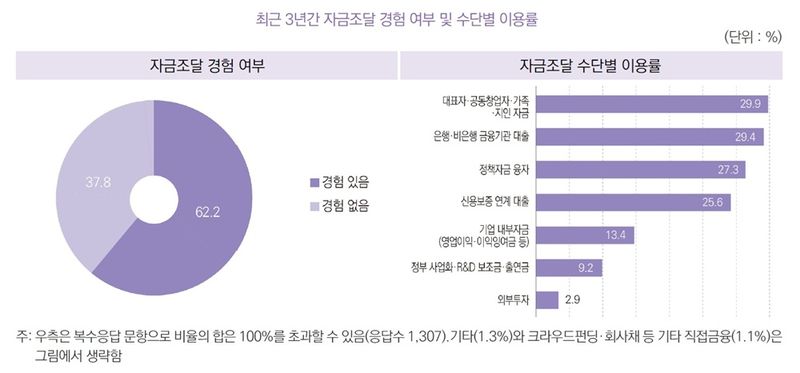
According to a report titled 'The Status of Financial Support for Women's Businesses and Policy Tasks: Focusing on Investment-Linked Support,' released on the 16th by the Women's Economic Research Institute, which is affiliated with the Women's Enterprise Support Center, 62.2% of women-owned businesses had experience raising funds over the past three years. By contrast, only 2.9% had used external investment.
The main funding sources were funds from business owners and related parties (29.9%), followed by bank and non-bank loans (29.4%). Businesses clearly tended to rely on their own funds or loans from financial institutions rather than raising money through investment.
The biggest difficulty in attracting external investment was a lack of understanding of investment methods and legal and contractual matters (40.1%). This was followed by a lack of investor networks (38.0%), preparing materials related to investor relations (IR), financial plans and company valuations (34.1%), and demonstrating revenue, market potential and growth prospects (30.7%).
The survey found a considerable gap between women-owned businesses' ambitions to grow and their actual level of investment readiness. Their growth orientation scored 4.3 out of 5, while their self-assessed investment readiness stood at just 3.4.
Responses about investment activity and plans showed that the largest share, 44.5%, were interested but had no concrete plans. Some 16.2% of businesses were pursuing or preparing for investment, while 23.1% planned to try to attract investment within the next two years. In other words, interest in investment is not translating sufficiently into actual preparation and action.
Businesses' demand for support also focused on the investment process as a whole. In a survey of women-owned businesses that had participated in startup and business support programs over the past three years, the most common response was a need for investor matching and connections to early-stage investment (61.9%). Connections to follow-on investment (61.6%) and coaching to prepare for investment (55.5%) also accounted for substantial shares.
Accordingly, there are calls for financial support policies for women-owned businesses to move away from their traditional focus on supplying funds and instead be tailored to businesses' growth stages and levels of investment readiness.
Other countries are pursuing policies that tailor financial support to businesses' growth stages. Canada provides small loans and consulting to early-stage companies, and connects growth-stage companies with venture capital, export financing and other resources. The United Kingdom supports the expansion of the investment base for women-owned businesses through capital-contribution programs for women fund managers and new and small funds.
The Women's Economic Research Institute stressed, "Financial support for women-owned businesses must now move beyond asking 'How much should we provide?' and take a more sophisticated approach by asking 'Which financial instruments should be connected to a business's circumstances?'" It added, "We should assess each business's investment readiness, help early-stage companies with IR, financial matters and understanding contracts, and establish a staged support system that connects businesses with the necessary capabilities to investors and follow-on investment."
The survey covered 1,328 companies, including women-owned businesses that had received certification and companies that had participated in the Women's Startup Competition over the past three years.
[email protected] Jumi Lee Reporter