Seongsu ranked first in growth in foreign visitors to Seoul last year, emerging as a key hub for 'G3 Seoul'
- Input
- 2026-10-16 11:17:11
- Updated
- 2026-10-16 11:17:11
[Financial News] Seoul Metropolitan Government’s plan to invest 86.1 trillion won to make the city one of the world’s top three cities has drawn attention to the Seongsu-dong development project. With foreign visitor numbers rising in Seongsu and a high-rise mixed-use development planned for the former Sampyo Remicon site, attention is focused on whether the area will emerge as a new global landmark for Seoul.
According to Seoul Metropolitan Government on the 16th, the city said it plans to invest a total of 86.1 trillion won by 2030 under the 'G3 Seoul Plan' announced on September 10. Of that amount, 9.4642 trillion won has been allocated to spatial innovation, including the reorganization of urban spaces.
London, Tokyo and New York, which the city cited as models in the G3 Seoul Plan, have concentrated business, residential and cultural functions through large-scale mixed-use urban development. This underscores the importance of creating spaces that can attract businesses and visitors, alongside building an industrial base, to boost competitiveness as global cities.
In Seoul, Seongsu-dong is growing into an area where corporate activity is increasingly concentrated, beyond tourism and shopping. Foreign visits to its established commercial district are rising as major companies move their headquarters there and new office facilities are developed.
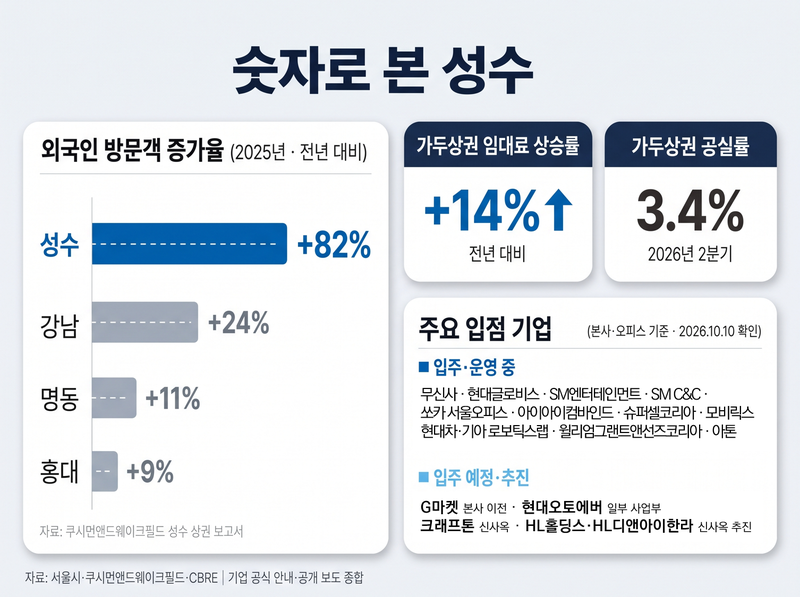
According to Cushman & Wakefield Korea, Seongsu-dong had the highest growth in foreign visitors among Seoul’s major commercial districts last year, at 82%. That was well above Gangnam (24%), Myeong-dong (11%) and Hongdae (9%). Data from the Korea Tourism Organization’s Data Lab also showed that the number of foreign tourists in Seongsu 2-ga 3-dong rose more than 100-fold, from about 22,000 in 2021 to 2,228,000 last year.
Growth is also evident in the commercial property rental market. According to CBRE Korea’s report on Seoul commercial real estate for the second quarter of this year, rents in Seongsu’s street-front retail district rose 14% from the same period a year earlier. The increase was higher than in Gangnam (9%) and Myeong-dong (7%) over the same period. Seongsu’s retail vacancy rate fell to 3.4%.
Companies are continuing to relocate to Seongsu. Musinsa moved its headquarters there in 2022, and Krafton is building a new headquarters with a gross floor area of about 218,000 square meters on the former site of the Seongsu branch of E-Mart. The relocation of Gmarket’s headquarters and some divisions of Hyundai AutoEver has also been confirmed. This is why Seongsu is being viewed as the fourth business district (SBD), following the central business district (CBD), Gangnam Business District (GBD) and Yeouido Business District (YBD).
Expanding office and accommodation facilities is seen as a challenge if this growth is to continue over the long term. Commercial and tourism activity can be linked to business demand only if large office spaces for companies and hotels where foreign visitors can stay are secured. According to Cushman & Wakefield Korea, new hotel supply in Seoul remains at around 1,000 rooms a year. Difficulties securing sites and rising construction costs are cited as constraints on supply.
One project set to expand Seongsu-dong’s office and accommodation functions is the 'Sampyo Global Landmark (SGL)', planned for the former Sampyo Remicon site. The project will redevelop a roughly 28,000-square-meter site that was used as a ready-mixed concrete plant for more than 40 years before the facility was demolished in 2022.
In July, the city’s Architectural Committee approved the mixed-use development project at 683 Seongsu-dong 1-ga. Plans call for a residential tower of up to 81 stories and a 53-story office complex, with 403 apartment units, 61 officetel units, 130 hotel rooms, and office, commercial and cultural facilities. Construction is targeted to begin in 2027, with completion planned for 2032.
Improvements to nearby traffic and pedestrian conditions are also planned alongside the development. As part of a public contribution valued at about 608.1 billion won, the project will include ramps connecting the Dongbu Arterial Road to Yongbi Bridge and a direct-connection ramp at the north end of Seongsu Bridge, among other facilities, as well as the Seoul Unicorn Startup Hub. The startup hub is planned to have a gross floor area of about 53,000 square meters.
An industry official said, “Seongsu is an area where foreign visitor numbers are rising at the same time as businesses are moving in,” adding, “We expect it to grow into one of Korea’s leading mixed-use hubs, where tourism and business come together, if office and accommodation facilities and public spaces are expanded along with the completion of SGL.”
[email protected] Choi A-young Reporter