Jeju People in Japan Continue Supporting Their Hometown University Into Its 56th Year; 6,594 Books and 33.1 Million Yen Donated
- Input
- 2026-10-16 09:38:50
- Updated
- 2026-10-16 09:38:50
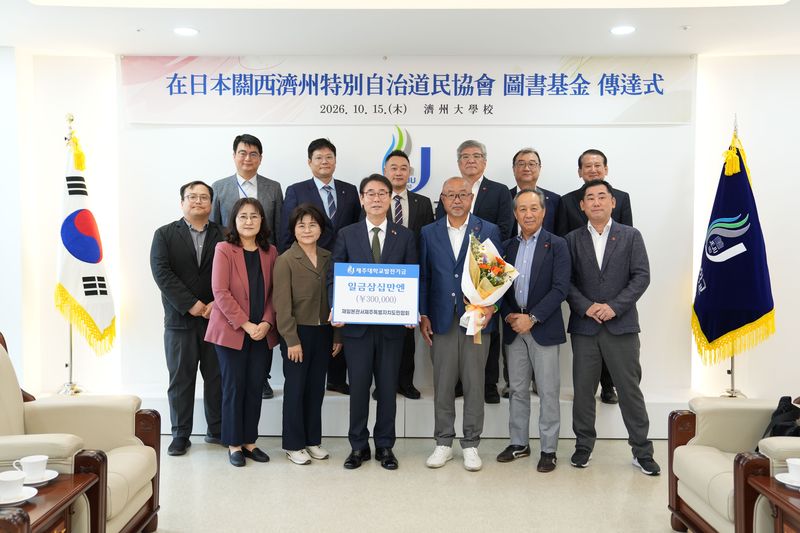
【Financial News, Jeju — Jeong Yong-bok】 Book support for Jeju National University from Jeju people in Japan began in 1971 and has continued into its 56th year. This year, the Kansai Jeju Residents Association, which took over the project from the youth association, donated 300,000 yen to the book fund.
According to Jeju National University on the 16th, a book fund presentation ceremony for the Kansai Jeju Special Self-Governing Province Residents Association in Japan was held on campus the previous day. Attendees included association chair Lee Min-nam and other executives, as well as Jeju National University President Yang Deok-sun and other university officials.
The donation is significant because the association’s main body has directly taken over a program to nurture future generations that Jeju people in Japan have sustained for more than half a century.
Since 1971, the Kansai Jeju Residents Association has donated books and funds to Jeju National University, primarily through its affiliated youth association. The initiative supports improvements to the hometown university’s education and research environment and the development of talent, even as members live in Japan.
The support totals are substantial. Jeju National University’s figures show that from 1971 through last year, a total of 6,594 books were donated and contributions amounted to 33.1 million yen (about 281 million won). The 300,000 yen (about 2.55 million won) donated this year is separate from those cumulative figures.
Initially, given the university’s difficulty obtaining the academic books it needed in Korea, books were purchased directly in Japan and delivered. The support later shifted to a book fund to help the university purchase the materials it needs.
Last year, too, the youth association visited Jeju National University and donated 200,000 yen to the book fund. At the time, members looked around the “Books Donated by the Kansai Youth Association” shelves in the university’s central library and saw the legacy of support continued by earlier generations of Korean residents in Japan.
The body responsible for running the program changed this year. As the existing youth association was incorporated into the main association, the Kansai Jeju Residents Association in Japan took direct charge of the book fund program. This structure continues the youth association’s support for the hometown university as an association-wide initiative.
The support provided by the Jeju community in Japan for more than half a century through books and education funds is an example of people-to-people exchange linking Jeju communities overseas with their hometown university. The continuation of the sponsorship program and transfer of responsibility for its operation despite generational change are particularly noteworthy.
Lee Min-nam, president of the Kansai Jeju Residents Association in Japan, said, “It is meaningful that our association is directly carrying on the tradition of love for the hometown and nurturing future generations, seeded by earlier generations of Korean residents in Japan.” He added, “I hope the donation will help Jeju National University students grow.”
Jeju National University President Yang Deok-sun said, “I am grateful to the Korean residents in Japan who have supported the university with unwavering affection for more than 50 years.” He added, “We will put the funds we received to good use for the development of Jeju National University and the nurturing of future talent.”
[email protected] Jeong Yong-bok Reporter