U.S. Navy: “Large unmanned surface vessel deployed for the first time with carrier strike group heading to the Middle East” ... Pressure on Iran intensifies
- Input
- 2026-10-16 10:10:28
- Updated
- 2026-10-16 10:10:28
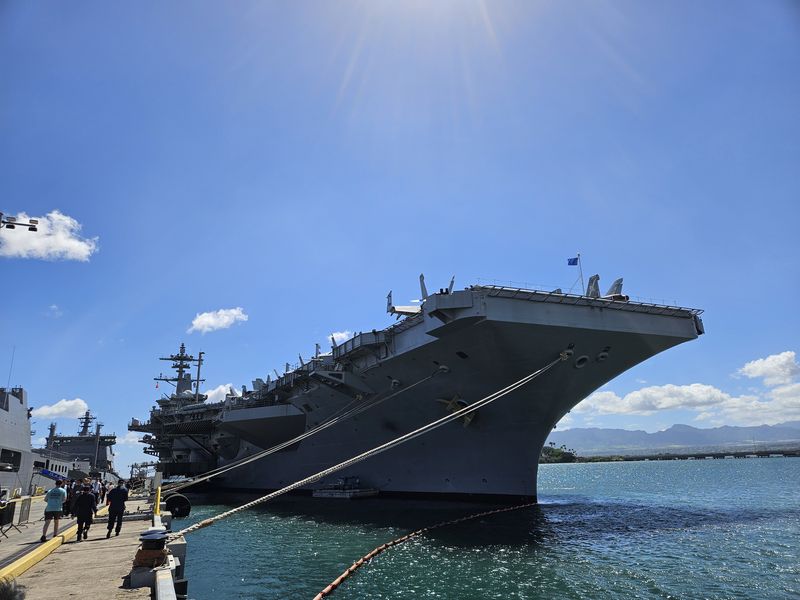
[Financial News] A large unmanned surface vessel has been deployed with a U.S. carrier strike group heading to the Middle East.
According to military news outlets Inside Defense and The Straits Times, among others, Acting Secretary of the Navy Hung Cao recently attended an Association of the U.S. Army event and, referring to the deployment aboard the aircraft carrier Theodore Roosevelt, said, “It is the first carrier to deploy a large unmanned surface vessel, boosting its capabilities.” That is tantamount to deploying “more guns.”
Cao emphasized that unmanned surface vessels would change the nature of naval warfare because they are easy to build and do not require complex systems to maintain a crew.
The Roosevelt left San Diego, California, in late September and is heading to the Middle East, where it is expected to arrive at the end of this month.
The unmanned surface vessel deployed aboard the Roosevelt is the Seahawk, made by U.S. defense contractor Leidos. It is a medium-sized unmanned surface vessel that minimizes human intervention and can automatically navigate around restricted areas.
It is reportedly able to maintain control even if its primary communications network is cut off. It can carry 14,000 gallons of fuel and has a full-load displacement of 147 tonnes.
The U.S. military had mainly used drones for intelligence gathering in the Middle East, but expanded their use during the war with Iran to include attacks on ports.
Austin Gray, founder of Blue Water Autonomy, a startup that builds unmanned surface vessels for the U.S. military, told Business Insider, a U.S. outlet, “Small maritime drones are less maneuverable than medium- or large-sized ones and cannot carry the required payload, so they are not suited to the operations of a heavily armed carrier strike group.”
He added, “Large unmanned surface vessels can support and protect a carrier strike group because they can carry missiles and drones, as well as sensors and electronic jamming equipment.”
Once the Roosevelt arrives, there will be three U.S. aircraft carriers in the Middle East, including the two already there.
The aircraft carrier USS George Washington (CVN-73), deployed to the Middle East in August, is likely to return to the Pacific after being relieved by the Roosevelt.
The possibility cannot be ruled out that U.S. President Donald Trump will build up forces, sharply increase military pressure on Iran, and launch an attack. This is also why attention is focused on the deployment of a large unmanned surface vessel aboard the Roosevelt.
Trump’s position is that he will not attack Iran before the November 3 midterm elections, as he is concerned about driving up oil prices. However, there are also concerns that he could launch an attack on Iran depending on changes in the situation and political needs around the midterms.
The U.S. military originally used unmanned surface vessels only for intelligence gathering, but during the war against Iran it began actively deploying them in operations such as rescuing people and attacking ports.
[email protected] Lee Seok-woo, International Affairs Correspondent Reporter