Jeju ranks fourth for childbirth conditions, but 17th for the proportion of young workers in regular employment and 12th for childcare
- Input
- 2026-10-16 09:32:46
- Updated
- 2026-10-16 09:32:46
【Financial News, Jeju = Reporter Jeong Yong-bok】 Jeju ranked fourth nationwide on the childbirth environment index, but had the lowest proportion of young workers in regular employment among the country’s 17 cities and provinces. Although the island has many childcare facilities, after-school care for elementary school children lags behind, making stable jobs and ongoing support for raising children key challenges.
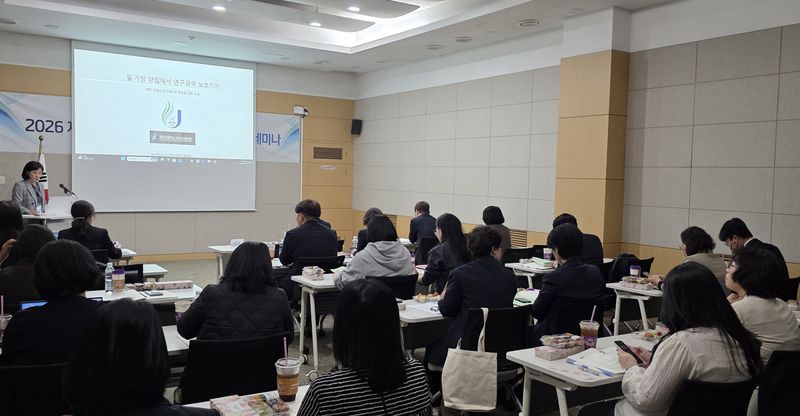
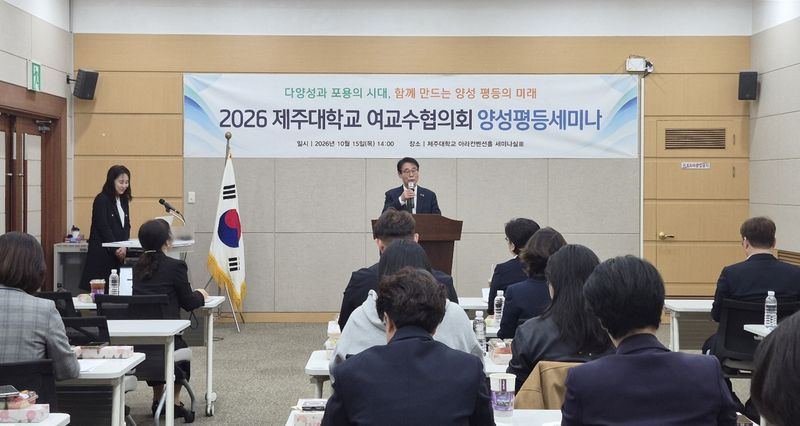
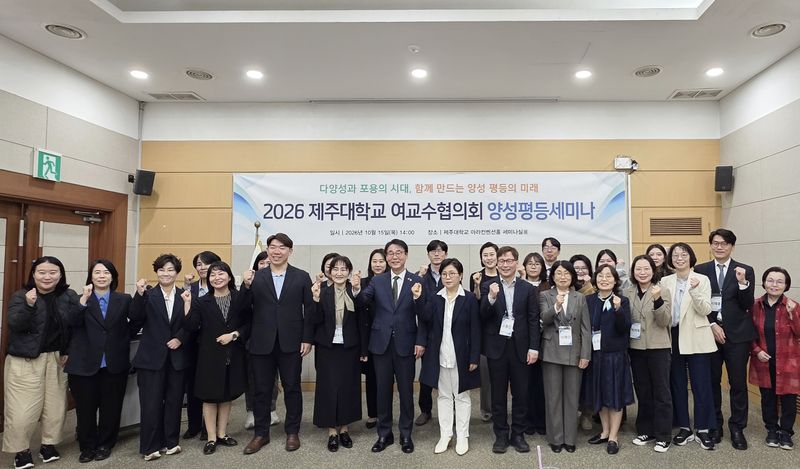
According to Jeju National University on the 16th, the 2026 Gender Equality Seminar was held the previous day at Ara Convention Hall under the theme “The Future of Gender Equality, Shaped Together in an Era of Diversity and Inclusion.” It was jointly hosted by the Jeju National University Women Professors’ Council (chaired by Kim Su-yeon), Jeju Province, the Jeju National University Faculty Council and the university’s Institute for Law and Policy.
Organized as a special project of the Jeju Province Gender Equality Council, the seminar discussed ways to improve policies, focusing on regional disparities in childbirth and child-rearing conditions, protecting the careers of university researchers, and work-family balance initiatives at public enterprises.
The gap between childbirth infrastructure and the actual conditions for raising children drew the most attention. Kang Gwon-o, a research fellow at the Jeju Women and Family Research Institute, said, “An analysis of the childbirth environment index across the country’s 17 cities and provinces found that Jeju ranked fourth.”
According to the “Study on Developing a Childbirth Environment Index for Jeju” published by the Jeju Women and Family Research Institute last year, Jeju scored 53.649 out of 100, above the national average of 44.021. It ranked fourth, behind Gangwon with 60.600, Sejong with 55.825 and North Jeolla with 54.647.
The childbirth environment index is a composite measure of 31 indicators across four areas: economy, employment and housing; family and daily life; health and safety; and society and institutions.
The detailed indicators revealed a clear imbalance. Jeju ranked first nationwide for the provision of childcare facilities and cultural infrastructure, but 17th for the proportion of young workers in regular employment. It ranked 16th for income and 14th for the homeownership rate, pointing to weak job and housing security.
In particular, Jeju ranked 12th for the provision of after-school care facilities. The assessment found that even when childcare facilities for infants and young children are relatively sufficient, there are limits to ensuring continuity of care after children start elementary school.
Jeju also ranked fifth nationwide for the provision of postpartum care centers, but 14th for their fees. This has prompted calls for policies to distinguish between access to facilities and the actual financial burden of using them.
Research Fellow Kang Gwon-o proposed five policy directions: improving the quality of jobs for young people and housing stability; ensuring continuity of care beyond elementary school; reducing the initial costs of childbirth; creating safer environments for children in their communities; and improving attitudes toward marriage and childbirth.
The seminar also addressed parental leave and career breaks among university researchers. Kim Sang-mi, a professor in Jeju National University’s Department of Silver Care and Welfare, emphasized that “work-family balance policies should be designed not simply as welfare support, but from the perspective of protecting research careers.”
She proposed reasonably accounting for periods when childbirth and child-rearing interrupt research activities in performance evaluations, and temporarily adjusting teaching and administrative workloads during the initial period after researchers return.
In particular, she proposed a “Return-to-Research” program that provides both funding for returning to research and research assistants. It would combine financial and staffing support to help researchers resume their previous research activities after childbirth and child-rearing.
Other key tasks identified included expanding male faculty members’ involvement in childcare and establishing a data-based monitoring system to assess the effectiveness of career-protection policies for researchers.
Examples of how public enterprises operate such programs were also presented. Kim Jin-ho, a deputy general manager at Jeju Free International City Development Center (JDC), shared his experience of taking three years of parental leave while caring for three children and his mother.
Kim emphasized that “men’s involvement in caregiving is directly linked to women’s ability to continue their careers.” JDC’s expanded leave for spouses following childbirth, workplace childcare center, work-from-home arrangements during the child-rearing years and school-vacation childcare-sharing program were also presented as examples of work-family balance initiatives.
The panel discussion focused on preventing disadvantages for those who use these programs and ensuring that policies are effective. Jeju National University Professor Lee Ye-an moderated the discussion, joined by Jeju National University Professors Song Jeong-guk and Park Ryeo-ok, Ewha Womans University Professor Lee Jae-hong, Song Seo-sun, a doctoral researcher at Jeju National University’s Institute for Law and Policy, and Bae Hwa-jeong, a team leader at the Jeju Provincial Government.
Professor Song Jeong-guk proposed using the childbirth environment index to set policy priorities and assess their effects. Professor Lee Jae-hong emphasized legal protection for care-related rights, including a ban on employment-related disadvantages resulting from parental leave.
Dr. Song Seo-sun proposed making the childbirth impact assessment ordinance effective and establishing a legal basis for a Jeju-style integrated care platform. Professor Park Ryeo-ok noted that the eligibility, duration and performance evaluation methods of career-protection programs should be clearly defined to ensure fairness among members.
Kim Su-yeon, chair of the Jeju National University Women Professors’ Council, emphasized, “It is not enough for gender equality programs simply to exist. They become a part of everyday life only when a culture is created in which everyone can use them without disadvantage.”
[email protected] Jeong Yong-bok Reporter