“What were you doing while investors piled into Samsung and SK hynix?” CNBC anchor furious over KOSPI plunge
- Input
- 2026-10-16 09:45:55
- Updated
- 2026-10-16 09:45:55
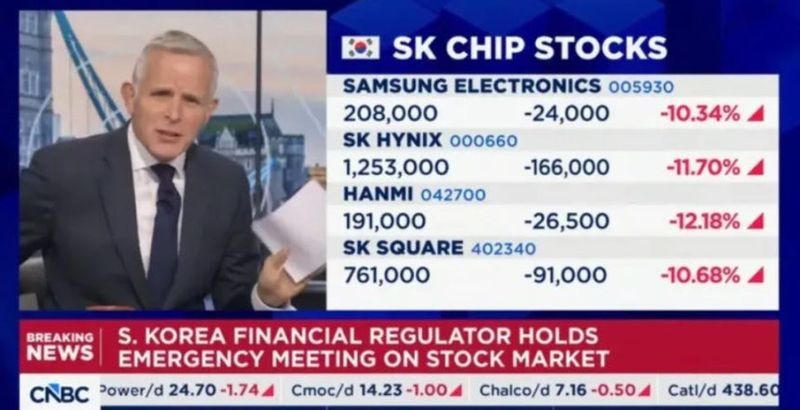
[Financial News] After the KOSPI plunged, a prominent anchor on the U.S. business network CNBC strongly criticized South Korea’s financial authorities, saying they had been slow to respond. The criticism was that authorities had done nothing while retail investors’ debt-funded investments surged and money poured into Samsung Electronics and SK hynix.
On the 15th (local time), CNBC International anchor Steve Sedgwick reported on an emergency market review meeting held by South Korea’s financial authorities during a broadcast covering a selloff in global AI-related stocks and the KOSPI’s sharp decline. The program was discussing the possibility that the KOSPI would suffer its biggest drop since April.
Sedgwick has about 11 years of experience working as a trader in financial markets. He currently reports on major stock markets around the world and macroeconomic news for CNBC International.
South Korea’s stock market has fallen sharply in recent days. From the 6th to the 15th, the KOSPI dropped 21%, while the share prices of its two largest companies by market capitalization, Samsung Electronics and SK hynix, plunged 24% and 31%, respectively.
Stock market volatility also rose sharply. The KOSPI 200 Volatility Index, known as Korea’s “fear gauge,” recorded its third-largest increase ever. The index closed at its highest level in about a month and a half.
In response to the sharp fall in share prices, the Financial Services Commission (FSC) held an “Emergency Meeting to Review Stock Market Conditions,” chaired by FSC Chairman Lee Eok-won. Officials from related agencies, including the Financial Supervisory Service and the Korea Exchange, as well as representatives of securities firms, attended the meeting.
At the meeting, Lee called for an active response to stabilize financial markets and protect investors. He said, “Please remain vigilant even amid small fluctuations and actively respond to ensure financial market stability and protect investors.”
Warnings about borrowing money to invest in stocks continued. Lee said that “investments relying on excessive debt and credit are risky,” and asked financial firms to “refrain from indiscriminate lending and focus on customer protection and risk management.”
Sedgwick, however, criticized the financial authorities for responding too late. As he reported on the emergency review meeting, he said, “Isn’t this a case of locking the stable door after the horse has bolted?”
Sedgwick took issue with retail investors’ growing use of leverage and the concentration of investment in large-cap semiconductor stocks. His point was that the financial authorities should have acted before the situation reached this point.
He raised his voice, asking, “Where were they, what were they doing when Korean retail investors were increasing their leverage to unprecedented levels, or when investors were piling into Samsung Electronics and SK hynix? Don’t those two stocks account for half of the KOSPI?”
The broadcast also discussed the risks of so-called “Samsung-SK hynix” leveraged products that bet on rising share prices of Samsung Electronics and SK hynix. Critics said the amount of leverage available to some investors was excessive.
Meanwhile, some South Korean retail investors have said they were taken aback by the larger-than-expected drop in share prices. The market had been becoming less volatile after regulations on single-stock leveraged exchange-traded funds (ETFs), before it suddenly plunged.
Forced selling by investors who had borrowed money to buy stocks also surged. Forced selling occurs when a securities firm compulsorily sells an investor’s holdings because the investor cannot repay borrowed money or fails to meet collateral requirements.
On the 14th, forced selling exceeded 89.3 billion won, the highest amount in about two months. The amount is estimated to have risen further on the 15th, when the KOSPI plunged again.
[email protected] Han Seung-gon Reporter