Beyond VMware Replacement, All the Way to AI: Scalability Is the Key Criterion for Enterprise Infrastructure
- Input
- 2026-10-16 09:58:34
- Updated
- 2026-10-16 09:58:34
Rising costs are the main reason organizations are looking to transition their virtualization infrastructure. In choosing a solution as part of a cost-cutting transition, they are carefully considering whether resources can be scaled up flexibly.
On the 16th, OCHestro said a survey it conducted last September of 13,541 IT workers at businesses and public institutions found that 70% of respondents cited “infrastructure scalability” as the most important criterion for choosing a solution. Another 20% selected “implementation and operating costs.”
OCHestro said its analysis found that while “performance and stability” (37%) was the top consideration in its survey last April, interest has recently grown in expanding workloads after an infrastructure transition and operating them flexibly.
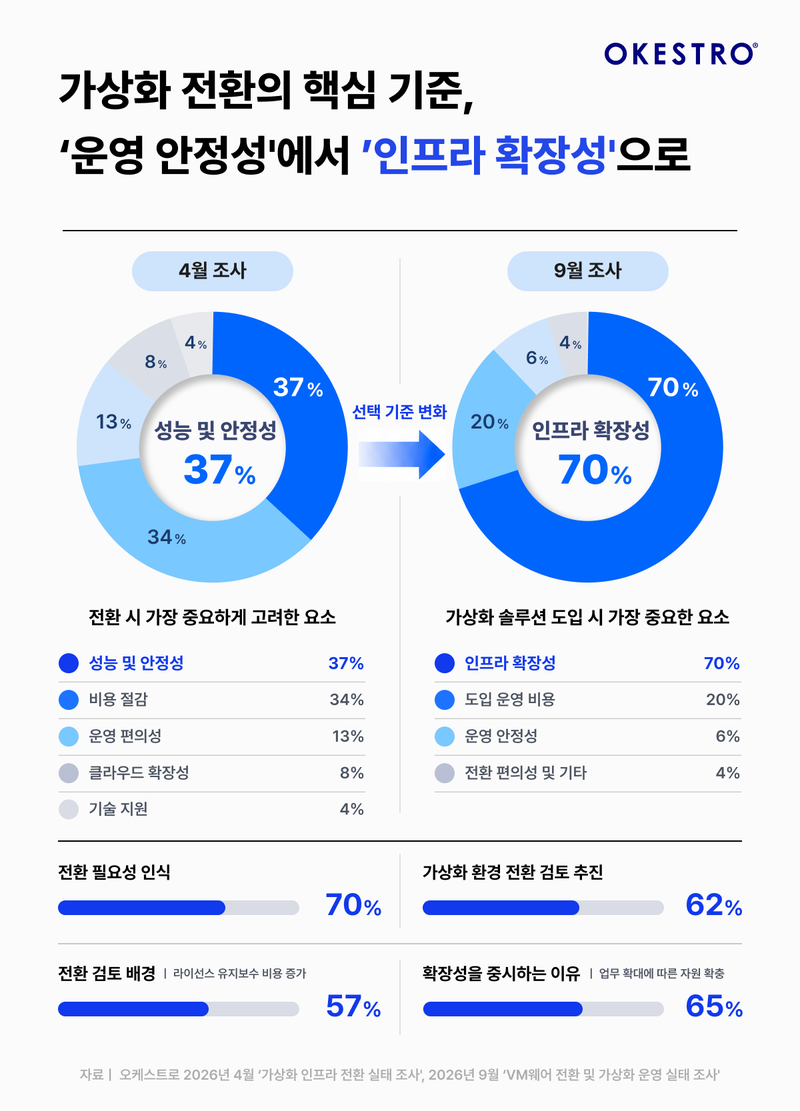
Sixty-two percent of all respondents said they were considering a transition in their virtualization environments, or were planning or already undertaking one. The main reason for considering a transition was “rising licensing and maintenance costs” (57%).
The most frequently cited reason for prioritizing scalability was “expanding computing resources as operations grow” (65%). This was followed by “ensuring flexibility in medium- to long-term infrastructure operations” (46%) and “expanding into AI and cloud environments” (41%). Organizations are looking not only to reduce immediate cost pressures but also to secure the resources they will need in the future.
Among technical requirements, “running existing operations and new workloads side by side” (68%) and “compatibility with existing server and storage environments” (61%) received high response rates. The results reflect demand for introducing new services while continuing to use existing equipment and work environments.
The areas cited for future infrastructure upgrades included “integrated operations across multi-cloud and hybrid cloud environments” (42%), “AI infrastructure and GPU operating environments” (35%), and “Kubernetes-based cloud-native environments” (31%).
OCHestro is addressing this demand primarily with its server virtualization solution, “CONTRABASS.” The company said the solution uses existing servers and storage to expand computing resources without service interruptions, and supports existing operations alongside new AI workloads through automated resource management and GPU management features. It also provides unified monitoring and failure root-cause analysis.
The Kubernetes-based platforms “VIOLA” and “OCHestro CMP” support, respectively, the operation of new container-based services and the integrated management of multiple cloud environments. The AI inference operations platform “Concerto AI” uses distributed resources to optimize inference and allocates GPU and NPU resources to reduce response latency and improve infrastructure utilization.
OCHestro CEO Kim Beom-jae said, “Enterprise IT infrastructure is no longer merely a foundation for maintaining current operations; it is evolving into a core competitive advantage that supports business growth and new technological innovation. We will broaden the range of technological choices available so that customers can flexibly extend their virtualized environments into cloud and AI without becoming dependent on a particular vendor or technology.”
[email protected] Yoon Hong-jip Reporter