Hyundai E&C brings PC construction to apartment cores, moving closer to 'ALL-PC' builds
- Input
- 2026-10-16 09:00:27
- Updated
- 2026-10-16 09:00:27
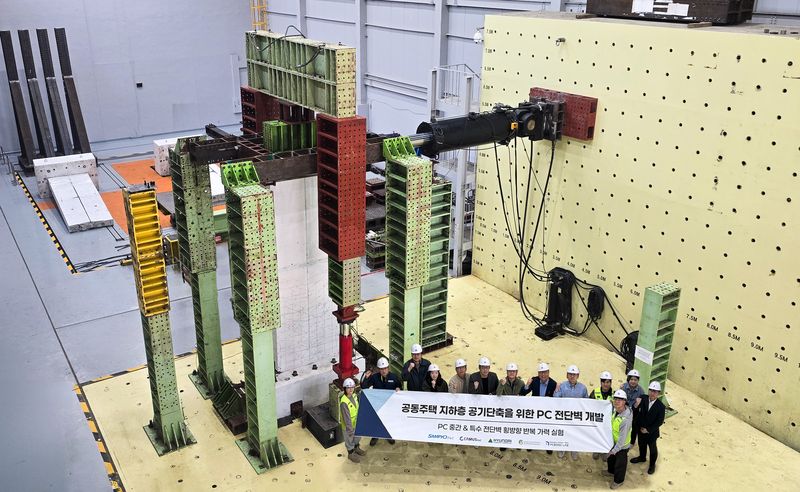
[Financial News] A path has opened for apartment elevator and stairwell cores, long left to on-site pouring, to be built with concrete walls precast at a factory. H-PCW, a PC structural wall system developed by Hyundai Engineering & Construction (Hyundai E&C), has received official recognition for its seismic performance. Combined with the PC Rahmen structure certified last year, it brings construction of 'ALL-PC' multi-family housing one step closer.
According to Hyundai E&C on the 16th, the company received standards-compliance certification from the Architectural Certification Center of the Architectural Institute of Korea for its 'PC Structural Wall System (H-PCW) with Seismic Performance Secured Through H-Link Connections.' The technology was developed in partnership with Sampyo P&C and CAMUS E&C, and Hyundai E&C has also filed a patent application.
At the heart of the technology is the 'H-Link.' It is a hook-shaped reinforcing bar formed into a U-shaped loop; when used to join PC wall panels vertically, it makes the joining work considerably easier. Hyundai E&C said the method also improves structural performance.
The certification is drawing attention because of the system's scope of application. Since the cores of high-rise apartment buildings are directly tied to structural safety, the conventional RC (reinforced concrete) method—tying reinforcing bars together, pouring concrete into formwork and letting it harden—has effectively been the standard approach. H-PCW has been confirmed to provide seismic performance and safety while using PC (precast concrete) walls in these areas.
Last year, Hyundai E&C secured technical certification from the Korean Association of Structural Engineers for its 'Residential PC Rahmen Structure System.' Using joint technology that connects beams and columns, the system creates flexible floor plans without columns inside individual units. At a plaque-unveiling ceremony held last March at its technical research center in Mabuk-dong, Yongin-si, Gyeonggi Province, Hyundai E&C said it had developed the technology with CAMUS E&C. The company also said that floor vibrations are dispersed through beams and columns, which is expected to reduce inter-floor noise. Since 2023, it has also been researching a floor structure rated Grade 1 for inter-floor noise that combines wall-type construction with a PC Rahmen structure. With Rahmen structures used inside the units and H-PCW in the cores, the pieces are falling into place to build all the main structures of multi-family housing with PC.
HMG Construction Technology Research Institute, the integrated R&D organization of Hyundai E&C and Hyundai Engineering Co., Ltd., is expanding its practical research into future housing technologies beyond structural and construction innovation. It is studying designs that separate the structural frame from interior spaces, allowing spaces to be flexibly reconfigured as lifestyles change. Energy Care technologies, which conserve energy while improving indoor comfort, and All-Life Care Houses, designed to support residents' health and quality of life, are also in development. The institute plans to focus on advancing Hyper-Living technologies that bring these areas together.
A Hyundai E&C official said, "It is true that, despite OSC's many advantages, including improved quality and productivity and reduced safety accidents and environmental impact, some concerns about structural safety have persisted in the multi-family housing market. Since H-PCW technology has secured the structural performance required by national design standards, we expect it to mark a new turning point in expanding the use of PC methods and revitalizing the OSC market."
[email protected] Jeong Gyeong-su Reporter