South Korea ranks second worldwide in patent growth for all-solid-state batteries and reusable launch vehicles
- Input
- 2026-10-18 12:00:00
- Updated
- 2026-10-18 12:00:00
The Ministry of Intellectual Property said on the 18th that it had published the October issue of “Global Technology Trends and Patents in National Strategic Technologies.” The report analyzes policy, technology and patent trends in major countries (South Korea, the United States, China, Japan and Europe) related to national strategic technologies, including next-generation batteries and aerospace.
All-solid-state batteries: overseas patents account for 63.8%
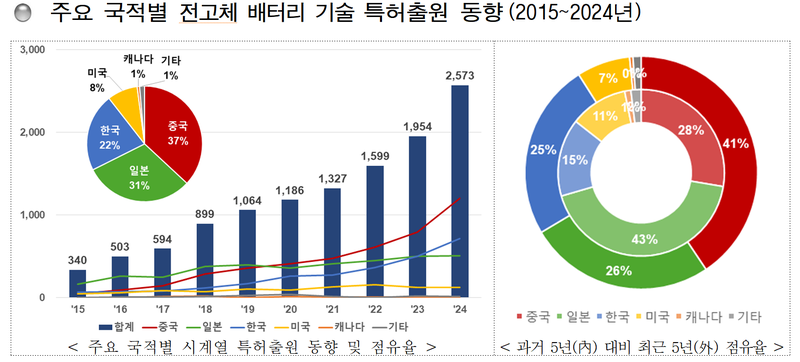
All-solid-state batteries are next-generation batteries that replace flammable liquid electrolytes with solid ones, reducing the risk of fires and explosions and increasing energy density. The analysis found that patent applications for all-solid-state batteries in major countries grew 7.6-fold over the past 10 years (2015–2024), from a total of 340 to 2,573.
South Korea filed a cumulative 2,631 applications over the 10-year period, ranking third worldwide behind China (4,447) and Japan (3,691). Its average annual growth rate was 29.5%, the world’s second-highest after China’s 42.4%, and well ahead of Japan (13.2%) and the United States (11.1%).
South Korea’s share of overseas patents was 63.8%, indicating that it is actively securing rights in global markets, alongside the United States (75.3%) and Japan (65.6%). China, by contrast, had the highest number of applications but an overseas patent share of just 5.7%, reflecting a patent-filing strategy focused on its domestic market.
Japan’s Toyota ranked first among global corporate and institutional applicants, with 1,996 applications. Four Korean companies made the top 10: Samsung SDI (second, 712), LG Energy Solution (third, 525), Samsung Electronics (fifth, 327) and Hyundai Motor (sixth, 284).
However, industry analysis indicates that despite the significant advantages of all-solid-state batteries in safety and energy density, considerable challenges remain before they can be commercialized. Key tasks include reducing interfacial resistance between the solid electrolyte and electrodes, and achieving adequate yields and cost competitiveness in mass-production processes. For this reason, the industry believes that the qualitative competitiveness of core technologies, including materials and processes, will be just as important as patent counts in determining when commercialization takes place.
Reusable launch vehicle applications: KARI ranks second
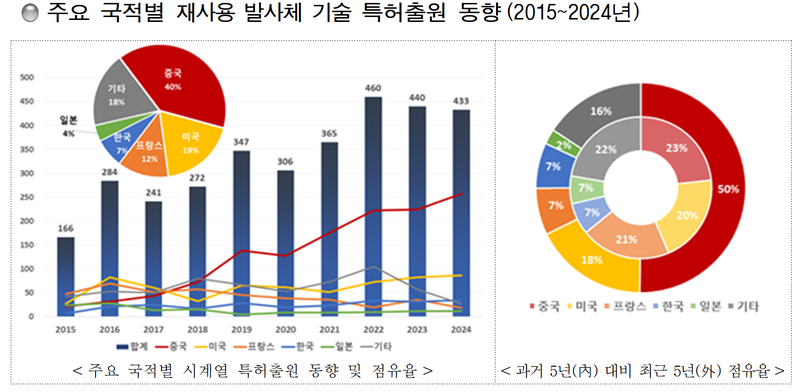
South Korea has also posted notable growth in reusable launch vehicles, a key technology for ushering in the era of commercial spaceflight by lowering satellite launch costs. Global patent applications in the field rose 2.6-fold over the past 10 years. South Korea ranked fourth worldwide, with a cumulative 235 applications, behind China, the United States and France. Its average annual growth rate was 21.3%, the world’s second-highest after China’s 32.1%.
By company and institution, France’s ArianeGroup ranked first with 448 applications, while the Korea Aerospace Research Institute (KARI) ranked second worldwide with 121. Korean private companies, including Innospace (30), Perigee Aerospace (14) and Hanwha Aerospace (11), are also actively filing patents and expanding the space transportation technology ecosystem.
Kim Il-gyu, director of the Intellectual Property Policy Bureau at the Ministry of Intellectual Property, said, “The patent competitiveness of core technologies is directly linked to future leadership in national industries.” He added, “We will provide timely analytical information to the R&D community so that South Korea can sustain its patent growth and secure a firm advantage in future markets.”
Meanwhile, some say the government’s approach to policy support must also evolve to strengthen a private-sector-led innovation ecosystem around these core technologies. They argue that patent-transfer procedures should be streamlined to facilitate the transfer and sharing of foundational patents held by public research institutions with private companies, and that mutually beneficial cooperation models between large companies and small and medium-sized enterprises should be promoted.
[email protected] Kim Won-jun Reporter