“SK hynix at 2.91 million won—will the rescue team come?” ... AI’s ‘super boomerang’ leaves practically every large-cap stock cut in half
- Input
- 2026-10-16 08:45:46
- Updated
- 2026-10-16 08:45:46
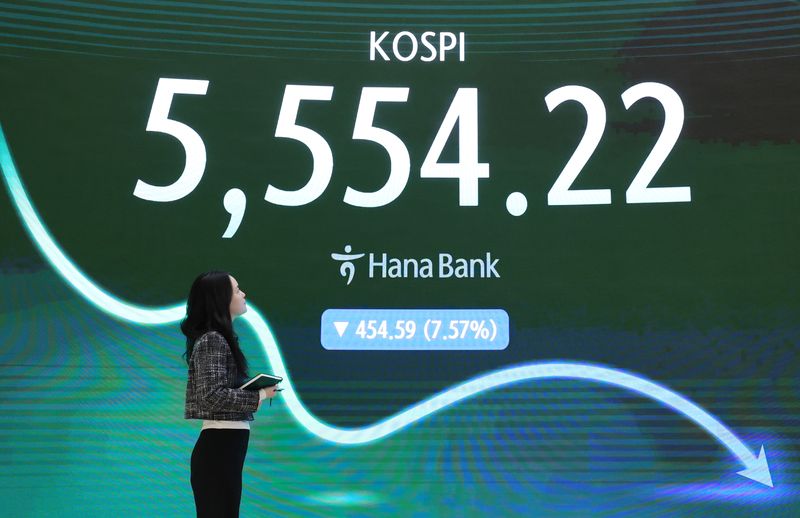
[Financial News] As the KOSPI traces a steep downward curve, the share prices of market-leading large caps, including SK hynix, Samsung Electronics, Samsung C&T and Hyundai Motor, have fallen to around half their late-June peaks.
KOSPI plunges 39% from its peak ... falls below July low
According to the Korea Exchange on the 16th, the KOSPI closed at 5,554.22 on the 15th, plunging 7.57%. This was its lowest level in about six months, since April 7 (5,494.78), and below the July low—the July 30 closing price of 5,593.56—which had unsettled retail investors as a market rout followed the bull run.
Compared with the KOSPI’s June peak (closing price: 9,114.55), the index fell 39.06%, and individual stocks posted similarly steep losses. Of the 938 KOSPI-listed stocks, 612 fell from the reference date; 64 declined by more than 40%, and 25 of those dropped by more than 50%, quite literally losing half their value.
Large caps that rode the AI boom up are falling one after another, ‘cut in half’
Losses are widening across the board, from semiconductor, power equipment, defense and shipbuilding stocks—which surged on the artificial intelligence (AI) investment boom—to automakers and retailers. Semiconductor-related shares have been particularly weak, with selling pressure spreading across the semiconductor and electronic components sectors and deepening losses among leading stocks. Robotics, auto-related and securities stocks also weakened.
According to Newsis on the 16th, SK hynix, which closed at 2,919,000 won on June 22, fell 56.77% to 1,262,000 won. SK Square, a major shareholder of SK hynix, also fell 61.17%, while SK dropped 40.14%. Samsung Electronics, the other half of the ‘Samsung-Hynix’ duo, also plunged 40.59%, from 353,500 won to 210,000 won. Samsung Electro-Mechanics fell 47.80%, while Samsung Electro-Mechanics preferred shares fell 60.22%, Samsung C&T 48.56% and Samsung Life Insurance 49.39%.
LG Innotek fell 64.51%, and LG Display dropped 43.39%. Hyundai Motor, which had surged on the robotics theme, also fell 49.14%; Hyundai Rotem dropped 54.89%, Hyundai AutoEver 50.96% and Hyundai Mobis 40.69%. HD Hyundai Electric and Hyosung Heavy Industries fell 52.86% and 52.50%, respectively.
Retail stocks also plunged. Shinsegae fell 63.19%, Hyundai Department Store 60.92% and Lotte Shopping 53.50%. With share prices down nearly 40% from their peaks, concerns over weak domestic consumption came to the fore. Mirae Asset Securities, which had surged in the first half on the SpaceX listing theme and a booming stock market, also fell 46.64%.
Meanwhile, Kumho Electric surges 264% ... ‘Honam semiconductor’ catalyst
Even in this downturn, as large caps tumbled one after another, 304 stocks rose, drawing attention. The gainers included stocks tied to the planned semiconductor cluster in the Honam region, as well as cosmetics and energy-related shares. Kumho Electric topped the gainers, rising 264.54% from a reference price of 2,425 won to 8,840 won. Kumho Engineering & Construction gained 146.40%, and Xi S&D rose 130.86%.
Other gainers included cosmetics-related stocks Cosmax and Korea Cosmetics Manufacturing, which rose 81.73% and 92.90%, respectively. Energy-related stocks also performed strongly: SK Innovation gained 54.69%, S-Oil 48.97% and GS 39.64%.
Brokerages expect high volatility in the stock market to persist for the time being. Their analysis is that investors should closely monitor macroeconomic conditions and changes in corporate earnings: domestic supply-demand conditions have weakened as retail investors exit and foreign investors sell, while large-scale share buybacks by Samsung Electronics and SK hynix have been completed; external conditions are also unlikely to improve in the short term.
Kim Seong-geun, an analyst at Mirae Asset Securities, noted, “To assess the durability of the AI investment cycle, it is important to watch revenue growth at AI model companies, Big Tech’s funding conditions and whether free cash flow (FCF) recovers.” With growth expectations being reassessed, he also identified the S-1 filings to be disclosed during IPOs scheduled for the fourth quarter as a key factor in gauging AI demand.
Kim said, “Credit default swap (CDS) premiums for Big Tech companies such as Google, Microsoft and Meta are rising, while the CDS premium for CoreWeave, whose financial position is weak, is above 1,000 basis points.” He forecast that “whether hyperscalers can demonstrate cash-generating capacity in line with market expectations will determine concerns about the sustainability of AI investment.”
[email protected] Kim Hee-seon Reporter