“Assets of 1.1 billion won, but only 17.2 million left after seven years?” ... A 62-year-old single’s retirement math [Money Planning Office]
- Input
- 2026-10-17 15:00:00
- Updated
- 2026-10-17 15:00:00

In this situation, growing total assets is important, but it is also necessary to secure living expenses. A person to help with caregiving, financial matters and other tasks should be designated, even if that means paying for the help.
Assets of 1.1 billion won—but how much is there to spend?
“If I get sick, who will pay my hospital bills and manage my money?”Kim Su-hyang (a pseudonym), 62, was worried. Kim worked for 32 years in corporate finance and management support before retiring two years ago. Now drawing on that experience, Kim provides management consulting on a contract basis and earns around 1.4 million won a month.Kim never married and has no spouse or children. Both parents have passed away, leaving only a younger sister, three years Kim’s junior, as family. The sister, however, lives in another region with her own family.
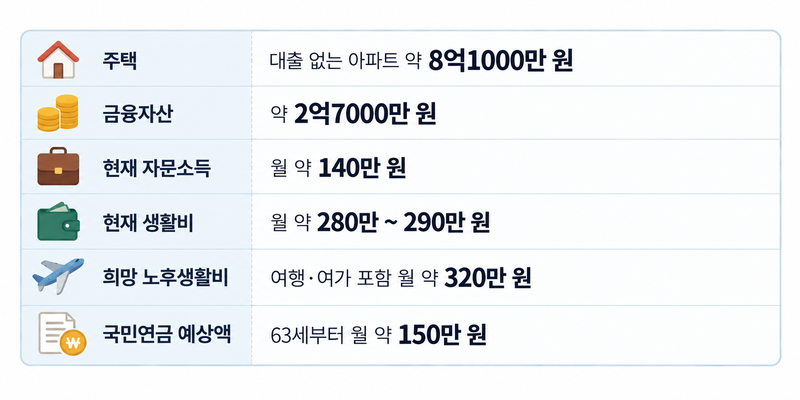
Kim is relatively financially secure. Net assets total 1.08 billion won, including an apartment with no mortgage, worth 810 million won, and 270 million won in financial assets. But monthly living expenses are currently 2.8 million to 2.9 million won, while Kim hopes to spend around 3.2 million won a month in retirement, including additional expenses such as travel. The National Pension will provide about 1.5 million won a month starting next year.
“At this rate, there’ll be little financial leeway in retirement”
A close friend’s surgery left Kim on edge. The friend’s family handled the hospital admission and bills, filed an insurance claim, and arranged care after discharge. It was not something money alone could take care of. Kim got along well with the younger sister but did not want to leave the business of managing later life to her. Kim had some assets, but had no arrangements for getting help when ill or handling the practical procedures involved.Financial planner Jo Hyeong-geun (AFPK), who advised Kim, examined the structural problems one by one. First, total assets are not the same as money available to spend each month. A substantial share of Kim’s assets is tied up in the home. If Kim stops consulting and relies only on the National Pension—1.5 million won a month—the income would be less than half the desired retirement budget of 3.2 million won. That means drawing 1.7 million won a month from financial assets to cover the shortfall. Even over just seven years, from age 63 through 69, that would require 142.8 million won.
One option is to set aside 110 million won of the 270 million won in financial assets in a trust for later-life expenses and care after age 70. But that would leave 160 million won, and after deducting the shortfall over seven years, only 17.2 million won would remain. There would not be much of a cushion.
Planner Jo advised, “This is a simple calculation that does not account for investment returns, inflation, taxes or fees,” adding, “We need to look at how long the consulting income may continue and how much the living expenses can be adjusted.”
Next, the amount needed for care and how long it will be needed are unclear. Whether there will be enough to cover medical care, caregiving and long-term care can only be determined by calculating the expenses the National Pension cannot cover. Even with long-term care insurance, out-of-pocket payments and non-covered services may leave additional expenses. Planner Jo noted, “If you decide on a lump sum without first checking the type of care you want and its cost, it may not match what you actually need.”
The final problem is that no procedures or person have been designated to manage the assets. Even with a trust, Kim would still need to confirm a hospital admission, prepare documents and request payments, and arrange care services. It is also necessary to plan for situations in which hospitalization makes it difficult to move, or declining decision-making capacity makes it impossible to handle administrative matters. Delegation or representation should be considered for the former, and legal support such as guardianship for the latter.
Start with accurate calculations

The timing for making use of the home should also be compared. The Korean Home Pension could be reconsidered around age 70, but there is no need to wait until then. If consulting income ends earlier than expected or falls rapidly, the enrollment date could be moved forward. According to the Korea Housing Finance Corporation, as of March 1, a 70-year-old who enrolls in the fixed-amount lifetime-payment plan using an ordinary home worth 800 million won would receive about 2.462 million won a month. Added to the National Pension, that would amount to 3.96 million won in total.
Finally, Kim needs to decide who can provide help and divide up the roles. Kim could ask the younger sister to be an emergency contact, and look into available services for hospital visits or caregiving. Someone will also be needed to handle financial matters. Kim should also make backup plans for situations in which any of these people become ill or cannot be reached.
For the trust that will provide this financial foundation, Kim should ask financial institutions not only about minimum contribution amounts and fees, but also who can request payments and what documentation they need; whether payments can be made directly to a hospital or care facility; and how long emergency payments take. Kim should also compare contract-amendment and early-termination terms, as well as the risk of losses under different management approaches.
Voluntary guardianship is one way to prepare for a decline in decision-making capacity. The guardianship agreement is drawn up as a notarized deed and takes effect when the Family Court appoints a supervisor. A will-substitute trust is one option for handling assets after death.
Planner Jo said, “Living alone doesn’t mean you have to handle everything by yourself,” adding, “Retirement planning means preparing so that my money will be used for me when I need it.”
We earn, spend and save money throughout our lives, but financial planning always takes a back seat. Money, however, has an age of its own and won’t wait. If we don’t make choices along the way, it gets neglected; if we don’t set a course, it slips away. That is why we need to plan the flow of money across our entire lives.[Money Planning Office]works with the Korea Financial Planner Association (IFPK), an AFPK certification body, to support people in planning their lives.
[email protected] Kim Tae-il, Lee Hyeon-jeong Reporter