A turning point for commercializing an Alzheimer’s treatment: Aribio’s global Phase 3 results are imminent
- Input
- 2026-10-16 08:58:44
- Updated
- 2026-10-16 08:58:44
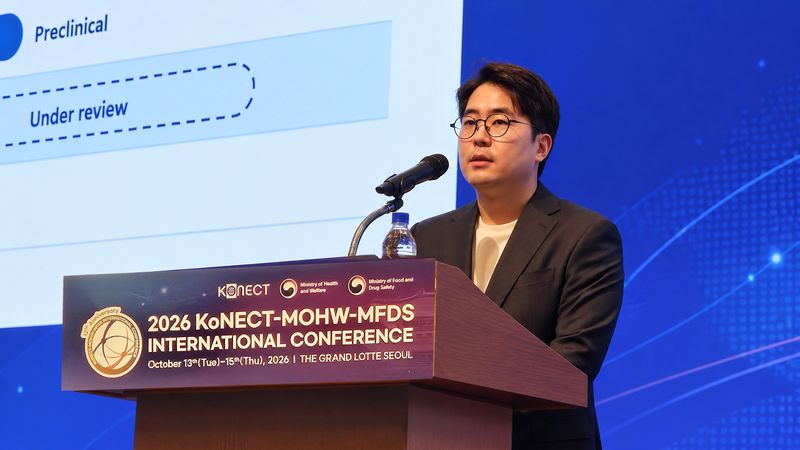
Aribio Co., Ltd. said on the 16th that it had presented its experience operating the global Phase 3 trial of AR1001, “POLARIS-AD,” at the “KIC 2026 International Conference,” held at the Lotte Hotel Seoul on the 15th. The presentation was delivered by Fred Kim, head of Aribio’s U.S. branch. KIC is an international academic event organized by the Korea National Enterprise for Clinical Trials (KoNECT) together with the Ministry of Health and Welfare and the Ministry of Food and Drug Safety.
POLARIS-AD is a trial evaluating the efficacy and safety of AR1001 in patients with early Alzheimer’s disease. A total of 1,535 people took part at 240 medical institutions in 13 countries, receiving either 30 mg of AR1001 or a placebo for 52 weeks. The primary endpoint is the Clinical Dementia Rating–Sum of Boxes (CDR-SB), which assesses the severity of dementia symptoms and everyday functioning. A total of 1,348 participants, or 87.8% of all participants, completed the treatment period.
Aribio directly handled the trial design, regulatory strategy and key decisions, with its clinical operations team in San Diego, U.S., at the center. It used multiple contract research organizations (CROs) by region and function, while deploying its own monitoring staff to manage medical institutions and external partners in each country. The company also cited standardized rater training and a system for responding quickly to issues at trial sites as part of its operational experience.
The trial was funded through support from affiliates and overseas licensing deals. Aribio said it secured more than 150 billion won in upfront payments through exclusive licensing agreements by region and used the funds for trial costs. In exchange for transferring some overseas business rights to its contractual partners, the company retained control of clinical development.
The company also received support from the Korea National Enterprise for Clinical Trials. In January 2023, AR1001 was selected for the foundation’s first public-interest clinical trial support program, which provided assistance with assessing the feasibility of conducting the trial in Korea, facilitating links with research institutions, and counseling and recruiting people interested in participating. The 200 participants from Korea accounted for about 13% of all trial participants.
Fred Kim, head of the U.S. branch, said, “By completing this Phase 3 trial, we have built capabilities across every stage of a multinational clinical trial, from design to execution,” adding, “We have secured a foundation for developing our follow-on pipeline.”
The key results of POLARIS-AD are expected to be unveiled for the first time on the 16th of next month at the Clinical Trials on Alzheimer’s Disease conference (CTAD 2026) in Boston, U.S. Professor Sharon Sha of Stanford University will give an oral presentation during the opening session. Attention will focus on whether the presentation will disclose specific results on AR1001’s efficacy and safety.
[email protected] Jung Sang-hee Reporter