Daegu Metropolitan Council Chair Im In-hwan: “I’ll do everything I can to make the council soft on the outside, strong on the inside”
- Input
- 2026-10-18 14:00:00
- Updated
- 2026-10-18 14:00:00
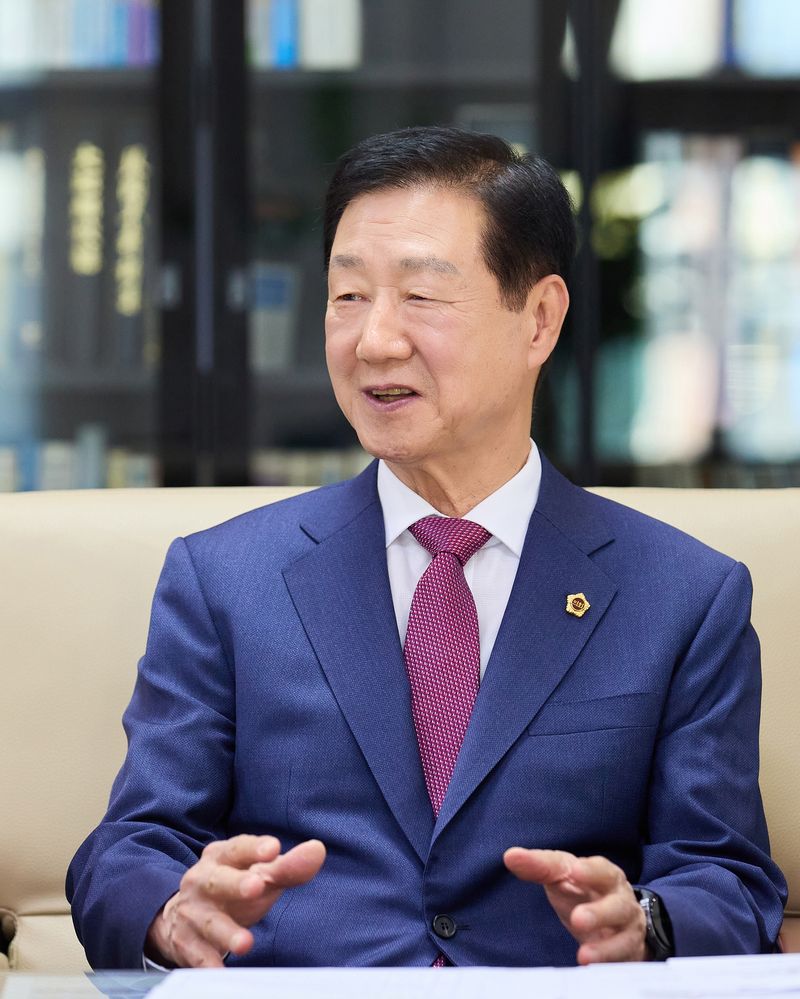
【Financial News, Daegu = Kim Jang-wook, staff writer】“I’ll do everything I can to make the council soft on the outside and strong on the inside. Ultimately, the change I envision for the Daegu Metropolitan Council is a council that is closer to citizens and a better place for council members to work.”
Having passed the 100-day mark since the launch of the 10th Council, Daegu Metropolitan Council Chair Im In-hwan said this in an interview with Financial News on the 16th. He stressed, “I’ll offer solutions rather than conflict, based on communication and cooperation, and do my utmost to make the council one that citizens can trust.”
Asked what change he considered most important, Chair Im said, “It is about enabling citizens to experience the council’s presence and role in their daily lives.” He added, “I don’t think the council can earn citizens’ trust if it remains merely an institution that reviews and votes on agenda items.”
He also said, “Within the council, each member’s expertise and role must be able to shine.” He added, “I want to create a council where members—not just the chair—can fully exercise their abilities in their respective fields and turn differing opinions into policy through discussion.”
—There are growing concerns that the central government’s fiscal policies will constrain local autonomy. How do you view the state of local finances?
▲The difficulties facing local finances are not unique to Daegu. Local governments across the country are struggling with accumulated welfare costs and the burden of matching national government funds.
Unfortunately, I don’t think the central government is giving sufficient consideration to this fiscal crisis facing local governments. Corporate tax revenue is expected to rise substantially, driven in part by the recent boom in the semiconductor industry, generating considerable additional tax revenue. Under the usual system, this increased revenue should flow to local governments in the form of Local Grant Tax or Local Education Subsidy Grants.
Chair Im explained, “There are concerns that the share flowing to local governments could shrink as the government establishes what it calls the ‘Future Response Fund.’ Given how difficult local finances already are, we need to carefully examine any measures that could further restrict local governments’ fiscal autonomy.”
He said in particular, “For Korea to thrive, its local communities must thrive.” He went on to stress, “We need to build a stable and predictable system of fiscal decentralization for which the central and local governments share responsibility. The Daegu Metropolitan Council, too, will speak up actively to ensure that local fiscal realities and voices from the ground are properly reflected in central government policies.”
—What internal changes are needed for the council to earn greater trust from citizens?
▲I believe citizens’ trust can grow alongside the council’s expertise. Members need strong expertise and policy skills to properly review complex policies that directly affect people’s lives and offer alternatives.
In particular, I don’t think training and education should amount to merely formal programs that members attend according to a set schedule. I’ll take a close look at what members actually need in their legislative work and improve the substance of training so it is practical and can be put to use immediately in the field.
I’ll make training more effective by focusing on what members actually need, including budget and ordinance reviews, administrative audits, and questions on city affairs. I’ll also expand training tailored to members’ areas of expertise and interest.
Chair Im said, “I believe a council trusted by citizens is built not through words, but through how much its members study, understand conditions on the ground, and offer sound policy alternatives.” He added, “We’ll continue to improve the council’s systems and working environment so members can develop those capabilities.”
—As administrative integration between Daegu and Gyeongbuk is being pursued again and discussions gather pace, what should be considered first?
▲I don’t think administrative integration should become an end in itself. The first thing we need to examine is how citizens’ lives will actually change after integration.
Rather than making administrative integration itself the goal, we need to carefully consider what will change after integration. It is also important to communicate so citizens can fully understand and appreciate the need for integration and its effects.
To that end, I plan to visit the Jeonnam-Gwangju Integrated Special City in person, hear from people on the ground, and closely examine the benefits and limitations that have emerged during the integration process, along with the institutional challenges and possible solutions. I’ll actively learn from approaches proven effective and address any setbacks thoroughly, incorporating the lessons into discussions on Daegu-Gyeongbuk integration.
Chair Im said, “Daegu and Gyeongbuk are already closely connected in many areas, including daily life, the economy, and transportation.” He added, “Regardless of whether integration happens, we should expand cooperation, starting with issues we can tackle jointly, and shape an approach to integration that delivers tangible benefits to citizens’ lives.”
—To boost Daegu’s future competitiveness, the construction of a new airport must be considered alongside industry, transportation, talent, and living conditions. What is Daegu’s strategy for future growth?
▲I don’t think Daegu’s future can be secured through a single project. Industry, transportation, talent, and living conditions all need to be connected, with the new airport at the center.
In particular, for the new airport to succeed, the effort cannot stop at building the airport. We need to develop logistics and industrial infrastructure linked to the airport and create an environment where companies can invest. We must also build well-connected transportation networks, including regional railways and roads, and establish the foundations for local talent to work and settle in Daegu.
It is important to establish a clear competitive edge for Daegu in future industries. The city can become a place where young people stay rather than leave, and where people come from elsewhere, only if companies and talent gather and new jobs are created.
I believe Daegu’s future strategy is to create a city where people and companies gather and put down roots, rather than viewing industry, transportation, and talent separately. Another important task is to build the foundations for Daegu and Gyeongbuk to function as a single economic and living area.
—With worsening fiscal conditions making it difficult to pursue all projects at once, what is the most important criterion the Daegu Metropolitan Council uses when considering the budget?
▲The more difficult fiscal conditions become, the more important it is to make choices and set priorities. We need to move beyond the assumption that every project can be carried out and clearly prioritize those that citizens truly need.
When reviewing the budget, we need to consider the whole picture—not just the size of a project or whether it is new, but also what benefits it will bring to citizens, how urgent it is, and whether the resulting fiscal burden can be sustained over time.
We need to scrutinize projects that will improve citizens’ lives over the long term and strengthen the region’s competitiveness more closely than one-off projects. Conversely, projects pursued without sufficient review or with little effectiveness should be reconsidered decisively.
Chair Im said, “Citizens’ tax money is limited, so every budget item must be treated responsibly.” He added, “The council’s careful budget reviews are not intended to obstruct the executive branch, but to ensure limited resources are properly spent where they are needed most.”
Asked about his resolve in carrying out the council’s work, Chair Im said, “The council must not stop at making ordinances and deliberating on the budget.” He added, “It must become a council that creates policies that make a tangible difference in citizens’ lives.”
He will also help revitalize the local economy and foster future industries, and the Daegu Metropolitan Council will be a strong pillar of support in making Daegu a place where young people stay and companies come.
Finally, Chair Im reiterated, “We will carry out the council’s fundamental role of checks and oversight in accordance with principle. We’ll work actively with the executive branch on policies that benefit citizens, offer solutions rather than conflict, and create a council that listens to citizens first.”
[email protected] Kim Jang-wook Reporter