A clipped newspaper, a mother painted on wood... An era preserved in ARKO’s collection [fn Art Snap]
- Input
- 2026-10-16 07:30:00
- Updated
- 2026-10-16 07:30:00
At the ‘3rd ST Exhibition’ in 1974, Sung Neung-kyung attached a newspaper to a wall and cut out articles with a razor blade. The newspaper on display is what remained from this act. It bears witness to everyday objects and actions becoming materials for art.
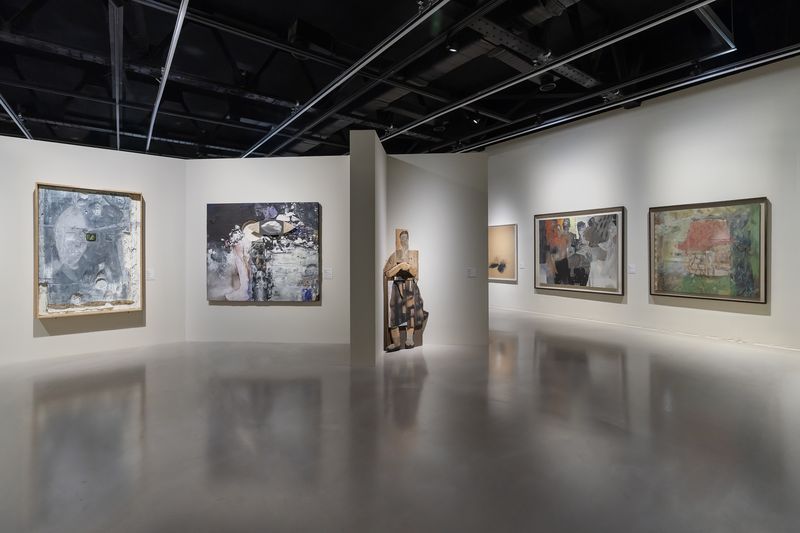
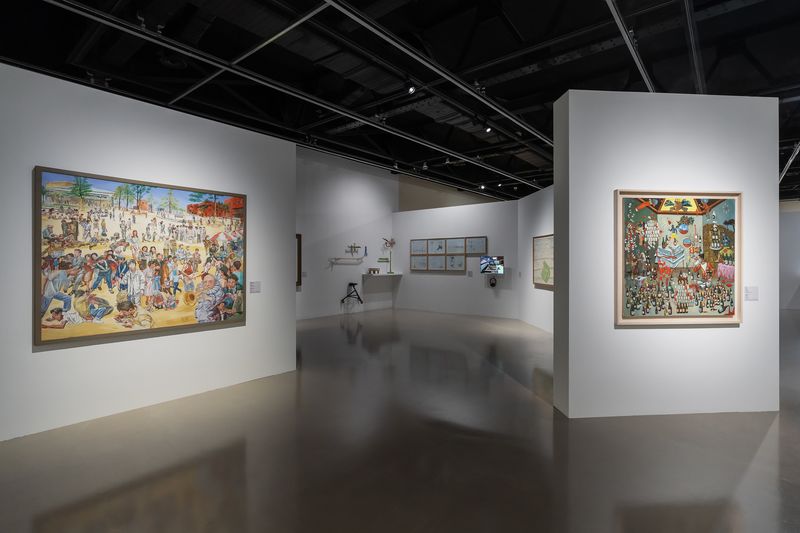
The exhibition explores changes in Minjung art and Korean painting through works from the 1980s, including Min Jeong-ki’s ‘Street of Abundance’ (1981) and Park Saeng-kwang’s ‘Yi Dynasty’ (1980).
In the 1990s, Yoon Suk-nam crossed the boundary between two-dimensional and three-dimensional art by painting a figure in acrylic on wood in ‘Mother 1: Nineteen Years Old’ (1993). Shin Hak-cheol’s ‘Korean Contemporary History 802’ (1994) is also on view as a work from this period.
By the 2000s, modes of expression had broadened, with works such as Kim Eul’s ‘Drawing Machine’ (2006) and Ham Yang-ah’s video ‘Venus of Jeju Island’ (2004). Rather than grouping an era under a single style, the exhibition shows different practices unfolding side by side.
About 25% of the collection consists of award-winning works donated between 1982 and 2006, when ARKO and its predecessor, the Korea Culture and Arts Foundation, organized and sponsored the Korea Grand Art Exhibition. In the 2000s, as the museum held more of its own exhibitions, it became more active in acquiring works in conjunction with them.
The exhibition includes around 20 award-winning works from the Korea Grand Art Exhibition, including Lee Ki-bong’s ‘Raw—Where a White Towel Lies’ and Kang Ae-ran’s ‘Life-II.’ Around 10 previously unpublished works will also be shown, including Park Saeng-kwang’s ‘Yi Dynasty’ and Kim Gu-rim’s ‘Yin-Yang 99-S, 207.’
At a briefing on the 15th, curator Cha Seung-joo noted that the collection also includes works different from the artists’ familiar signature pieces, describing the exhibition as ‘a chance to take a somewhat more multidimensional look at the artists’ diverse tendencies.’
Alongside the works, the exhibition presents records of the artists’ exhibition participation and artist collective activities, as well as records of the museum’s major exhibitions. A separate archive space shares the findings of six outside researchers who have studied Korean painting, printmaking, sculpture, crafts, and other fields. The research findings will also be made available as digital materials on the museum’s website.
Through December 6. Admission is free Tuesday through Sunday, from 11 a.m. to 7 p.m. A research-sharing session and workshops for children and seniors will also be held.
[email protected] Jang In-seo Reporter