“It wasn’t Samsung that was going under—it was me”... Retail investors run out of “buying ammunition” as their line of defense collapses
- Input
- 2026-10-16 05:20:00
- Updated
- 2026-10-16 05:20:00
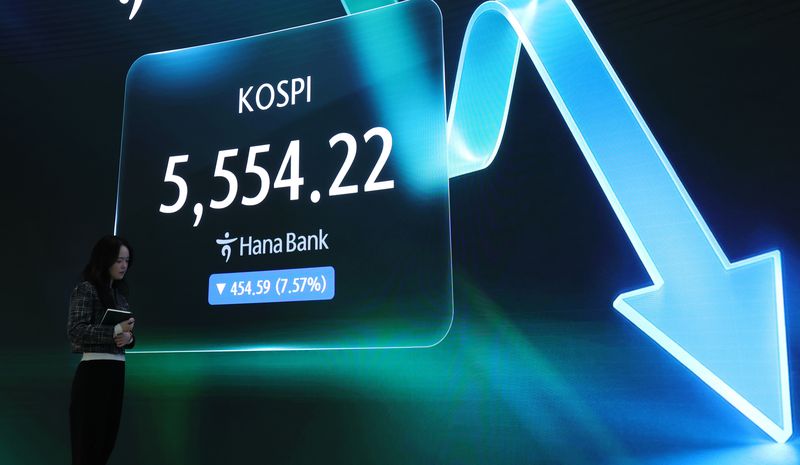
[Financial News] The domestic stock market was thrown into a panic as retail investors’ “buying ammunition”—which had served as the last line of defense against a fierce foreign sell-off—ran out. On the 15th, the KOSPI plunged more than 8% intraday, putting even the 5,500 level under threat, and circuit breakers were triggered in both markets, forcibly halting trading.
KOSPI closes down 7.57%... Samsung Electronics and SK hynix plunge in unison
According to the Korea Exchange, the KOSPI closed at 5,554.22 on the 15th, down 7.57% from the previous trading day. Another record-setting plunge came just two days after the index dropped by more than 5% on the 13th. At one point during the session, it slid as much as 8.06% to 5,452.51. Fear gripped the markets as circuit breakers halted trading for 20 minutes in both the KOSPI and KOSDAQ markets amid the sharp declines.
The index’s plunge was led by the two largest semiconductor stocks by market capitalization. Market leader Samsung Electronics closed at 210,000 won, down 9.48% from the previous day, while SK hynix plunged 11.06% to 1,262,000 won. Compared with their closing prices at the end of September, Samsung Electronics had plunged 21.79% and SK hynix 28.94% in just two weeks.
The KOSPI extended its losing streak to seven consecutive trading days through the 15th, with an estimated 1,170 trillion won in market capitalization wiped from the stock market over that period.
U.S. CPI shock and Big Tech chill... fears of Fed tightening act as a “trigger”
The immediate triggers weighing on global markets that day were inflation concerns stemming from the United States and debate over excessive valuations in artificial intelligence (AI).
The U.S. Consumer Price Index (CPI) for September, released overnight, came in above market expectations, reigniting concerns that the Federal Reserve System (Fed) would keep interest rates high for longer. Higher financing costs stemming from the burden of high interest rates fueled doubts about the earnings of AI infrastructure companies. The tech-heavy Nasdaq fell 1.88% in New York, while major AI infrastructure stocks, including Oracle and CoreWeave, plunged across the board.
A chill spread across the semiconductor sector as well: SOXL, the Direxion Daily Semiconductor Bull 3X Shares, a 3x leveraged ETF on the U.S. Philadelphia Semiconductor Index that Korean retail investors trading overseas had bought in large numbers, plunged 13.35% in a single day, closing at $110.54.
Retail investors who had absorbed foreign selling run out of ammunition... the market’s supply-demand defense line collapses
Market experts cite the “collapse of the domestic supply-demand defense line” as the fundamental backdrop to the plunge. Until the first half of the year, individual investors had absorbed the brunt of heavy foreign selling and defended the index, but analysts say their financial capacity has recently reached its limits.
According to EpicAI, an AI-powered investment information platform, the KOSPI fell on just 11 of the 26 trading days in May and June when foreign investors were net sellers of at least 1 trillion won a day, and closed higher on 15 days. The index also rose solidly on a day when foreign investors dumped shares worth around 3.7 trillion won. Individual investors provided a strong backstop, with average daily net purchases of 3.562 trillion won.
But the situation completely reversed in September and October. The index fell on 14 of the 15 trading days when foreign investors were net sellers of at least 1 trillion won. During that period, individual investors’ average daily net purchases shrank to 1.545 trillion won, less than half the level in the first half of the year.
Even institutional investors turned away. Institutions, which bought an average of 280 billion won a day in May and June when foreign investors were net sellers of 1 trillion won, became net sellers in September and October, selling an average of 390 billion won. Pension funds also net sold 433.1 billion won in September and have remained net sellers this month, leaving the index to fall unchecked.
The decline in trading value is also pronounced. The KOSPI’s average daily trading value, which reached 50.3 trillion won in May and June, plunged 57% to 21.4 trillion won in September and October. Compared with the peak of 80.3 trillion won recorded on May 29, it has contracted by at least 70%, reflecting an extreme slump in trading.
Retail investors caught in the 7,000–8,500 range are devastated... “A further rebound will be hard to come by”
With many individual investors having made substantial purchases when the index was in the 7,000–8,500 range, they have now completely run out of funds even to buy more and average down.
According to LS Securities, individual investors have put about 195 trillion won into the stock market since July 2024. As a result, liquid assets held by households and nonprofit institutions have declined year over year for the first time since the Global Financial Crisis (GFC).
Posts lamenting losses of principal are flooding major securities communities and online stock forums every day. “I’ve given back all my gains and am now more than 10 million won in the red”; “I can’t even cover my loan payments, and I don’t have money to buy more”; “I swallowed my tears and cut my losses, accepting a 30 million won loss”—self-deprecating comments like these continue to pour in.
Jeong Da-woon, a researcher at LS Securities, said, “Both individual investors and domestic institutions have extremely limited capacity to buy,” adding that “we are in a phase where net foreign selling is amplifying the scale of stock-price declines.”
A senior figure in Yeouido’s securities industry warned, “There is a supply-demand vacuum, with no buyers left to absorb foreign selling,” adding, “The sharp drop in trading value means even bargain hunters are reluctant to enter the market. Unless global technology-stock jitters and foreign selling pressure ease, further downward pressure on the stock market will be inevitable.”
[email protected] Mun Yeong-jin Reporter