From complex crises to follow-up cooperation between Korea and Central Asia... Jeju Forum seeks solutions for pragmatic diplomacy
- Input
- 2026-10-15 17:15:28
- Updated
- 2026-10-15 17:15:28
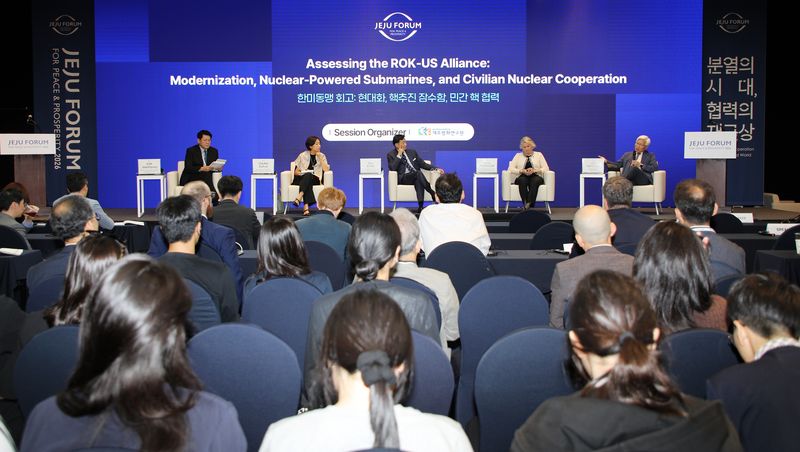
【Financial News, Jeju = Reporter Jeong Yong-bok】 The Jeju Forum will review how the Lee Jae-myung government can put its pragmatic diplomacy into practice, focusing on responses to complex crises, cooperation with the Global South, and follow-up tasks from the Korea-Central Asia summit.
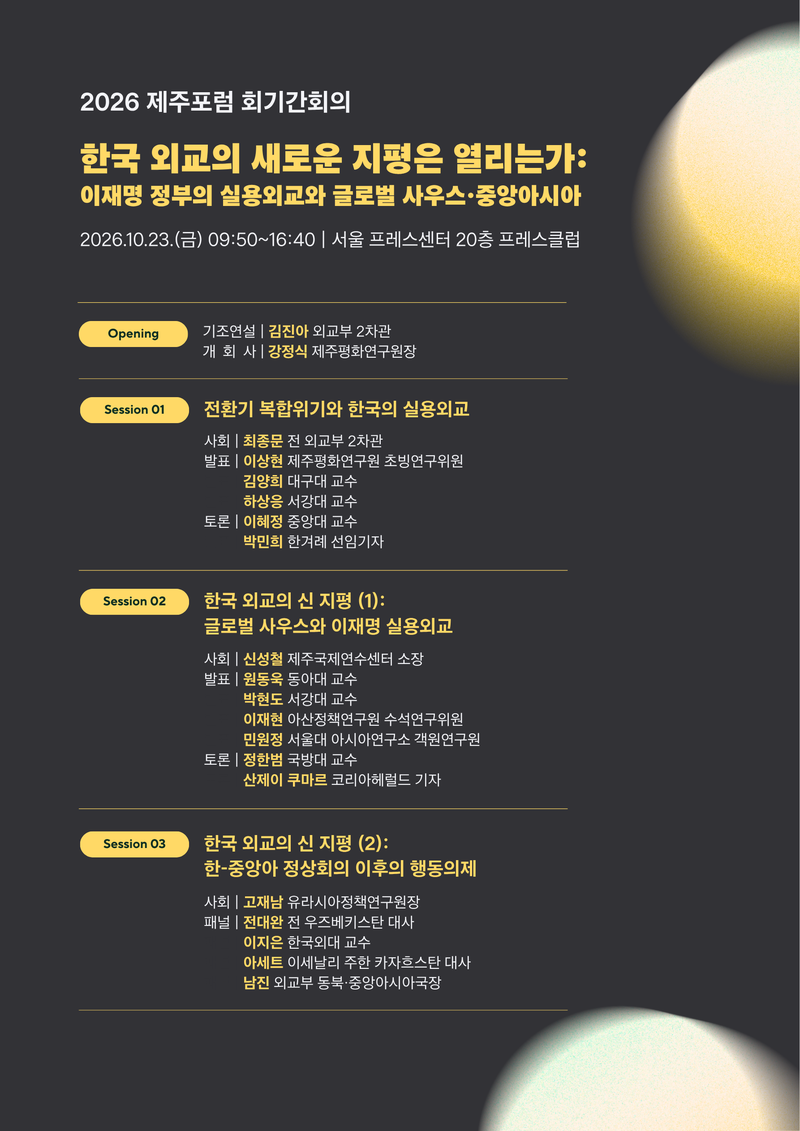
According to the Jeju Forum Secretariat on the 15th, the 2026 Jeju Forum inter-session meeting will be held at the Press Club on the 20th floor of the Seoul Press Center at 9:50 a.m. on the 23rd. Its overarching theme is “Will a New Horizon Open for Korean Diplomacy? The Lee Jae-myung Government’s Pragmatic Diplomacy and the Global South and Central Asia.”
The inter-session meeting of the Jeju Forum, co-hosted by the Ministry of Foreign Affairs and Jeju Province, will examine the Lee Jae-myung government’s pragmatic diplomacy in connection with changes in the international situation, emerging regions for cooperation, and follow-up tasks from summit diplomacy.
The meeting will open with a keynote address by Second Vice Minister of Foreign Affairs Kim Jin-a and opening remarks by Kang Jeong-sik, president of the Jeju Peace Institute. This will be followed by three sessions, held in sequence, on the complex crises facing Korean diplomacy, cooperation with the Global South, and follow-up tasks for summit diplomacy with Central Asia.
The first session will be held under the theme “Complex Crises in a Time of Transition and Korea’s Pragmatic Diplomacy.”
Choi Jong-moon, a former second vice minister of foreign affairs, will moderate. Presentations will be given by Lee Sang-hyun, an invited research fellow at the Jeju Peace Institute; Kim Yang-hee, a professor at Daegu University; and Ha Sang-eung, a professor at Sogang University. Lee Hye-jung, a professor at Chung-Ang University, and Park Min-hee, a senior reporter at the Hankyoreh, will join the discussion.
The session will examine how Korean diplomacy should respond amid complex crises, in which risks in multiple fields, including security, the economy, and trade, are intertwined. A complex crisis is a situation that arises when risk factors in international politics, the economy, and security affect one another.
The second session will look at expanding the range of Korean diplomacy’s partners for cooperation to include the Global South. Its theme is “A New Horizon for Korean Diplomacy (1): The Global South and Lee Jae-myung’s Pragmatic Diplomacy.”
Shin Seong-cheol, director of the Jeju International Training Center, will moderate. Presenters will include Won Dong-wook, a professor at Dong-A University; Park Hyeon-do, a professor at Sogang University; Lee Jae-hyun, a senior research fellow at the Asan Institute for Policy Studies; and Min Won-jeong, a visiting research fellow at the Asia Center, Seoul National University. Jeong Han-beom, a professor at Korea National Defense University, and Sanjay Kumar, a reporter for The Korea Herald, will serve as discussants.
The Global South generally refers to developing and emerging countries, mainly in Asia, Africa, and Latin America. It encompasses countries with diverse levels of economic development and diplomatic interests, and its importance as a partner for cooperation is growing amid changes in the international order.
The session will discuss the strategic significance of the Global South and the direction of cooperation for South Korea in relation to the Lee Jae-myung government’s pragmatic diplomacy.
The final session will be held under the theme “A New Horizon for Korean Diplomacy (2): An Action Agenda Following the Korea-Central Asia Summit.”
Ko Jae-nam, president of the Eurasia Policy Institute, will moderate. The panel will include Jeon Dae-wan, a former ambassador to Uzbekistan; Lee Ji-eun, a professor at Hankuk University of Foreign Studies; Aset Isenali, Kazakhstan’s ambassador to South Korea; and Nam Jin, director-general for Northeast and Central Asian Affairs at the Ministry of Foreign Affairs.
The discussion is linked to follow-up cooperation from the first Korea-Central Asia Summit, held in Seoul on September 16. South Korea and the five Central Asian countries discussed ways to expand cooperation in various fields, including economic and security cooperation, trade and investment, and industry and infrastructure.
According to the Ministry of Trade, Industry and Energy, on the occasion of the summit South Korea signed nine bilateral and multilateral cooperation documents with the governments of the five Central Asian countries in industry and supply chains, including critical minerals and crude oil. In the private sector, 116 memorandums of understanding were also signed in areas such as plants and infrastructure.
The final session will address the tasks involved in translating the achievements of this summit diplomacy into concrete cooperation projects and policies. With Korean foreign policy officials, Central Asian diplomats, and regional experts participating together, it will be an opportunity to consider the direction of follow-up cooperation.
The Jeju Peace Institute researches peace and cooperation on the Korean Peninsula and in Northeast Asia, and organizes the annual Jeju Forum for Peace and Prosperity. The inter-session meeting will continue the Jeju Forum’s discussions in Seoul and take a comprehensive look at the direction of Korean pragmatic diplomacy, from responding to complex crises and cooperating with the Global South to follow-up implementation tasks for summit diplomacy between Korea and Central Asia.
[email protected] Jeong Yong-bok Reporter