AI services “faster and more cost-efficient” ... Hanyang University tops the world in AI semiconductor optimization
- Input
- 2026-10-15 16:58:29
- Updated
- 2026-10-15 16:58:29
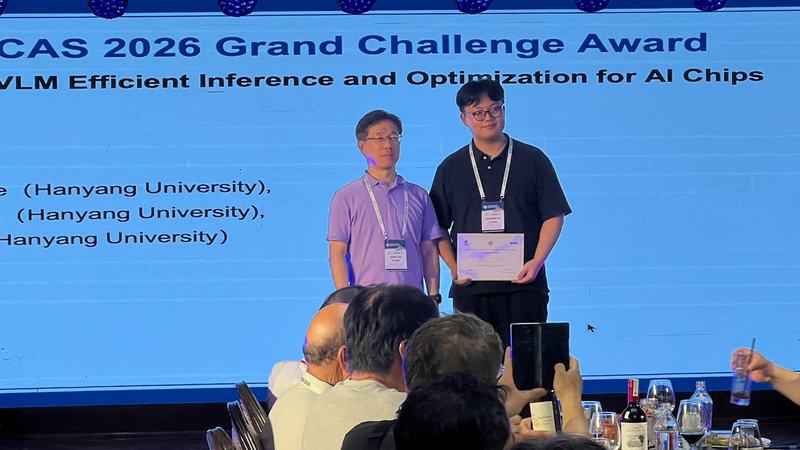
[Financial News] Technical prowess developed by Korean researchers to dramatically reduce the “enormous computing costs and slow response times” considered a major challenge for artificial intelligence (AI) services has gained recognition on the world stage.
Hanyang University announced on the 15th that the team led by Professor Choi Jeong-wook of the Department of Convergence Electronics Engineering in its College of Engineering (AIHA Lab) took first place and the top prize in the Grand Challenge at IEEE AICAS 2026, one of the world’s largest AI academic conferences.
The competition tested how efficiently AI software could be integrated with the semiconductor chips that run it to maximize service performance. A total of 71 teams from around the world took part, and Hanyang University’s research team claimed the overall victory after fierce competition with the 16 teams that advanced to the finals.
The team competed to improve the operating efficiency of vision-language AI models (VLMs), which can read and understand not only text but also images and documents all at once. Vision-language AI has been limited by its complex processing, which consumes large amounts of power and memory and slows response times.
To address this, the team applied a software technique that efficiently reduces the amount of data an AI model must process while maintaining the same level of accuracy. In particular, it precisely analyzed unnecessary delays that occur as semiconductor chips exchange data, significantly increasing overall operating speed.
The composition of the research team also stood out. Unlike the conventional approach in which students follow a professor’s lead, Lee Si-hwa, a student at the Graduate School of Artificial Intelligence, served as technical advisor and oversaw the overall research direction and strategy. Students from different fields, including the Department of Convergence Electronics Engineering and the Department of AI Semiconductor Engineering (Lee Jong-won, Lee Dam-hyeon and Heo Yu-jun), also worked together like interlocking gears to achieve the result.
The AI technology optimization expertise gained by the research team is expected to play a key role in building AI data centers in South Korea and upgrading related services. The team plans to share its achievement with South Korea’s semiconductor industry, contributing to the advancement of the country’s AI inference software technology and the training of specialized personnel.
[email protected] Kim Man-gi Reporter