No Japanese Residents, Yet Japan Claims the ‘Northern Territories’ as Its Own [Park Jong-won’s Then and There]
- Input
- 2026-10-17 06:00:00
- Updated
- 2026-10-17 06:00:00

[Financial News] Russia’s domestic intelligence agency, the Federal Security Service of the Russian Federation (FSB), raided a hotel on the 13th in Yuzhno-Sakhalinsk, on Sakhalin Island in Russia’s Sakhalin Region. They soon arrested 34-year-old reporter Yuki Imai of Hokkaido Shimbun in a hotel room. Imai was the only correspondent officially sent to Russia by Japanese media who was working in Sakhalin. The FSB claimed that Imai had been investigating how many residents of the Kuril Islands near Sakhalin Island had been mobilized for or supported the war in Ukraine, with the intention of passing the figures on to Japanese authorities.
If Imai really was a spy, his mission would not have been easy. That is because ethnic Japanese residents, from whom information might be relatively easy to obtain, make up just 0.05% of Sakhalin Region’s population. Why are there so few ethnic Japanese residents in this area, which lies about 3.7 km from Japan’s Hokkaido at its closest point and no more than 43 km away at its farthest?
Sakhalin Region, east of Russia’s Primorsky Krai and north of Japan’s Hokkaido, includes Sakhalin Island and the Kuril Islands and covers 87,100 km2 in total. Sakhalin Island alone covers 72,492 km2, about 70% of South Korea’s area. According to the 2021 census, Sakhalin Region has a population of 466,609; 40% live in Yuzhno-Sakhalinsk, and more than 90% live on Sakhalin Island. Some 86.5% of the population is White and of East Slavic descent.
Sakhalin Island and the Kuril Islands were originally inhabited by local Indigenous peoples and the Ainu, who came from Hokkaido. The region entered recorded history in earnest during the Mongol expansion. After overthrowing the Jin dynasty, the Mongols continued eastward and attacked Sakhalin Island in 1264. In 1308, they withdrew their troops on the condition that Indigenous tribes pay tribute. The region later became part of Yuan territory, and then the territories of the Ming and Qing dynasties. Chinese dynasties tried to govern the area around Sakhalin Region, but their control was loose because it was so remote. Meanwhile, Japan’s Tokugawa shogunate steadily advanced north. In the early 1800s, Japanese settlers began arriving in southern Sakhalin Island. The Russian Empire also expanded its settlements, taking advantage of the Qing dynasty’s administrative vacuum.
The Tokugawa shogunate and the Russian Empire accordingly signed the 1855 Treaty of Shimoda and settled their border without the consent of the Qing dynasty, the nominal owner of the territory. They agreed to jointly administer Sakhalin Island, while the Tokugawa shogunate would take the four southern Kuril Islands.
After losing the Second Opium War in 1860, the Qing dynasty ceded Primorsky Krai and Sakhalin Island to the Russian Empire under the Treaty of Beijing that same year. But Indigenous people, Russians and Japanese were already living together on Sakhalin Island and the Kuril Islands.
Japan, which began the Meiji Restoration in 1868, redrew its border with the Russian Empire under the 1875 Treaty of St. Petersburg. Japan gave up its claims to Sakhalin Island in exchange for bringing all of the Kuril Islands under Japanese rule. The newly established Japanese government, following the end of shogunate rule, exchanged Sakhalin Island for the rest of the Kuril Islands, citing a desire to avoid military competition with the Russian Empire and to avoid wasting resources developing barren land.
The border changed again after Japan won the Russo-Japanese War. Under the 1905 Treaty of Portsmouth, Japan took the part of Sakhalin Island south of the 50th parallel north. It then named southern Sakhalin “Karafuto” and established the Karafuto Agency to administer it. About 390,000 Japanese lived in Karafuto in 1944, while an estimated 18,000 Japanese lived in the Kuril Islands at the end of the war in 1945. At the time, Japan also forcibly conscripted tens of thousands of Koreans under Japanese colonial rule from the Korean Peninsula and sent them to Sakhalin for forced labor. Even today, about 5.3% of Sakhalin Region’s residents are of Korean descent.
In August 1945, near the end of World War II, the former Soviet Union, successor to the Russian Empire, attacked Japan and took control of all of Sakhalin Island and the Kuril Islands. Beginning in 1946, the Soviet Union forcibly deported Japanese residents of the region to mainland Japan. As a result, the ethnic Japanese population living in Sakhalin Region has virtually disappeared.
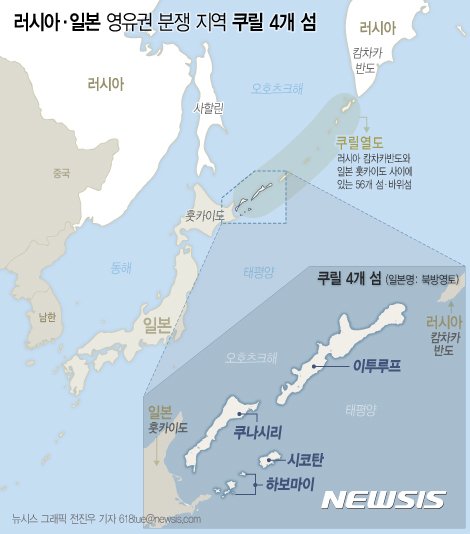
Even now, despite the disappearance of Japanese residents from Sakhalin Region, the Japanese government calls the four southern areas of the Kuril Islands—the islands of Iturup, Kunashir and Shikotan, and the Habomai Islands—the “Northern Territories” and claims they are Japanese land. Defeated in World War II, Japan agreed under the 1951 Treaty of San Francisco to renounce ownership of Karafuto and the Kuril Islands. However, Japan argues that the Tokugawa shogunate’s sovereignty over the Northern Territories was recognized under the 1855 Treaty of Shimoda, and maintains that they are Japan’s inherent territory, not overseas territory renounced in 1951.
[email protected] Park Jong-won Reporter