“The inevitable has happened” ... KOSPI Falls to 5,500 [fn Market Closing Report]
- Input
- 2026-10-15 17:08:07
- Updated
- 2026-10-15 17:08:07
[Financial News] “The inevitable has happened.”
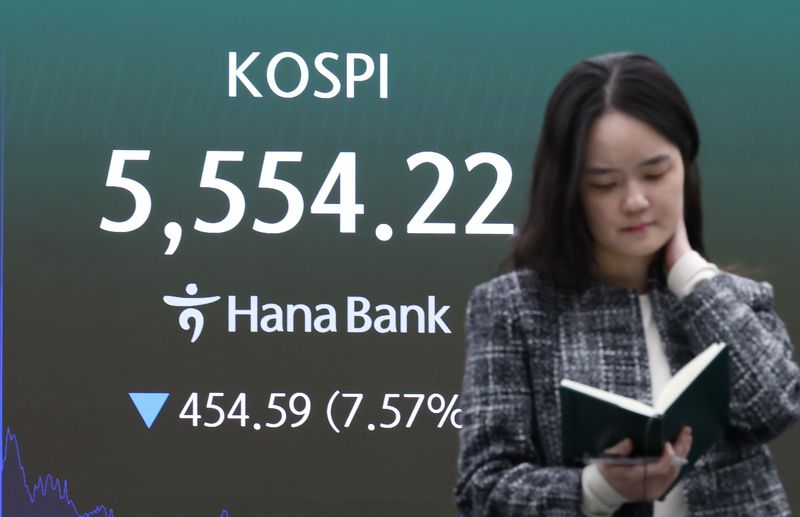
That was the terse assessment of the market, which had plunged to the 5,500 level, by a Yeouido expert who formerly headed a securities firm’s research center. With the index tumbling at least 7%, concerns have emerged that “the KOSPI has now entered a bear market.” Financial authorities convened an emergency review meeting and moved to calm investor jitters, saying they would “actively respond to ensure financial market stability and protect investors.”▶Related articles on pages 3 and 12According to the Korea Exchange, the KOSPI closed at 5,554.27 on the 15th, down 454.59 points (7.57%) from the previous trading day. It opened 335.8 points (5.59%) lower at 5,673.01 and continued to plunge, triggering a sidecar—which suspends the effectiveness of program-trading orders—and then a circuit breaker, which halted trading. The index slid as low as 5,450.81 in the afternoon, sending fear to a peak, but buying on dips came in and it closed above the 5,500 level.
Foreign investors unleashed another wave of selling that day, dumping 3.5281 trillion won worth of shares on the KOSPI. Individuals and institutions were net buyers of 2.3582 trillion won and 495.7 billion won, respectively. Foreign investors extended their net selling streak to eight consecutive trading days, selling a total of 17.931 trillion won.
Most of the stocks with the largest market capitalizations also fell. Samsung Electronics (-9.91%), SK hynix (-11.06%), SK Square (-10.45%) and Samsung Electro-Mechanics (-15.50%) plunged.
The sharp market decline that day is seen as the result of concerns over worsening profitability at artificial intelligence (AI) companies, compounded by pressure from rising interest rates. Anthropic’s third-quarter revenue, reported overnight, was $16.8 billion (about 2.25069 trillion won), with quarter-on-quarter growth limited to 45%. Revenue growth had plunged from 140% in the second quarter, slowing the company’s growth and fueling doubts about whether investment could be sustained.
Adding to the pressure, the U.S. Consumer Price Index (CPI) for September came in above market expectations, putting the credit risk of AI infrastructure companies in the spotlight as a new headwind. CoreWeave plunged 15.5% as a sharp rise in its corporate bond yields heightened concerns about financing. Shares across the AI value chain came under heavy selling, with Micron down 4.1% and Nvidia down 3.2%.
The KOSDAQ also closed at 760.82, down 7.65% from the previous trading day. On the KOSDAQ market, foreign investors were net buyers of 217.2 billion won, while individuals and institutions were net sellers of 67.4 billion won and 163.7 billion won, respectively. The largest-cap stocks all weakened. EcoPro (-8.98%), Alteogen (-5.79%), Jusung Engineering (-14.97%), Wonik IPS (-15.47%) and EO Technics (-10.03%) all fell.
Market analysts see the 5,000 level as a potential short-term support, but some are now warning that the market has entered a bear phase. Jo Ain, a researcher at Samsung Securities, said, “Volatility in the domestic stock market is rising, but if corporate earnings forecasts do not begin to deteriorate in earnest, the 5,000 level could provide downside support.”
However, Jung Yong-taek, a researcher at IBK Investment & Securities, said, “Given the unfavorable macroeconomic environment, including interest rates and inflation, this was something that was bound to happen at some point, in one form or another.” He warned, “If a slowdown in earnings growth starts to show up in the figures late this year and early next year, a bear market unlike the market’s previous trend will take hold in earnest.”
Meanwhile, an “Emergency Meeting to Review Stock Market Conditions” was held that day at Government Complex Seoul, chaired by Financial Services Commission Chairman Lee Eok-won and attended by relevant institutions, including the Financial Supervisory Service and the Korea Exchange, as well as market experts. The meeting reviewed domestic market trends and the buying and selling activity of foreign and institutional investors.
Chairman Lee Eok-won stressed, “We will remain vigilant even amid small fluctuations and actively respond to ensure financial market stability and protect investors. Investing with borrowed money is risky, and risk management is especially important at times like this. Financial companies should refrain from indiscriminate lending and do everything they can to protect customers and manage risk.”
[email protected] Han Young-jun Reporter