₩1.2 quadrillion wiped out in just seven days... “Who’s responsible?”
- Input
- 2026-10-15 16:16:40
- Updated
- 2026-10-15 16:16:40
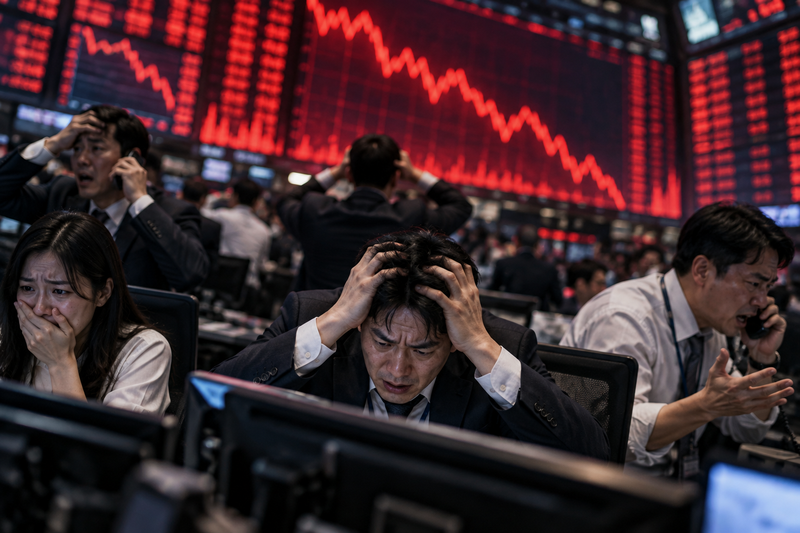
[Financial News] After the domestic stock market plunged for seven consecutive trading days, approximately ₩1.193 quadrillion in market capitalization evaporated from the KOSPI market. That is more than the total market capitalization of Mexico’s stock market.
As selling spread among large-cap semiconductor stocks, including Samsung Electronics and SK hynix, the KOSPI sank to the 5,500 mark. Mirae Asset Securities focused on the likelihood that high volatility would persist for the time being, as domestic and external uncertainties are unlikely to be resolved in the short term.
According to the Korea Exchange on the 15th, the market capitalization of KOSPI-listed stocks stood at ₩4.5815029 quadrillion that day. Compared with ₩5.7747114 quadrillion on October 2, just before the steep decline gathered pace, it had fallen by ₩1.1932085 quadrillion in seven trading days.
The KOSPI closed at 5,556.31 that day, down 452.50 points (7.53%) from the previous trading day. Compared with the closing level of 7,003.74 on the 2nd, the index had fallen about 20.7%. Market capitalization stood at ₩4.9571139 quadrillion at the close on the 14th, but dropped by a further approximately ₩375.6 trillion over the course of that day alone.■ Samsung Electronics and SK hynix plunge as shock spreads across semiconductor stocksIn this downturn, losses were particularly steep among semiconductor stocks with large market capitalizations. Samsung Electronics fell 9.48% from the previous trading day to ₩210,000, while SK hynix dropped 11.06% to ₩1,262,000. Selling was concentrated across large-cap semiconductor stocks, with Samsung Electronics’ preferred shares also falling 9.35%.
These stocks account for a large share of the KOSPI’s market capitalization, so their price declines have a significant effect on the broader index. When Samsung Electronics and SK hynix plunge at the same time, weakness in the semiconductor sector extends beyond individual stocks and amplifies downward pressure on the market as a whole.
Mirae Asset Securities researchers Kim Seong-geun and Kim Seok-hwan said, “With domestic supply-demand conditions deteriorating and the global environment unlikely to improve in the short term, high volatility may persist for the time being,” and forecast that “inflation and France’s fiscal problems, among other factors, could increase upward pressure on global government bond yields.”
Variables to monitor going forward include revenue at AI model companies, AI companies’ financing conditions, fund flows related to Bitcoin, changes in U.S. real interest rates, and France’s fiscal problems. The analysis says the key issue is not the expansion of AI investment itself, but whether large-scale capital investment translates into actual revenue and cash flow.■ If the KOSPI hits 5,000, market capitalization could fall by more than ₩1.6 quadrillionIn a scenario where the KOSPI falls to the 5,000 mark, the decline in market capitalization could be even greater. Assuming that the index and market capitalization move in proportion, and using the October 2 market capitalization of ₩5,775 trillion as the baseline, market capitalization at the 5,000 mark would be estimated at about ₩4,122 trillion. The decrease from the peak would amount to approximately ₩1,653 trillion.
However, this is a scenario based on the assumption that the index and market capitalization move in proportion; actual market capitalization varies according to individual share prices and the number of shares listed, among other factors. The market’s future course is expected to depend not only on changes in foreign investor flows and whether large-cap semiconductor stocks stabilize, but also on how AI investment performs and how global interest rates and fiscal risks develop.
[email protected] Kang Jung-mo Reporter